

Imperial Eagle vs Verreaux's Eagle
Aquila heliaca versus Aquila verreauxii
Play a quiz with Imperial Eagle and Verreaux's Eagle
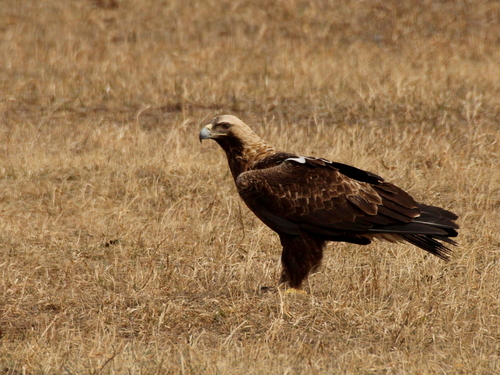 Imperial Eagle
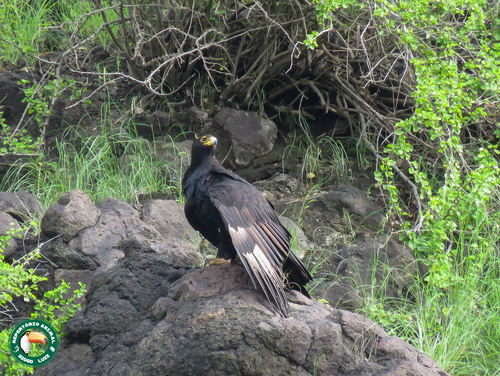 Verreaux's Eagle
In short
The most reliable field mark between Imperial Eagle and Verreaux's Eagle is overall coloration: adult Verreaux's is strikingly black with bold white patches, while Imperial Eagle is dark brown with distinctive white shoulder spots and a paler greyish undertail. Juvenile and immature birds are also separable by wing and body pattern: young Imperial Eagles are pale tawny-buff with brown streaking, never blackish, while juvenile Verreaux's Eagles are dark brown with a golden crown and extensive white mottling on the wings. In flight, Verreaux's Eagle has a unique, deep dihedral wing posture and paddle-shaped wings, while Imperial Eagle soars with flatter wings and a more slender, less bulky silhouette. Size is not a reliable field mark in the field, but Verreaux's is heavier and bulkier. Habitat can help: Verreaux's is almost exclusively African and tied to rocky, mountainous terrain, while Imperial Eagle is Eurasian, favoring open plains and steppe.
Identification tips
- Adult coloration: Verreaux's Eagle is jet black with bold white patches on the back and wings; Imperial Eagle is dark brown with white shoulder spots and a greyish undertail. This is diagnostic in good light.
- Juvenile/immature plumage: Juvenile Imperial Eagle is pale tawny-buff with brown streaking and contrasting dark and pale areas; juvenile Verreaux's is dark brown with a golden crown, rufous nape, and extensive white mottling on the wings. No age of Imperial Eagle is ever blackish overall.
- Underwing pattern (immatures): Verreaux's juvenile and immature show large white patches and mottling on the underwing, especially at the base of primaries and secondaries; Imperial Eagle juveniles have pale primary wedges but not the same bold white panels.
- Flight profile: Verreaux's Eagle soars with a deep dihedral (V-shaped) wing posture, wings held above the back and primaries upturned; Imperial Eagle soars with flatter wings and appears more slender.
- Wing shape: Verreaux's has paddle- or spoon-shaped wings, broad outer secondaries, and a pinch at the base of the primaries; Imperial's wings are less broad and more evenly tapered.
- Head and neck: Imperial Eagle has a proportionately larger head and longer neck, but appears less bulky overall; Verreaux's is more massive and compact.
- Golden nape (immatures): Only Verreaux's shows a golden crown and rufous nape in immature plumage; Imperial Eagle never shows this feature.
- White shoulder spots: Adult Imperial Eagle shows white spots on the wing mantle (shoulder); Verreaux's adult shows white on the back and wings but not as discrete shoulder spots.
- Tail and undertail: Imperial Eagle has a greyish undertail and blackish tail in juveniles; Verreaux's tail is dark with some white streaks in young birds.
- Legs and thighs: Immature Verreaux's has creamy, lightly marked thighs and legs; Imperial Eagle's legs are less contrasting.
- Habitat context: In Africa, especially rocky or mountainous terrain, a large black eagle is almost always Verreaux's; in Eurasian open country, Imperial is expected.
- Size impression: Verreaux's is bulkier and heavier, but beware overlap; structure and plumage are more reliable.
- Perched jizz: Verreaux's looks more massive and imposing when perched; Imperial Eagle is more upright and slender.
- Range: If observed outside Africa, especially in Eurasia, Verreaux's is extremely unlikely; if in Africa, especially southern/eastern highlands, Imperial is very rare.
- Confusion risk: Both can show white on the wings, but the pattern, extent, and background color differ: Verreaux's is black with bold white, Imperial is brown with smaller white spots.
Size
Verreaux's Eagle is the heavier and more robust of the two, with an average adult body mass of about 4012.5 g compared to the Imperial Eagle's 3215.0 g. In the field, Verreaux's appears bulkier and more powerful, especially in the chest and wings, while Imperial Eagle is more slender and less imposing, though still a large eagle. However, overlap in size between large female Imperial Eagles and small male Verreaux's means size alone is not diagnostic. The hallux claw is notably larger in Verreaux's relatives (Golden Eagle), but this is not a practical field mark for these two.
Plumage
Juvenile and immature plumages are the most useful for separation. Juvenile Imperial Eagles are pale tawny-buff with brownish streaking, creating a contrasting effect: dark mantle and chest band, very pale rear body, blackish tail and remiges, and pale primary wedges in flight. This combination is unique and never matched by Verreaux's. Juvenile Verreaux's Eagles are overall dark brown, with a strongly contrasting golden crown, rufous nape, and blackish wings with large white patches, plus white streaks on the upperparts and extensive white mottling on the underwings. As Verreaux's ages, black feathers increase, but the creamy thighs and golden nape remain until adulthood. Adults are unmistakable: Verreaux's is jet black with bold white on the back and wings, while Imperial Eagle is dark brown with white shoulder spots and a greyish undertail. In all ages, Imperial Eagle lacks the black-and-white contrast and golden nape of Verreaux's.
Behaviour
In flight, Verreaux's Eagle is distinctive for soaring in a pronounced dihedral (V-shaped) with wings held above the back and primaries upturned, giving a paddle or spoon-shaped appearance. Imperial Eagle soars with flatter wings and appears more slender and less bulky. Perched, Verreaux's looks heavier and more imposing, while Imperial Eagle is more upright and less massive. Verreaux's is highly specialized for hunting rock hyraxes in rocky terrain, while Imperial Eagle is a generalist predator of open country.
Habitat
Verreaux's Eagle is almost entirely restricted to hilly and mountainous regions of sub-Saharan Africa, with a preference for rocky outcrops and cliffs, and only marginally enters the Middle East. Imperial Eagle is a bird of open plains, steppes, and lowland forests in southeastern Europe and central Asia, wintering in the Middle East, northeastern Africa, and South/East Asia. Overlap is minimal, and habitat context is a strong clue: a large black eagle in African mountains is almost certainly Verreaux's; a large dark brown eagle in Eurasian steppe is Imperial.