

Iberian Magpie vs Maghreb Magpie
Cyanopica cooki versus Pica mauritanica
Play a quiz with Iberian Magpie and Maghreb Magpie
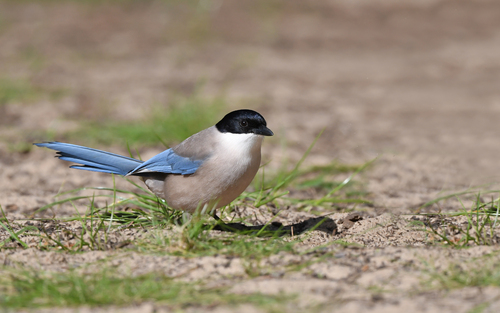 Iberian Magpie
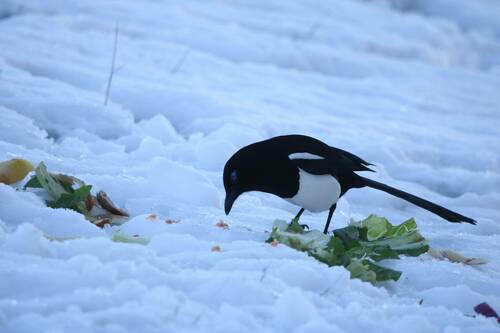 Maghreb Magpie
In short
The most reliable field mark to separate Iberian Magpie from Maghreb Magpie is the presence of a vivid blue patch of bare skin behind the eye on Maghreb Magpie—completely absent in Iberian Magpie. Structure is also a strong clue: Iberian Magpie is noticeably more slender, with a smaller bill and legs, and has a long, azure-blue tail and wings, while Maghreb Magpie is bulkier, with a longer tail, shorter wings, and a much more contrasting black-and-white pattern. Both species can show blue in the wings and tail, but their overall shape and head pattern are quite different. Immature and adult plumages are similar within each species, so focus on head and body structure, especially in flight or at a distance.
Identification tips
- Blue bare skin behind the eye: Only Maghreb Magpie shows a vivid blue patch of bare skin behind and below the eye. This is the single most diagnostic mark—always check the head in good light. Iberian Magpie never shows this feature.
- Overall structure: Iberian Magpie is slender, with a small bill and legs, and a more elongated, delicate shape. Maghreb Magpie is bulkier, with a heavier bill, longer tail, and shorter wings, giving a more robust impression.
- Head and throat pattern: Iberian Magpie has a glossy black crown and nape with a white throat and face, creating a capped look. Maghreb Magpie has a black head and breast, with no white throat, and the blue bare skin patch stands out against the black.
- Underparts color: Iberian Magpie shows light grey-fawn underparts and back, while Maghreb Magpie has a white belly patch (though narrower than Eurasian Magpie) and black breast. The contrast is sharper in Maghreb Magpie.
- Wing and tail color: Iberian Magpie's wings and long tail are bright azure-blue, often catching the light. Maghreb Magpie's wings and tail are iridescent blue-green but less extensive and more subdued than the Iberian's vivid blue.
- Scapular patch: Maghreb Magpie has a small white scapular patch (smaller than Eurasian Magpie), while Iberian Magpie lacks this feature—its back is grey-fawn.
- Tail length and shape: Both species have long tails, but Maghreb Magpie's is even longer and more graduated. In flight or when perched, the tail appears more prominent in Maghreb Magpie.
- Bill size: Iberian Magpie has a noticeably smaller, finer bill compared to the thick, heavy bill of Maghreb Magpie. This is most obvious at close range.
- Behavior in groups: Large, noisy flocks (especially outside the breeding season) suggest Iberian Magpie. Maghreb Magpie is more often seen in pairs or small groups.
- Habitat and range: If in Iberia (Spain, Portugal), it's Iberian Magpie; if in North Africa (Morocco, Algeria, Tunisia), it's Maghreb Magpie. There is no overlap in natural range.
- Perched vs. flight views: In flight, Iberian Magpie's blue wings and tail are very obvious, while Maghreb Magpie looks more black-and-white with iridescent highlights. Perched, check head pattern and bare skin.
- Juvenile/immature plumage: No distinctive age-specific flight marks are described for either species, so use the same field marks for all ages.
- White belly patch: Maghreb Magpie's white belly is narrower than in Eurasian Magpie, but still contrasts with the black breast; Iberian Magpie's underparts are uniformly pale grey-fawn.
- Plumage pitfalls: Do not confuse the blue in Iberian Magpie's wings and tail with the iridescence of Maghreb Magpie—look for extent and brightness. Also, the blue bare skin of Maghreb Magpie is not the same as feather color.
- When marks fail: If the blue skin patch is not visible (poor light, distant view), rely on structure, underpart color, and overall jizz. Range is a strong fallback if location is known.
Size
Iberian Magpie is smaller and more slender, measuring 31–35 cm in length, with proportionately smaller legs and bill. Maghreb Magpie is larger, around 48 cm long, and appears heavier and bulkier in the field. The tail of Maghreb Magpie is relatively longer, and the wings are shorter compared to the Iberian Magpie. These differences are most apparent when the birds are side by side, but even singly, Iberian Magpie gives a more delicate, elongated impression, while Maghreb Magpie is robust and heavyset.
Plumage
Juvenile and adult Iberian Magpie share a distinctive plumage: glossy black crown, white throat, light grey-fawn underparts and back, and striking azure-blue wings and tail. This blue is extensive and bright, especially in good light. Maghreb Magpie, by contrast, is black-and-white overall, with a black head, back, and breast, white scapulars and belly (though the white belly patch is narrower than in Eurasian Magpie), and iridescent blue-green wings and tail. The most diagnostic feature is the patch of vivid blue bare skin behind the eye in Maghreb Magpie—never present in Iberian Magpie. Both species have long tails, but Maghreb Magpie's is even longer and more graduated. The white scapular patch is smaller in Maghreb Magpie than in Eurasian Magpie, but still present. There are no age-specific upperwing patterns described for either species, so focus on head, underparts, and tail color for all ages.
Behaviour
Iberian Magpie is highly social, often seen in large, noisy family groups or winter flocks, sometimes up to 70 birds. They forage together, often on the ground or in low vegetation, and are more likely to be seen in loose colonies. Maghreb Magpie is typically seen in pairs or small groups, and its behavior is similar to Eurasian Magpie—more solitary or in small family parties, less likely to form large flocks. Both species are omnivorous and opportunistic, but Iberian Magpie is more likely to be seen in urban parks and gardens, foraging for human scraps.
Habitat
Iberian Magpie is found in southwestern and central Iberian Peninsula (Spain and Portugal), sometimes in southwestern France and recently in northwestern Italy. It prefers coniferous and broadleaf forests, especially pine, but is also common in parks and gardens. Maghreb Magpie is restricted to North Africa, from Morocco to Tunisia, at altitudes from sea level up to 2,300 meters. It occupies a range of habitats but is not found in the Iberian Peninsula. Thus, range is a strong clue: only Maghreb Magpie occurs in North Africa, only Iberian Magpie in Iberia.