

Hooded Merganser vs Red-breasted Merganser
Lophodytes cucullatus versus Mergus serrator
Play a quiz with Hooded Merganser and Red-breasted Merganser
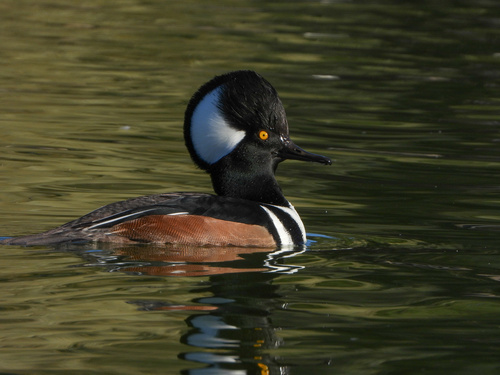 Hooded Merganser
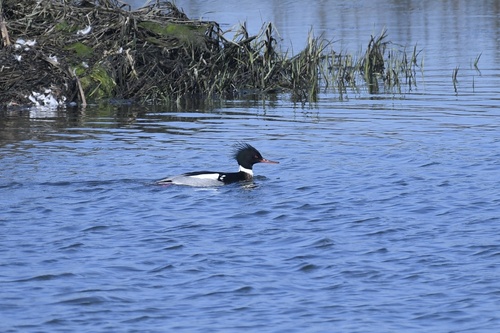 Red-breasted Merganser
In short
The most reliable field mark between Hooded Merganser and Red-breasted Merganser is the unique head and crest shape: Hooded Merganser shows a bold, fan-shaped crest (especially in males), while Red-breasted Merganser has a spiky, shaggy crest. Juvenile and female plumages can be confusing, but bill color and shape, crest structure, and size are key. In flight, both show white in the wing, but the pattern and extent differ subtly by age. Red-breasted Merganser is much larger and longer-bodied, with a thinner, longer bill. Always check for the Hooded Merganser’s compact build and distinctive head shape, especially when viewing birds at a distance or in mixed flocks.
Identification tips
- Crest shape: Hooded Merganser has a bold, fan-shaped crest (especially in males, but visible in both sexes and ages), while Red-breasted Merganser’s crest is long, spiky, and shaggy. This is often the quickest field clue at any distance.
- Bill structure and color: Hooded Merganser has a short, thin, dark bill; Red-breasted Merganser’s bill is longer, thinner, and distinctly red (though color may be hard to see at distance). The bill of Red-breasted is also more slender and dagger-like.
- Size and shape: Red-breasted Merganser is much larger and longer-bodied, with a proportionally longer neck and bill. Hooded Merganser is compact, short-necked, and sits higher in the water.
- Male breeding plumage: Hooded Merganser males show a large white patch on the crest, black head and neck, chestnut flanks, and bold white breast stripes. Red-breasted Merganser males have a dark green head, spiky crest, white neck, rusty breast, and white underparts. Only Red-breasted has the rusty breast in breeding plumage.
- Female/immature plumage: Hooded Merganser females have a compact, rounded, reddish-brown crest and a narrow white patch on the lower breast and belly. Red-breasted Merganser females have a spiky, rusty crest and a more uniform rusty head, lacking the sharp white breast patch.
- Eye color: Female Hooded Mergansers have brown eyes; males develop yellow eyes in their first winter. Red-breasted Merganser adults have red eyes (both sexes), but this can be subtle in the field.
- Wing pattern in flight: Hooded Merganser shows narrow white stripes along the tertials (which can look like lines on the back at rest); Red-breasted Merganser has a broader white wing patch, especially obvious in flight. Juvenile Hooded Mergansers have narrower white tertial edges than adults.
- Jizz in flight: Red-breasted Merganser appears longer, sleeker, and more streamlined in flight, with a long neck and bill projecting forward. Hooded Merganser is compact and quick, with a short neck and rounder head.
- Habitat context: Hooded Merganser is more likely in small, wooded ponds and rivers; Red-breasted Merganser is more likely on large lakes, bays, or saltwater.
- Group behavior: Red-breasted Mergansers often gather in larger flocks, especially on open water, and may display synchronized courtship. Hooded Mergansers are usually in smaller groups or pairs.
- Seasonal confusion: In nonbreeding season, male Hooded Mergansers resemble females but retain yellow eyes and a more compact crest. Red-breasted Merganser males lose some of their bold coloring but maintain the spiky crest and thin bill.
- Juvenile confusion: Juvenile Hooded Mergansers have a gray-brown neck and upperparts, and narrower white tertial edges; Red-breasted juveniles have a shorter crest and smaller white wing patches than adults.
- Perched posture: Hooded Merganser often sits higher in the water, with a more upright posture; Red-breasted Merganser appears lower, more elongated, and often with the bill held slightly upward.
- Bill serrations: Both have saw-like bills, but this is rarely visible in the field and not a practical separation point.
- When in doubt: Focus on crest shape, bill length, and overall size/shape before relying on subtle plumage marks, especially with distant or backlit birds.
Size
Red-breasted Merganser is substantially larger and heavier (adult mass ~1020 g) than Hooded Merganser (typically 450–880 g). Red-breasted averages 51–64 cm in length with a 66–74 cm wingspan, while Hooded Merganser is 40–49 cm long with a 60–66 cm wingspan. In the field, Red-breasted appears longer-necked and more elongated, with a proportionally longer and thinner bill. Hooded Merganser is compact, short-necked, and noticeably smaller, often looking daintier when side-by-side.
Plumage
-
Juvenile/immature birds: Hooded Merganser first-winter birds have a gray-brown neck and upperparts, with narrower white edges to the tertials than adults; adult females have much darker (nearly black) upperparts. Red-breasted Merganser juveniles resemble females but have a shorter crest and slightly smaller white wing patches. Both species show white in the wing, but Hooded Merganser’s white tertial stripes are narrow and can look like longitudinal lines on the back when perched, while Red-breasted’s white wing patch is broader and more obvious in flight.
-
Adult males (breeding): Hooded Merganser males are striking with a black head and neck, large white fan-shaped crest patch, chestnut flanks, and bold white breast stripes. Red-breasted Merganser males have a dark greenish head with a spiky crest, white neck, rusty breast, black back, and white underparts. The red breast is unique to Red-breasted in breeding plumage.
-
Adult females: Both are brownish with a rusty or reddish crest, but Hooded Merganser females have a compact, rounded crest and a narrow white patch on the lower breast and belly; Red-breasted females have a spiky, unkempt crest and a more uniform rusty head. Hooded Merganser females have brown eyes, while Red-breasted females have red eyes (though this can be hard to see at distance).
Behaviour
Both species dive for fish using serrated bills, but Red-breasted Merganser is more likely to be seen in larger, more open water, often in coastal or saltwater habitats, and is a rapid, strong flyer. Hooded Merganser is more often found in smaller, wooded ponds and rivers. Red-breasted Merganser males perform elaborate, synchronized courtship displays with neck stretching and crest fanning; Hooded Merganser males also display their crest but are less flamboyant in group displays.
Habitat
Hooded Merganser is typically found in wooded freshwater ponds, rivers, and small lakes, often close to shore and in sheltered areas. Red-breasted Merganser favors larger bodies of water, especially coastal bays, estuaries, and large lakes, and is the only North American merganser that regularly winters on saltwater. Overlap occurs, but context can help: a small, wooded pond is more likely to host Hooded, while choppy, open water or saltwater is more likely to have Red-breasted.