

Himalayan Swiftlet vs Black-nest Swiftlet
Aerodramus brevirostris versus Aerodramus maximus
Play a quiz with Himalayan Swiftlet and Black-nest Swiftlet
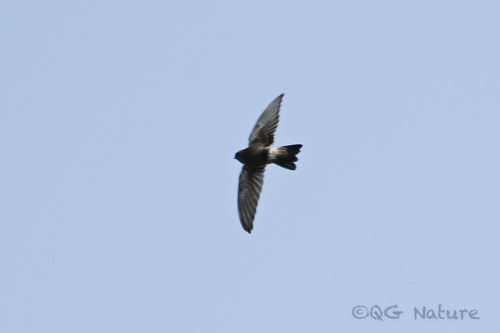 Himalayan Swiftlet
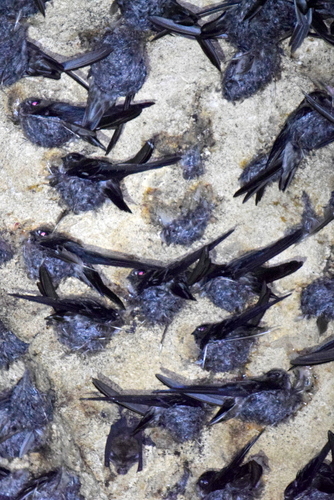 Black-nest Swiftlet
In short
The most reliable field mark between Himalayan Swiftlet and Black-nest Swiftlet is the presence of a pale grey rump on most Himalayan Swiftlets, which contrasts with the generally darker, less distinct rump of Black-nest Swiftlet. Himalayan Swiftlet also tends to show a paler brown underside and a pale patch above the bill, while Black-nest Swiftlet is overall darker and more uniform. Juvenile Himalayan Swiftlets may have a less distinct rump, making separation trickier in young birds. Structural differences are subtle, but Himalayan Swiftlet is slightly smaller and more slender, with a higher likelihood of being seen at higher elevations or in large flocks. Vocalizations and echolocation clicks are not reliably separable in the field between these two species.
Identification tips
- Pale grey rump (adults): Himalayan Swiftlet usually shows a distinct pale grey rump, visible in flight from behind or below, especially in good light. This is the best single field mark for adults.
- Rump variation (juveniles/subspecies): Juvenile Himalayan Swiftlets have a less distinct rump, and some subspecies (e.g., inopina) have a darker rump, so this mark can fail in young birds or certain populations.
- Uniform dark plumage: Black-nest Swiftlet is overall darker and more uniform, with the rump not contrasting with the back. If the bird looks uniformly dark above and below, Black-nest is more likely.
- Pale patch above bill: Himalayan Swiftlet often shows a pale patch above and behind the bill, which is lacking or much less obvious in Black-nest Swiftlet. This can be subtle at distance.
- Underpart color: Himalayan Swiftlet is paler brown below, while Black-nest Swiftlet is darker and more uniform underneath. Look for contrast between upperparts and underparts in good light.
- Size and structure: Himalayan Swiftlet is slightly smaller and more slender, but this is only useful if you have direct comparison or experience with both.
- Tail shape: Both species have a forked tail, but there is no strong difference described; do not rely on this alone.
- Wing shape and flight: Both have swept-back, crescent-shaped wings, but Himalayan Swiftlet may appear more delicate and glide more often due to longer primaries and smaller breast muscles.
- Flock size and behavior: Large, high-flying flocks (50–300 birds) in montane areas are more likely to be Himalayan Swiftlet, especially at high elevation. Black-nest Swiftlet is more typical in smaller groups at lower elevations.
- Habitat context: At high elevations (above 2,000 m), Himalayan Swiftlet is much more likely. At sea level or in coastal lowland forest, Black-nest Swiftlet is the default.
- Nesting sites: Both nest colonially in caves, so this is not diagnostic, but Himalayan Swiftlet’s nests may be found at higher, colder sites.
- Vocalizations: Calls and echolocation clicks are similar and not reliably separable in the field; do not use this as a primary mark.
- Seasonal movement: If seen descending to lowland fields in bad weather or at dusk near mountains, consider Himalayan Swiftlet, especially if flocks are large.
- Geographic overlap: In areas where both occur (e.g., Thailand, Myanmar), rely on rump and underpart color as primary marks, and use habitat and elevation as supporting clues.
- Beware pale-rumped Black-nest Swiftlets: Some individual variation may occur, but a truly pale, contrasting rump is rare in Black-nest Swiftlet; always check for other supporting marks.
Size
Himalayan Swiftlet is slightly smaller and more slender than Black-nest Swiftlet, with a length of about 13–14 cm [wikipedia]. While precise measurements for Black-nest Swiftlet are not provided in the sources, it is generally considered a larger swiftlet. This size difference is subtle and may not be obvious in the field unless both species are seen together. Both species share the typical swiftlet proportions: long, narrow wings and a forked tail, but Himalayan Swiftlet may appear a bit more delicate overall.
Plumage
Adult Himalayan Swiftlet is mainly grey-brown above with a distinct pale grey rump (except in some subspecies where the rump is darker), paler brown below, and a pale patch above and behind the bill. Juveniles have a less distinct rump, which can make them appear more uniform and thus closer to Black-nest Swiftlet. Black-nest Swiftlet, in contrast, is overall darker and more uniform, lacking the obvious pale rump and pale facial patch. The underparts of Black-nest Swiftlet are also darker, and the rump does not contrast strongly with the back. In flight, both species show swept-back, crescent-shaped wings and a forked tail, but the pale rump of Himalayan Swiftlet is often visible from below or behind, especially in adults. Subspecific variation in Himalayan Swiftlet can affect rump tone, but even the darkest races usually show some contrast. No distinctive juvenile wing pattern is described for either species, so separation relies mainly on rump and underpart coloration.
Behaviour
Himalayan Swiftlet is highly gregarious, often seen in flocks of 50 or more, sometimes up to 300, and prefers highland and montane areas, especially open spaces over forests and river valleys. Its flight is characterized by long glides due to very long primaries and small breast muscles. Black-nest Swiftlet also forms flocks but is more typically associated with lowland and mid-elevation forests. Both species nest colonially in caves, using saliva to build nests, and both are aerial insectivores. Himalayan Swiftlet may be more likely to descend to lower elevations in bad weather or evening, but is generally more associated with higher altitudes.
Habitat
Himalayan Swiftlet is primarily a highland and montane species, breeding at elevations up to 4,500 m in the Himalayas and descending to lower elevations in winter or poor weather. It is most often encountered in open areas over forests, river valleys, and cultivated land near hills. Black-nest Swiftlet, by contrast, is found in a wider range of elevations but is more typical of subtropical or tropical moist lowland and montane forests across Southeast Asia, including coastal regions and islands. Overlap can occur in some areas (e.g., Thailand, Myanmar), but Himalayan Swiftlet is rarely found at sea level, while Black-nest Swiftlet is common there.
Voice
Both species produce a variety of twittering calls and echolocation clicks for navigation in caves. Himalayan Swiftlet is described as having a 'chit-chit' roosting call and a piercing 'teeree-teeree-teeree' call, with echolocation clicks audible to humans. There is no detailed description of Black-nest Swiftlet’s vocalizations in the sources, but as a member of Aerodramus, it is likely similar. In practice, vocalizations and echolocation clicks are not reliably separable in the field between these two species.