

Himalayan Prinia vs Hill Prinia
Prinia crinigera versus Prinia superciliaris
Play a quiz with Himalayan Prinia and Hill Prinia
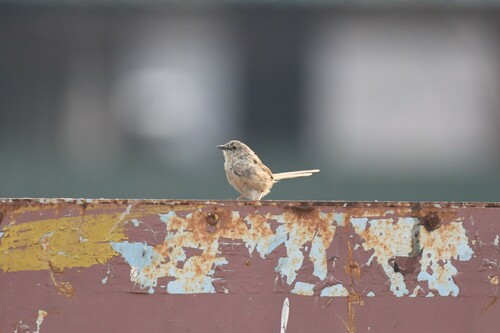 Himalayan Prinia
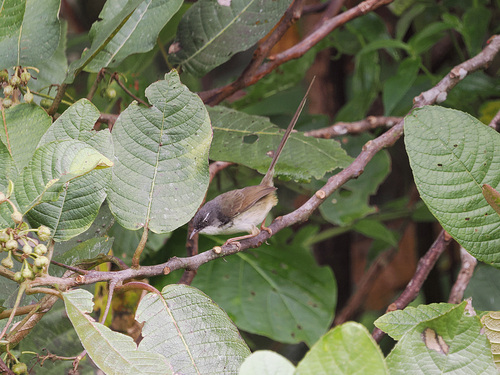 Hill Prinia
In short
The most reliable field mark between Himalayan Prinia and Hill Prinia is the strong seasonal and sexual variation in Himalayan Prinia, especially the dark, cold-toned tail and the breeding male's blackish crown and face. In non-breeding plumage, Himalayan Prinia shows clear streaking on the upperparts and mottling on the face and breast, while Hill Prinia lacks these features. Structure and jizz are similar, but Himalayan Prinia tends to look colder and darker overall, especially in the tail. Both species overlap in parts of their range, so careful attention to plumage details—especially in breeding males and non-breeding birds—is essential.
Identification tips
- Tail color and structure: Himalayan Prinia has a long, broad tail with a cold-toned dark coloration. This is often the most obvious field mark, especially when the bird is perched or flicking its tail. Hill Prinia's tail is less broad and typically warmer-toned.
- Seasonal and sexual dimorphism (Himalayan Prinia): In breeding season, males show a blackish crown and face, with dark mottling on the breast sides. Females are paler and less streaked, but still colder-toned than Hill Prinia. Hill Prinia does not show such strong seasonal or sexual variation.
- Non-breeding plumage (Himalayan Prinia): Both sexes show streaked upperparts and mottled face/breast, which are absent in Hill Prinia. Look for these marks in autumn and winter.
- Bill color: Breeding male Himalayan Prinia has a blackish bill, while breeding females have a pale pinkish bill, darker at the tip and lower mandible. Bill color is less useful for Hill Prinia, as no distinctive seasonal change is described.
- Overall coloration: Himalayan Prinia is generally colder and darker, especially in the tail and head. Hill Prinia is expected to be warmer and more uniform in tone.
- Crown and face pattern: Only Himalayan Prinia breeding males have a blackish crown and face. If you see this, Hill Prinia can be ruled out.
- Upperpart streaking: Streaked mantle and crown (especially in non-breeding Himalayan Prinia) are good marks. Hill Prinia lacks this streaking.
- Breast pattern: Mottling on the sides of the breast is a feature of Himalayan Prinia, especially in non-breeding and breeding males. Hill Prinia is more uniform below.
- Geographic context: If you are in the core Himalayas, especially Afghanistan, Pakistan, Nepal, Bhutan, or northern India, Himalayan Prinia is more likely. In Southeast Asia, Hill Prinia is more likely. In Yunnan and adjacent areas, both may occur—use plumage marks.
- Subspecies variation (Himalayan Prinia): Some subspecies (e.g., P. c. striatula) are paler, but still show the cold tail and streaking. Be cautious with very pale birds in the western range.
- Sexing Himalayan Prinia: If you see two birds together and one is larger, darker, and more streaked, it is likely the male. Hill Prinia does not show such strong sexual dimorphism.
- No distinctive flight or wing pattern: Neither species has a unique upperwing or flight mark described, so focus on perched and foraging birds.
- Habitat overlap: Both species can occur in similar habitats in overlap zones, so do not rely on habitat alone for identification.
- Voice: No vocal differences are described in the sources; do not use song or call for separation based on current information.
- Beware confusion with Striped Prinia (P. striata): Himalayan Prinia was formerly lumped with Striped Prinia; if you are in China or Taiwan, check current taxonomy and range.
Size
Direct size comparisons are not available in the sources, but both species are typical prinias in overall structure. Himalayan Prinia may appear slightly bulkier and longer-tailed, with a broader tail, but this is subtle and not always reliable in the field. Sexual dimorphism in size is present in Himalayan Prinia, with males larger than females, but this is difficult to judge without side-by-side comparison.
Plumage
- Juvenile/immature/first-winter: No age-specific upperwing or flight pattern differences are described for either species in the sources. Focus must be on general coloration and streaking.
- Non-breeding (both sexes, Himalayan Prinia): Shows distinct streaking on the upperparts and mottling on the face and breast. The tail is long, broad, and cold-toned dark, which stands out against the typically warmer tones of Hill Prinia.
- Breeding male (Himalayan Prinia): Striking blackish crown (paler at edges), blackish face, and dark, mottled sides of breast. The mantle is streaked, though less so than the crown. Bill is blackish. Breeding females are paler, with less streaking and a pinkish bill.
- Hill Prinia: No detailed plumage description is provided in the sources, but it lacks the strong streaking, blackish crown/face, and cold dark tail of Himalayan Prinia. Expect a more uniform, warmer-toned appearance, with less contrast and less pronounced sexual/seasonal dimorphism.
Behaviour
No diagnostic behavioral differences are described in the sources. Both species are typical prinias, likely to be seen foraging in low vegetation, flicking their tails, and moving actively. Flight and foraging jizz are not described as distinctive between the two.
Habitat
Both species occur in overlapping regions in the Himalayas and adjacent areas, but Himalayan Prinia is more tightly associated with the Himalayan belt (Afghanistan, Pakistan, India, Nepal, Bhutan, Yunnan in China), while Hill Prinia has a broader range extending into Southeast Asia (China, India, Indonesia, Laos, Malaysia, Myanmar, Thailand, Vietnam). In areas of overlap (e.g., Yunnan), careful attention to plumage is needed. Habitat preferences are not detailed in the sources, but both are likely to be found in scrub, grassland, or edge habitats.