

Hill Prinia vs Yellow-bellied Prinia
Prinia superciliaris versus Prinia flaviventris
Play a quiz with Hill Prinia and Yellow-bellied Prinia
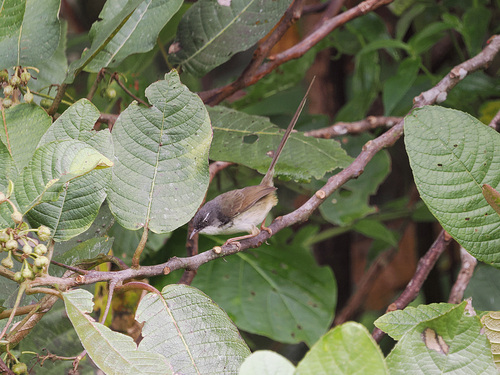 Hill Prinia
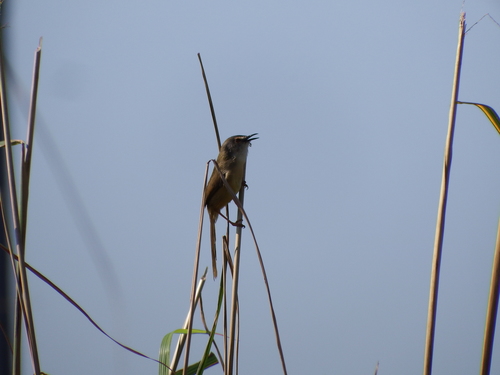 Yellow-bellied Prinia
In short
Hill Prinia and Yellow-bellied Prinia are both small, active warblers in the same family and can overlap in parts of Southeast Asia, but they differ most reliably in underpart color: Yellow-bellied Prinia shows a distinctly yellow belly, while Hill Prinia lacks this feature. Both species are similar in overall structure and behavior, but their ranges only partially overlap, and Hill Prinia is generally found at higher elevations. Juvenile and immature-specific wing or flight patterns are not described in the available sources, so underpart color and habitat context are the most practical field marks. Structural differences are subtle and not emphasized in the sources.
Identification tips
- Underpart color is the most reliable field mark: Yellow-bellied Prinia always shows a yellow belly, while Hill Prinia does not. This is true for all ages and sexes.
- Habitat context helps: Hill Prinia is more likely in hilly or montane areas, while Yellow-bellied Prinia prefers lowlands, especially near water or in grassy areas. Use elevation and habitat as supporting clues.
- Range overlap is partial: In areas where both species occur (e.g., parts of Southeast Asia), rely on plumage and habitat together. In Pakistan or the Himalayan foothills, only Yellow-bellied Prinia is likely; in Indonesia, only Hill Prinia.
- Size is not a safe separator: Both are small prinias, and field size differences are negligible.
- No distinctive flight or wing pattern differences are documented: If you see a prinia in flight, focus on underpart color rather than wing markings.
- Behavior is similar: Both species are active and often skulk in dense vegetation, sometimes perching up to sing or call. Do not rely on behavior alone.
- No known seasonal or sex-based plumage differences relevant to separation: Both species are consistent in their main field marks year-round.
- Supercilium and upperpart color are not described as diagnostic: If you notice a strong eyebrow or back color, do not use it as a primary separator unless supported by other sources.
- Vocalizations are not detailed in the available notes: If you hear a prinia, do not rely on song or call for separation unless you have local experience.
- Juvenile and immature birds: No special flight or wing pattern marks are described for either species, so use the same underpart and habitat clues for young birds.
- In mixed flocks or edge habitats: If you see both species together, look for the yellow belly to pick out Yellow-bellied Prinia.
- If in doubt, photograph the underparts: This is the quickest way to confirm the ID in the field.
- Do not use tail length or shape as a separator: No differences are described in the sources.
- If you only see the bird from above or in silhouette, ID may not be possible: Wait for a clear view of the underparts.
- Consult local checklists for abundance: In some regions, one species may be much more common, which can help with likely ID, but always confirm with field marks.
Size
Only Yellow-bellied Prinia has a recorded average body mass (7.6 g [wikidata]), but both species are small and similar in size, typical for prinias. There is no evidence from the sources that size alone is a reliable separator in the field.
Plumage
No age-specific upperwing or flight pattern differences are described for either species. The most consistent plumage difference is on the underparts: Yellow-bellied Prinia has a yellow belly (all ages and sexes), while Hill Prinia does not. Other plumage features such as upperpart color, supercilium, and tail pattern are not detailed in the sources, so cannot be reliably used for separation based on this dataset. There is no mention of seasonal or sex-based plumage variation that would affect field identification.
Behaviour
Both species are active, often skulking warblers typical of the genus, moving through low vegetation and sometimes perching in the open. No behavioral differences are highlighted in the available notes, so behavior alone is not diagnostic for separating these two species.
Habitat
Hill Prinia is found in hilly or montane areas across China, India, Southeast Asia, and Indonesia, typically at higher elevations. Yellow-bellied Prinia occupies a broader range, including Pakistan, the Himalayan foothills, northeastern India, and Southeast Asia, but is more often found in lowland habitats. If you encounter a prinia in higher elevation scrub or grassland, Hill Prinia is more likely; in lowland wetlands or grass, Yellow-bellied Prinia is expected. However, there is some overlap in Southeast Asia, so habitat should be used alongside plumage for best results.