

Helmeted Guineafowl vs Wild Turkey
Numida meleagris versus Meleagris gallopavo
Play a quiz with Helmeted Guineafowl and Wild Turkey
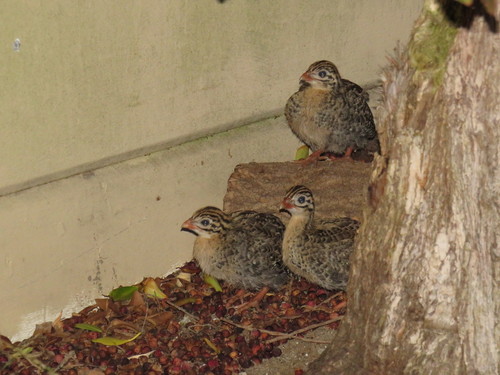 Helmeted Guineafowl
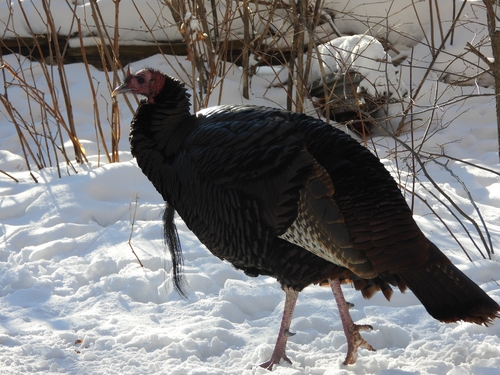 Wild Turkey
In short
The most reliable field mark for separating Helmeted Guineafowl from Wild Turkey is the combination of head and body shape: guineafowl have a small, bare, bony-knobbed head and a round, compact body, while wild turkeys are much larger, with long legs, a long neck, and a proportionally larger, featherless head with fleshy wattles and caruncles. In flight or at rest, guineafowl show a short tail and short, rounded wings, whereas turkeys have a long, broad tail and much larger overall proportions. Plumage is also distinctive: guineafowl are evenly speckled gray-black with white, while turkeys are dark with a coppery or bronze iridescence and barred wings. Juvenile and adult turkeys have different tail feather lengths, which can be useful in age determination. Both species have bare heads, but the guineafowl's casque and blue/red facial skin are unique. Size difference is extreme, with turkeys being several times heavier and longer.
Identification tips
- Size: Wild Turkeys are dramatically larger than Helmeted Guineafowl—useful even at a distance. If the bird is turkey-sized (comparable to a large goose), it is not a guineafowl. Guineafowl are chicken-sized or smaller.
- Head shape and ornamentation: Guineafowl have a small, bare head with a prominent bony casque (helmet) and blue/red/black facial skin. Turkeys have a much larger, bare head with fleshy red wattles, caruncles, and (in males) a long snood over the bill. Only turkeys have a beard of hair-like filaments on the breast (mostly males).
- Body shape: Guineafowl are round-bodied, compact, and short-tailed; turkeys are long-legged, long-necked, and have a long, broad tail.
- Plumage pattern: Guineafowl are evenly speckled with white dots on gray-black; turkeys are dark with a metallic coppery sheen and barred wings, lacking any speckled pattern.
- Tail: Guineafowl have a short, inconspicuous tail; turkeys have a long, fan-shaped tail (especially obvious in displaying males). Juvenile turkeys have uneven tail feather lengths, while adults have even tail fans.
- Wings: Guineafowl wings are short and rounded, matching their terrestrial habits. Turkey wings are broad, with bold white barring, and are used for powerful flight into trees.
- Legs and spurs: Turkeys have long, sturdy legs and males have a spur on the back of each leg; guineafowl lack spurs entirely.
- Flight style: Guineafowl rarely fly and do so only explosively for short distances, quickly gliding down. Turkeys can fly strongly for longer distances, especially to reach roosts in trees.
- Group size: Guineafowl are often seen in tight flocks of 10–25 birds; turkeys are more often in smaller groups or solitary, except in winter or at communal roosts.
- Vocalizations: Guineafowl make harsh, grating calls; turkeys gobble (males), yelp, and cluck, with a more varied and musical repertoire.
- Habitat: In the Americas, a large, dark galliform in forest or field is almost always a turkey; guineafowl are only present where introduced and usually near farms or in captivity.
- Sexual dimorphism: Turkey males are much larger, more iridescent, and have more elaborate head ornamentation than females; guineafowl show less sexual dimorphism, with both sexes similarly speckled and ornamented.
- Juvenile marks: Juvenile turkeys (jakes) have uneven tail feather lengths, while guineafowl juveniles are cryptically colored but still speckled.
- Beard: Only turkeys (mostly males) have a beard of coarse filaments on the breast; guineafowl never do.
- Spur presence: Turkey males have a visible spur on the leg; guineafowl never have spurs.
Size
Wild Turkey is vastly larger than Helmeted Guineafowl. Guineafowl average about 1.6 kg in mass and 53–58 cm in length, while female turkeys are 2.5–5.4 kg and 76–95 cm, and males are 5–11 kg and 100–125 cm long. Turkeys are the heaviest North American galliform and can be up to seven times heavier than a guineafowl. In the field, turkeys appear much taller and bulkier, with longer legs, neck, and tail. Guineafowl are compact and chicken-like by comparison.
Plumage
No age-specific upperwing pattern is described for either species, but overall body and wing plumage are distinctive. Helmeted Guineafowl of all ages are gray-black with dense white speckling across the body and wings; the wings are short and rounded, and the tail is short. The bare head is capped with a dull yellow or reddish bony casque and blue/red/black facial skin. Wild Turkeys, by contrast, are dark brown to blackish with a complex coppery or bronze iridescence, especially in adult males. Their wings show bold white barring, and the tail is long and fan-shaped in adults. Males have a featherless, reddish head with fleshy wattles and a snood, and often a 'beard' of coarse filaments on the breast. Juvenile turkeys (jakes) have uneven tail feather lengths, while adults have even tail fans. Females are duller and browner but still lack the guineafowl's speckled pattern. Both species have bare heads, but only the guineafowl has a casque.
Behaviour
Helmeted Guineafowl are highly terrestrial, running rather than flying when alarmed, and form tight flocks outside the breeding season. They scratch for food like chickens and are agile runners, able to cover long distances on foot. Their flight is short, explosive, and quickly transitions to gliding. Wild Turkeys are also ground-dwelling but are more likely to fly up into trees to roost, using their strong legs for running and their broad wings for powerful, sustained flight when necessary. Males display by fanning their tails and puffing up their bodies, a behavior not seen in guineafowl. Turkeys are less gregarious outside the breeding season, often seen in smaller groups.
Habitat
Helmeted Guineafowl are native to sub-Saharan Africa but have been widely introduced elsewhere, often near farms, open woodlands, or savanna. They are commonly seen in agricultural areas, feeding on seeds, tubers, and invertebrates. Wild Turkeys are native to North America and prefer mixed forests, open woodlands, and edges, often near fields or clearings. Both species may be found near human habitation, but turkeys are more strictly associated with North American habitats, while guineafowl are more likely in African or introduced contexts.
Voice
Helmeted Guineafowl make loud, harsh, grating calls when disturbed, often described as cackling or clucking. Wild Turkeys have a wide range of vocalizations, most famously the male's gobble, as well as yelps, clucks, and purrs. The gobble is loud and carries over long distances, especially during the breeding season. Guineafowl calls are generally more raucous and less musical than turkey vocalizations.