

Hawaiian Goose vs Blue-winged Goose
Branta sandvicensis versus Cyanochen cyanoptera
Play a quiz with Hawaiian Goose and Blue-winged Goose
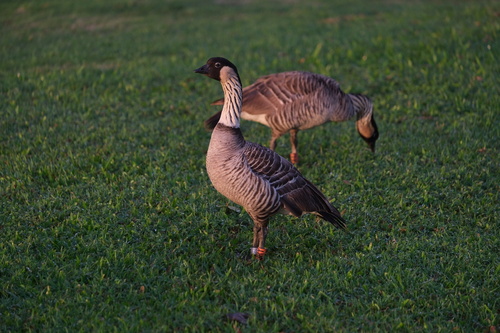 Hawaiian Goose
 Blue-winged Goose
In short
The most reliable field mark to separate Hawaiian Goose from Blue-winged Goose is the presence of a bold, diagonally-striped black-and-white neck on the Hawaiian Goose, versus the overall dull grey-brown appearance and pale blue forewing (visible in flight) of the Blue-winged Goose. Juvenile Hawaiian Geese show reduced striping and duller tones, but still lack the blue wing panel of Blue-winged Goose immatures. In perched views, focus on the neck pattern and head color; in flight, Blue-winged Goose reveals a distinctive pale blue upper forewing, while Hawaiian Goose lacks any blue in the wing. Both species are stocky, but the Blue-winged Goose is slightly larger and has a thick, loose plumage texture. Habitat is a strong clue: Hawaiian Goose is strictly Hawaiian, while Blue-winged Goose is endemic to Ethiopia.
Identification tips
- Neck pattern (all ages): Hawaiian Goose shows bold black-and-white diagonal striping on the neck (adults) or at least some striping and color contrast (juveniles), while Blue-winged Goose always has a plain, slightly paler grey-brown head and neck with no striping.
- Head color (all ages): Hawaiian Goose has a black head and hindneck with buff cheeks; Blue-winged Goose has a uniformly dull, pale head and neck, lacking strong contrast.
- Wing panel in flight (all ages): Blue-winged Goose reveals a pale blue upper forewing bordered by black primaries and green-glossed secondaries in flight or when stretching; Hawaiian Goose never shows blue in the wing.
- Juvenile confusion: Juvenile Hawaiian Geese are duller and less distinctly marked than adults, but still lack any blue in the wing and retain some neck patterning. Juvenile Blue-winged Goose is even duller than adults but retains the blue wing panel.
- Bill and legs: Both species have black bills and legs, but Blue-winged Goose's bill is smaller and less robust; not a strong field mark unless seen very well.
- Plumage texture: Blue-winged Goose has thick, loose plumage, especially obvious in cold or windy conditions; Hawaiian Goose's feathers are tighter and less fluffy.
- Feet: Hawaiian Goose has less extensive webbing, adapted for walking on lava; this is only visible at close range.
- Overall color impression: Hawaiian Goose is more patterned and contrasting, especially around the head and neck; Blue-winged Goose is overall dull grey-brown with a slightly paler head and neck.
- Flight jizz: Blue-winged Goose may appear bulkier and slower in flight, with the blue forewing panel flashing; Hawaiian Goose is more agile and lacks any blue in the wing.
- Habitat and range: If seen in Hawaii, it is almost certainly Hawaiian Goose; if in Ethiopia, Blue-winged Goose. Any other location suggests captive birds.
- Size: Blue-winged Goose is larger and bulkier, but size overlap means this is not always reliable.
- Sex differences: Both species show little sexual dimorphism in plumage; size difference is subtle and not a strong field mark.
- Voice: Blue-winged Goose may give a high-pitched whistle or barking alarm call, but is generally quiet; Hawaiian Goose is also quiet and not known for distinctive calls.
- Perched vs. in flight: Rely on neck pattern and head color when perched; in flight, check for blue wing panel (Blue-winged Goose) versus plain dark wings (Hawaiian Goose).
- Common pitfalls: Immature Hawaiian Geese may appear dull and less marked, but never show blue in the wing. Always check for neck striping and blue wing panel as primary separation marks.
Size
Blue-winged Goose is generally larger, measuring about 60–75 cm in length and with an average adult mass of 2180 g [wikidata]. Hawaiian Goose stands about 41 cm tall, with males averaging 1695–3050 g and females 1525–2560 g [wikipedia]. In the field, Blue-winged Goose often appears bulkier and more robust, especially when standing. However, size overlap is possible, so rely more on plumage and structure for positive ID.
Plumage
Juvenile and immature Hawaiian Geese are duller brown than adults, with less distinct head/neck color contrast and greatly reduced neck striping, but still lack any blue in the wing. Blue-winged Goose of all ages shows a thick, loose, grey-brown plumage with a paler head and neck, and in flight, a conspicuous pale blue upper forewing bordered by black primaries and green-glossed secondaries. The underwing is mostly black with a white inner forewing. Adults of Hawaiian Goose have a striking black head and hindneck, buff cheeks, and bold diagonal black-and-white neck stripes, with no blue in the wing. Blue-winged Goose adults and immatures are much plainer, with a small black bill and black legs, and only show the blue wing panel in flight or when stretching wings. Both species' immatures are duller than adults, but the blue wing panel is unique to Blue-winged Goose.
Behaviour
Hawaiian Goose spends most of its time on the ground but is capable of daily flights between nesting and feeding areas. It is adapted to walking on rough volcanic terrain, with less extensive webbing on the feet. Blue-winged Goose is also terrestrial and stocky, adapted for the cold Ethiopian highlands with thick, loose plumage. Both species are generally quiet and not particularly gregarious, but the Blue-winged Goose may appear bulkier and less agile than the Hawaiian Goose.
Habitat
Hawaiian Goose is strictly endemic to the Hawaiian Islands (Maui, Kauaʻi, Molokaʻi, and Hawaiʻi) and is never found outside this range in the wild. It frequents volcanic slopes, grasslands, and shrublands. Blue-winged Goose is endemic to Ethiopia, inhabiting highland lakes, marshes, and wetlands. If seen outside their respective endemic regions, captive origin should be suspected. Habitat context is a strong clue for separation.
Voice
Blue-winged Goose is a quiet species, rarely vocalizing, but both sexes may give a high-pitched whistle and a barking alarm call when flushed. It does not honk or cackle like true geese. No specific vocalization details are given for Hawaiian Goose in the notes, but it is not known for a distinctive or loud call in the field. Voice is not a strong field mark for separating these two species.