

Hawaii Akepa vs Cerulean Warbler
Loxops coccineus versus Setophaga cerulea
Play a quiz with Hawaii Akepa and Cerulean Warbler
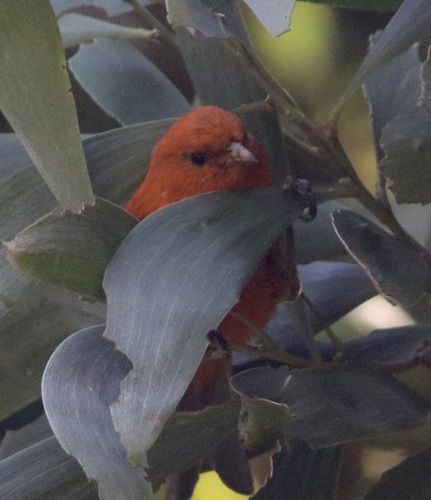 Hawaii Akepa
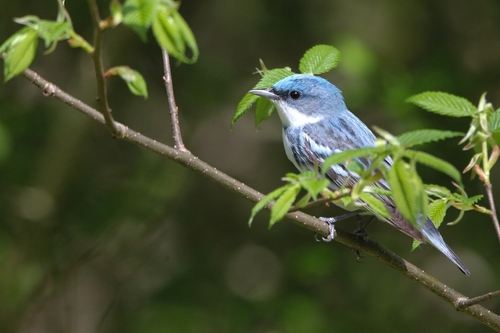 Cerulean Warbler
In short
The most reliable field mark to separate Hawaii Akepa and Cerulean Warbler is overall color and wing pattern: Cerulean Warbler of any age shows two bold white wing-bars and white tail spots, while Hawaii Akepa lacks wing-bars entirely. Adult male Akepa is bright orange, never blue or white, while male Cerulean Warbler is blue above and white below. Females and immatures of both species are duller, but Cerulean Warbler always shows wing-bars and a pale eyebrow, while Akepa is plain greenish with a small, slightly crossed bill. Bill shape and habitat are also strong clues: Akepa has a tiny, cross-tipped bill and is only found in old-growth Hawaiian forests, while Cerulean Warbler has a thin, straight warbler bill and is a canopy migrant in eastern North America or the Andes. Vocalizations are very different, but may be hard to compare unless heard well.
Identification tips
- Wing-bars and tail spots: Cerulean Warbler of any age or sex always shows two bold white wing-bars and white tail spots; Hawaii Akepa never shows wing-bars or tail spots. This is the fastest field check, especially for immatures and females.
- Bill shape: Akepa has a tiny, slightly crossed bill (unique among Hawaiian honeycreepers); Cerulean Warbler has a thin, straight, pointed warbler bill. Bill shape is visible even at a distance with good views.
- Adult male color: Male Akepa is bright orange (not red), with no blue or white; male Cerulean Warbler is deep blue above, white below, with a black necklace and black flank streaks. No overlap.
- Female/immature color: Female and immature Akepa are plain dusty greenish with no markings; female and immature Cerulean Warbler are blue-green above, yellowish below, with a pale eyebrow and always with wing-bars.
- Supercilium (eyebrow): Female and immature Cerulean Warbler show a distinct pale eyebrow; Akepa never shows an eyebrow at any age.
- Streaking: Male Cerulean Warbler has black streaks on the flanks and a black necklace; Akepa is always unstreaked and plain.
- Leg color: Cerulean Warbler adults have black legs; Akepa's leg color is not specified as diagnostic, but is not a primary mark.
- Tail shape: Cerulean Warbler has a longer tail with white spots; Akepa's tail is shorter and plain.
- Vocalizations: Cerulean Warbler sings a buzzy, accelerating song and buzzy calls; Akepa gives a simple, quivering whistle with a trill. If heard, these are very different.
- Habitat: Akepa is only found in old-growth Hawaiian forests; Cerulean Warbler is never found in Hawaii, only in North/South America. If seen in Hawaii, it's Akepa; if in North America or the Andes, it's Cerulean Warbler.
- Behavior: Cerulean Warbler is highly active and migratory, foraging high in the canopy; Akepa is resident, less active, and forages methodically using its cross bill.
- Seasonal context: Cerulean Warbler is present in North America only during the breeding season (late spring/summer); Akepa is present year-round in Hawaii.
- Courtship groups: Large courtship groups are sometimes seen with Akepa during breeding season; Cerulean Warbler is more solitary or territorial.
- Nesting: Akepa is a cavity-nester, requiring old tree cavities; Cerulean Warbler nests in the canopy but not in cavities.
- Size/jizz: Both are tiny, but Akepa is more compact with a short bill and tail; Cerulean Warbler is slightly longer, with a more slender, elongated look and longer tail.
Size
Both species are very small songbirds and similar in length: Hawaii Akepa is about 10 cm (4 in) long [wikipedia], while Cerulean Warbler is about 11 cm (4.3 in) [wikipedia]. Cerulean Warbler has a slightly longer wingspan (20 cm vs. Akepa's unlisted but likely shorter span), and is marginally heavier (8–10 g). In the field, both will appear tiny, but Akepa is more compact with a shorter, stubbier bill, while Cerulean Warbler is a bit more elongated and slender, with a longer tail and a thin, pointed bill.
Plumage
The most diagnostic mark for all ages and sexes is the presence or absence of white wing-bars and tail spots: Cerulean Warbler (adult male, female, and immature) always shows two prominent white wing-bars and white spots on the tail [wikipedia]. Hawaii Akepa never shows wing-bars or tail spots at any age. Adult male Akepa is bright orange (not red), while female and immature Akepa are dusty greenish and plain. Cerulean Warbler adult male is deep cerulean blue above, white below, with a black necklace and dark flank streaks; adult female is blue-green above, yellowish below, with a pale supercilium (eyebrow), and no streaking. Immature Cerulean Warblers resemble females but are even duller and more yellowish above, still with wing-bars and eyebrow. Akepa of all ages is plain, with no streaking, no wing-bars, and no supercilium. Bill color also differs: Akepa has a small, slightly crossed bill; Cerulean Warbler's bill is thin, straight, and pointed, with color varying by age (black in adult males, gray or brownish in females and immatures).
Behaviour
Hawaii Akepa is an obligate cavity-nester, foraging in old-growth native Hawaiian forests, often high in the canopy but sometimes lower. It is not migratory. Cerulean Warbler is a long-distance migrant, breeding in the canopy of mature eastern North American forests and wintering in the Andes. Cerulean Warbler is highly active, often foraging high in the canopy, and is strongly territorial. Akepa may be seen in courtship groups during breeding season, but otherwise is less conspicuous. Akepa's foraging is more methodical, using its cross bill to probe bark and cavities.
Habitat
Hawaii Akepa is strictly found in old-growth native forests on the island of Hawaii, requiring large, old trees with natural cavities for nesting [wikipedia]. It never leaves this habitat. Cerulean Warbler breeds in mature deciduous forests of eastern North America, especially in the canopy, and winters in subtropical forests on the eastern slope of the Andes in South America. It is never found in Hawaii. Thus, location alone is often diagnostic: Akepa is Hawaiian and non-migratory; Cerulean Warbler is a Nearctic-Neotropical migrant.
Voice
Hawaii Akepa gives a slight, quivering whistle ending with a long trill [wikipedia]. Cerulean Warbler sings a buzzy, accelerating series ("zray zray zray zray zeeee") and gives a buzzy, metallic "zzee" call. Cerulean Warbler's song is much more complex and buzzy, while Akepa's is simpler and more whistled. Cerulean Warbler males sing frequently; Akepa's vocalizations are less often heard and less varied.