
Harris's Hawk vs White-tailed Hawk
Parabuteo unicinctus versus Geranoaetus albicaudatus
Play a quiz with Harris's Hawk and White-tailed Hawk
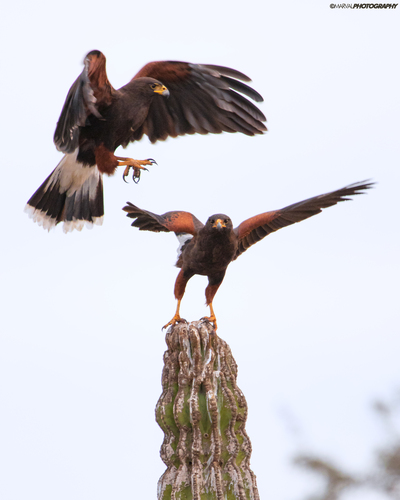 Harris's Hawk
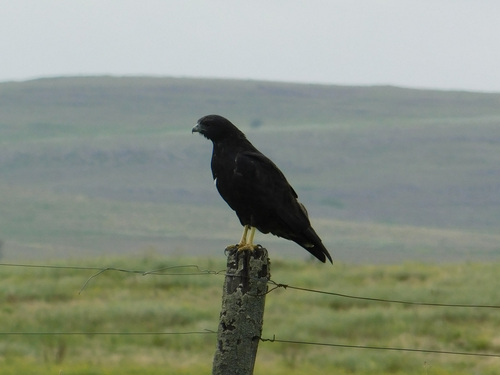 White-tailed Hawk
In short
The most reliable field mark between Harris's Hawk and White-tailed Hawk is the wing and tail pattern in flight, especially in immature birds. Juvenile Harris's Hawks show buffy, streaked underwings with a pale panel on the primaries and a broad white tail base and tip, while immature White-tailed Hawks have a dark, almost blackish appearance with a boldly spotted black-and-white wing lining and a brown tail with dark bars. Adults are easier: Harris's Hawk is overall dark with chestnut shoulders and thighs, and a white-tipped tail, whereas adult White-tailed Hawk is pale below, gray above, with a striking white tail and a rusty shoulder patch. Both are large, long-legged raptors, but structure and flight style are less helpful than plumage for separation.
Identification tips
- Juvenile wing and tail pattern: In flight, juvenile Harris's Hawk shows buffy underwings with brown streaking and a pale panel on the outer primaries; the tail has a broad white base and tip, giving a double white-banded look. Immature White-tailed Hawk is much darker, with a brown tail barred dark and a conspicuously spotted black-and-white wing lining. Use this for all immatures.
- Adult tail pattern: Harris's Hawk of all ages has a tail with broad white at both base and tip, separated by a dark band; White-tailed Hawk's adult tail is white with a single, narrow black subterminal band, never with a white base.
- Shoulder color: Harris's Hawk has rich chestnut on the shoulders and thighs, visible both perched and in flight. Adult White-tailed Hawk has a rusty-red shoulder patch, but immatures lack this. If the shoulder is chestnut and the thighs match, think Harris's; if the shoulder is rusty and the rest of the underparts are white, think White-tailed.
- Underparts color: Harris's Hawk is overall dark (adults) or heavily streaked and buffy (juveniles) below; White-tailed Hawk is white below (adults) or very dark (immatures), rarely streaked.
- Underwing pattern: Harris's Hawk (adult) has dark underwings with chestnut coverts; juveniles have buffy underwings with streaks and pale panels. White-tailed Hawk (adult) has whitish underwings with faint brownish barring and no chestnut.
- Flight silhouette: Harris's Hawk is long-tailed and long-legged, with a slimmer, more agile look; White-tailed Hawk is stockier, with a shorter tail and broader wings, more like a typical buteo.
- Group behavior: Harris's Hawks often hunt and perch in groups, sometimes even standing on each other's backs. White-tailed Hawks are almost always solitary.
- Perching posture: Harris's Hawk often perches upright on exposed branches or cacti, sometimes in groups. White-tailed Hawk perches more like a buteo, solitary and upright.
- Habitat context: In arid, brushy, or desert areas with cacti, Harris's Hawk is more likely; in open grasslands or savanna, especially in South America or southern Texas, White-tailed Hawk is more likely.
- Immature confusion: Immature White-tailed Hawks can appear nearly black, but lack the pale underwing panels and double white tail bands of juvenile Harris's. If you see a dark raptor with a brown, barred tail and spotted wing lining, it's White-tailed.
- Tail length: Harris's Hawk has a proportionately longer tail, often obvious in flight and when perched.
- Rusty shoulder patch: Only adult White-tailed Hawk has a rusty-red shoulder patch on otherwise pale plumage; Harris's Hawk's chestnut is more extensive and includes the thighs.
- Vocalizations: Not diagnostic with current information.
- Bill and bare parts: Not reliably separable in the field.
- Season and molt: Both species can be seen year-round in their respective ranges; age-related plumage differences are more important for ID than season.
Size
Both species are large, broad-winged hawks. Harris's Hawk averages 843.7 g in body mass [wikidata], while White-tailed Hawk is typically a bit heavier (865–1,240 g, depending on subspecies [wikipedia]). White-tailed Hawk is slightly longer in total length (44–60 cm vs. slightly shorter for Harris's) and has a broader wingspan (118–143 cm). In the field, size overlap is substantial and not a reliable separator, though White-tailed Hawk may appear bulkier and more buteo-like, while Harris's Hawk is a bit slimmer and longer-tailed.
Plumage
- Juvenile/Immature: Juvenile Harris's Hawks are much paler below than adults, heavily streaked with white or buff, and show buffy underwings with brown streaking and a pale panel on the outer primaries. Their tail has a broad white base and tip, creating a double white-banded effect. In contrast, immature White-tailed Hawks are very dark overall, sometimes appearing nearly black, especially in poor light, and lack the chestnut shoulder. Their wing lining is conspicuously spotted black-and-white, and the tail is brown with several dark bars (not white-based/tipped as in Harris's).
- Adult: Adult Harris's Hawks are dark brown to blackish overall with rich chestnut on the shoulders, thighs, and wing linings, and a tail with broad white base and tip. Adult White-tailed Hawks are pale below and gray above, with a short, strikingly white tail with a narrow black subterminal band, and a rusty-red shoulder patch. Their underwings are whitish with faint brownish barring, lacking the strong chestnut of Harris's.
- Subspecies: Harris's Hawk subspecies differ slightly in ventral streaking and wing/tail proportions, but these are subtle and not useful for field separation from White-tailed Hawk.
Behaviour
Harris's Hawks are famous for cooperative hunting and often seen in small groups, sometimes perched together or flying in loose formation. They may also be seen standing on each other's backs (backstanding). White-tailed Hawks are more solitary and are often observed hovering while hunting, or soaring alone. Both species perch conspicuously, but group behavior is a strong clue for Harris's. In flight, White-tailed Hawk often appears more buteo-like, gliding with wings slightly raised, while Harris's Hawk is more direct and agile.
Habitat
Both species occur in open or semi-open habitats, but with some differences. Harris's Hawk prefers arid scrub, desert, and savanna with scattered trees or cacti, often in the southwestern US and into South America. White-tailed Hawk is found in tropical and subtropical grasslands, savannas, and open country, especially in South America and southern Texas. Overlap occurs in some regions, but White-tailed Hawk favors more open, grassy landscapes, while Harris's is more tied to brushy or semi-arid habitats.