

Harris's Hawk vs Grey Hawk
Parabuteo unicinctus versus Buteo plagiatus
Play a quiz with Harris's Hawk and Grey Hawk
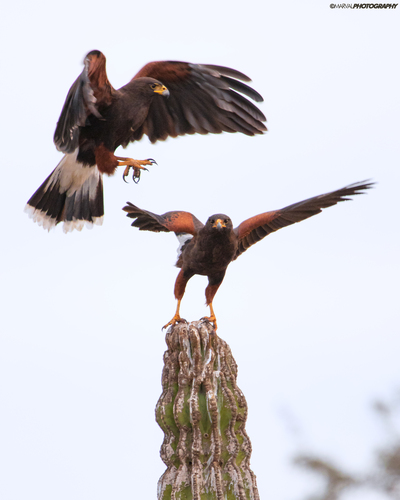 Harris's Hawk
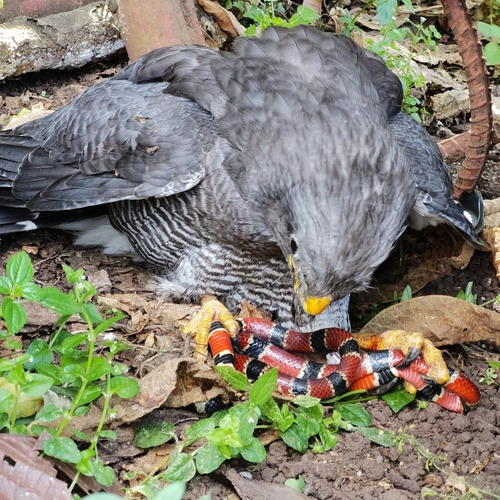 Grey Hawk
In short
The most reliable field mark to separate Harris's Hawk from Grey Hawk is the overall plumage and tail pattern, especially in juveniles and in flight. Juvenile Harris's Hawks show a buffy, heavily streaked underside with a pale panel on the outer wing and a broad white tail base and tip, while juvenile Grey Hawks have a streaked or spotted underside, bold facial stripes, and a tail with multiple narrow dark bands and white upper tail coverts. Adults are also distinctive: Harris's Hawk is dark brown with chestnut shoulders and thighs, and a striking white rump and tail tip; Grey Hawk is smooth pale gray above and below with a black tail and three white bands. Harris's Hawk is much heavier and bulkier, often seen in cooperative groups, whereas Grey Hawk is smaller, slimmer, and more solitary. Always check tail pattern and underwing in flight for quick separation.
Identification tips
- Juvenile underwing and tail pattern: In flight, juvenile Harris's Hawks show a buffy, streaked underwing with a pale panel on the outer primaries and a broad white base and tip to the tail. Juvenile Grey Hawks have a streaked or spotted underside, bold facial stripes, and a tail with multiple narrow dark bands and white upper tail coverts. Use these marks for any streaky, brownish raptor.
- Adult tail pattern: Harris's Hawk always shows a broad white base and tip to the tail, with a dark band in between. Grey Hawk has a black tail with three white bands (one wider), and white at the tip, but no broad white base.
- Chestnut plumage: Only Harris's Hawk has rich chestnut on the shoulders and thighs, visible in all ages and especially obvious in adults. Grey Hawk is always plain gray or brown (juvenile), never rufous.
- Overall color: Harris's Hawk is dark brown overall (adults), while Grey Hawk is smooth pale gray above and below (adults). Juvenile Harris's is streaked buff and brown; juvenile Grey Hawk is brown above, streaked/spotted below.
- Facial pattern: Juvenile Grey Hawk shows bold facial stripes, lacking in Harris's Hawk of any age.
- White upper tail coverts: Juvenile Grey Hawk shows obvious white at the base of the tail (upper tail coverts), a useful mark when perched or in flight. Harris's Hawk shows a white rump and tail tip, but not the same pattern.
- Size and bulk: Harris's Hawk is much larger and heavier (843.7g vs 475g), with a bulkier, more robust appearance. If you see two similar hawks together, the larger is likely Harris's.
- Flight silhouette: Harris's Hawk has longer wings and tail, and appears bulkier in flight. Grey Hawk is more compact, with broader, rounded wings and a long tail, but is smaller overall.
- Leg color: Grey Hawk has orange-yellow legs, which can be visible at close range. Harris's Hawk's leg color is less distinctive.
- Group behavior: Harris's Hawk is often seen in groups, perching or hunting together. Grey Hawk is solitary or in pairs.
- Habitat: Harris's Hawk prefers open, arid, or scrubby areas; Grey Hawk is more likely in wooded edges or near water.
- Vocalization: A shrill, whistled 'kleee-ooo' is diagnostic for Grey Hawk. Harris's Hawk's calls are less distinctive.
- Perched posture: Harris's Hawk often appears more upright and bulky, sometimes with multiple birds on a single perch. Grey Hawk is slimmer and more solitary.
- Subspecies variation: Southern Harris's Hawks (P. u. unicinctus) may show more patterned, lighter underwings as adults, but always retain chestnut and tail pattern. Grey Hawk does not show this variation.
- Season and molt: Juvenile marks are most useful in late summer and fall, when young birds are dispersing and most likely to be confused.
Size
Harris's Hawk is significantly larger and heavier, averaging 843.7g, while Grey Hawk is much lighter (average 475g). Harris's Hawk appears bulkier and more robust in both perched and flight views, with longer wings and tail, especially in the northern subspecies. Grey Hawk is smallish for a Buteo, with a relatively short wingspan but a long tail, and a more compact, agile appearance. In the field, Harris's Hawk will look noticeably bigger and more imposing, especially when seen together or near similar perches.
Plumage
- Juveniles:
- Harris's Hawk: Underparts are heavily streaked with white or buff, appearing much lighter than adults. In flight, the underside of the wings is buff with brown streaking, and the primaries show a pale panel (whitish except at tips). The tail has a broad white base and tip, with a paler band than adults. Chestnut plumage on the shoulders and thighs is present even in young birds.
- Grey Hawk: Juveniles have dark brown upperparts, a streaked or spotted white underside, bold facial stripes, and white upper tail coverts. The tail is brown with numerous narrow dark bands, lacking the broad white base and tip of Harris's. The overall impression is of a streaky, brownish bird with strong face pattern and banded tail.
- Adults:
- Harris's Hawk: Uniform dark brown body with rich chestnut on shoulders and thighs, and a very distinctive tail with a broad white base and tip. The underwing is solidly dark in northern birds, more patterned in southern ones.
- Grey Hawk: Smooth, unpatterned pale gray above and below, with a black tail featuring three white bands (one wider than the others) and white at the tip. Legs are orange-yellow. No chestnut or rufous tones.
- Flight views: Harris's Hawk shows a striking white rump and tail tip, chestnut wing patches, and a bulkier silhouette. Grey Hawk is more uniform gray, with a strongly banded black-and-white tail and no rufous tones.
Behaviour
Harris's Hawk is unique among raptors for its cooperative hunting and nesting behavior, often seen in groups of three or more birds working together to hunt or defend a nest. They may perch together, fly in formation, or share duties at the nest. Grey Hawk is much more solitary, typically seen alone or in pairs, and hunts from high perches or by gliding low over open areas. Harris's Hawk is more likely to be seen in open, arid habitats moving as a group, while Grey Hawk is more secretive and agile, often making quick, direct flights from cover.
Habitat
Harris's Hawk prefers open, arid habitats such as deserts, scrublands, and savannas, often nesting in small trees, shrubs, or cacti. They are most common in the southwestern US through to South America, especially in areas with scattered perches. Grey Hawk is found in open country and forest edges, from Costa Rica north into the southwestern US, but is more closely associated with riparian woodlands, forest edges, and areas with taller trees. Overlap can occur in the southwestern US and northern Mexico, but Harris's Hawk is more likely in drier, more open terrain, while Grey Hawk favors wooded edges and river corridors.
Voice
Grey Hawk has a distinctive, shrill, whistled 'kleee-ooo' call, which can be a useful clue, especially in breeding season. Harris's Hawk's vocalizations are less distinctive and not described in detail in the provided sources, so voice is more useful for confirming Grey Hawk than for ruling out Harris's.