

Gyr Falcon vs Peregrine Falcon
Falco rusticolus versus Falco peregrinus
Play a quiz with Gyr Falcon and Peregrine Falcon
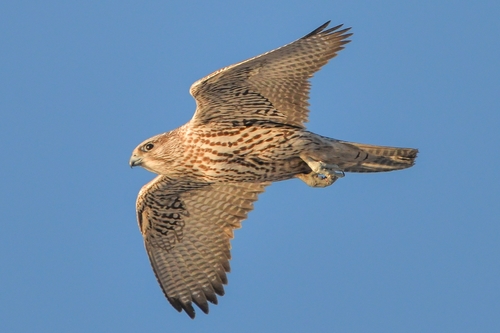 Gyr Falcon
 Peregrine Falcon
In short
The most reliable field mark between Gyr Falcon and Peregrine Falcon is overall size and structure: Gyr Falcon is much bulkier, with broader wings and a longer tail, while Peregrine is more compact and angular. In flight, Gyr Falcons appear heavy and powerful, lacking the crisp, pointed wing shape and deep chest of Peregrine. Plumage is variable in Gyr Falcon, especially among immatures, but brown morphs lack the Peregrine's strong facial markings. Immature birds can be confusing, but look for the Gyr's streaked nape and crown and absence of a bold malar stripe. Use structure and flight style first, then check for facial pattern and overall bulk.
Identification tips
- Size and bulk: Gyr Falcon is much larger and heavier than Peregrine, with a bulkier body, broader wings, and longer tail. Use this as your first check, especially when seen perched or next to other birds.
- Wing shape in flight: Gyr Falcon's wings are broader and less pointed than Peregrine's, giving a heavier, more buteo-like impression. Peregrine's wings are long, narrow, and sharply pointed.
- Facial pattern: Peregrine of all ages shows a bold black cap and a sharply defined dark malar stripe ('moustache'). Gyr Falcon lacks a strong malar stripe and cap; the face is paler and more blended, especially in brown morphs.
- Juvenile/immature plumage: Juvenile Gyr Falcons are darker and browner overall, with cream streaking on the nape and crown, and lack the crisp facial markings of juvenile Peregrines. Juvenile Peregrines have a strong dark hood and well-marked moustache, with finely barred underparts.
- Adult plumage variation: Gyr Falcon is highly variable: white morphs are unique (never matched by Peregrine), brown morphs are streaked and lack strong facial marks, black morphs have black-spotted underparts. Peregrine adults are always blue-grey above, with barred white underparts and a black head.
- Underpart markings: Gyr Falcon (especially black morph) shows black spots below, while Peregrine is finely barred. Brown and silver Gyrs are streaked below, not barred.
- Flight style: Gyr Falcon flies with heavy, powerful wingbeats and less agility than Peregrine. Peregrine is fast, agile, and often seen stooping at high speed.
- Habitat context: In Arctic tundra or far north, Gyr Falcon is more likely. In temperate, urban, or widespread open habitats, Peregrine is much more likely.
- Perched jizz: Gyr Falcon appears massive and long-tailed when perched, with a large head and thick legs. Peregrine is more compact, with a deep chest and shorter tail.
- Sexual dimorphism: Both species have larger females, but even a female Peregrine is smaller and less bulky than a male Gyr Falcon.
- Color morphs: Only Gyr Falcon shows white or silver morphs; Peregrine is never white or pale grey overall.
- Facial contrast at distance: At a distance, Peregrine's face appears boldly marked, while Gyr Falcon's face is pale and less contrasting.
- Nape and crown: Gyr Falcon (especially juveniles) shows cream streaking on nape and crown; Peregrine has a solid dark cap.
- Tail length: Gyr Falcon's tail is longer and broader, contributing to its overall bulk; Peregrine's tail is shorter and more squared.
- When marks fail: In poor light or at great distance, rely on structure and flight style first, then habitat and range. If the bird is all-white or very pale, it is a Gyr Falcon.
Size
Gyr Falcon is the largest falcon, with males 48–61 cm long (wingspan 110–130 cm, weight 805–1350 g) and females even larger (51–65 cm, wingspan 124–134 cm, weight 1180–2100 g). Peregrine Falcon is smaller and more compact: males and females are both substantially lighter and shorter, with a crow-sized build. In the field, Gyr Falcon looks noticeably bulkier, with broader wings and a longer tail, while Peregrine is more streamlined and pointed. Even a large female Peregrine will look slighter and less massive than a Gyr Falcon of either sex.
Plumage
Juvenile and immature Gyr Falcons are darker and browner than adults, with cream streaking on the nape and crown and lacking a sharply defined malar stripe or cap. This contrasts with juvenile Peregrines, which show a strong dark hood and a well-marked malar stripe ('moustache'), as well as finely barred underparts. Adult Gyr Falcons are highly variable, ranging from all-white (unique among falcons) to dark brown or blackish, but even the brown morphs lack the crisp facial markings of Peregrine. Black morph Gyrs have black-spotted underparts, not the fine barring of Peregrine. Silver morph Gyrs are pale grey, but always larger and broader-winged. Peregrine adults are blue-grey above, with a black head and bold moustachial stripe, and barred white underparts. In all ages, the Gyr's face appears paler and less sharply marked than Peregrine's. No sex-based color differences in either species, but Gyr juveniles are always darker than adults.
Behaviour
Gyr Falcons typically hunt over open tundra or Arctic landscapes, often flying low and powerfully, sometimes harassing large prey or even other raptors. Their flight is heavy and direct, with less of the rapid, agile stooping typical of Peregrine. Peregrine Falcons are famous for their high-speed stoops and aerial agility, often hunting birds in open areas, wetlands, or even urban settings. Gyr Falcons may harass intruders near their nests aggressively, including large mammals. Both species are fierce predators, but Peregrine is more likely to be seen hunting in dramatic dives.
Habitat
Gyr Falcon is a high-latitude specialist, breeding on Arctic coasts, tundra, and islands of northern North America and Siberia, usually nesting on cliffs and rarely venturing far south except as a winter vagrant. Peregrine Falcon is much more cosmopolitan, found on every continent except Antarctica, and occupies a wide range of open habitats, including cities, wetlands, cliffs, and fields. In most temperate or urban settings, a large falcon is far more likely to be a Peregrine than a Gyr.