
Gull-billed Tern vs Caspian Tern
Gelochelidon nilotica versus Hydroprogne caspia
Play a quiz with Gull-billed Tern and Caspian Tern
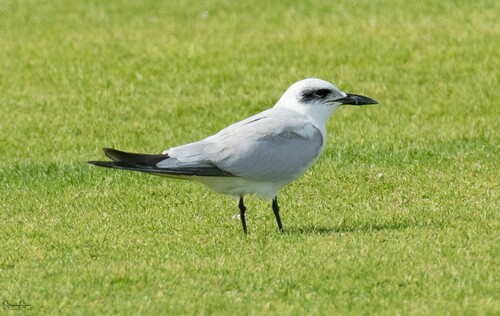 Gull-billed Tern
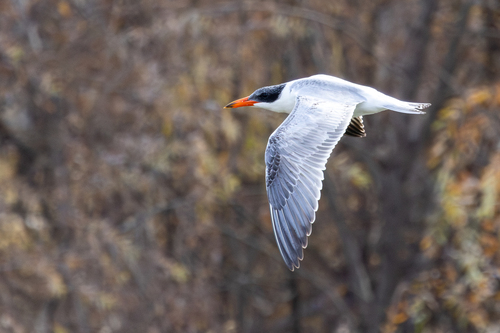 Caspian Tern
In short
The most reliable field mark between Gull-billed Tern and Caspian Tern is the bill: Gull-billed has a short, thick, black, gull-like bill, while Caspian’s bill is much longer, heavier, and bright red-orange with a dark tip. Caspian Tern is also much larger overall, with a longer, broader wingspan and heavier build. In flight, Caspian shows dark primary feathers on the underwing and a less forked tail, whereas Gull-billed has broad wings but lacks the Caspian’s strong underwing contrast. Adult summer plumages both show a black cap, but bill color and size are the quickest separation. Winter and juvenile plumages can be confusing, but bill shape and size remain reliable, especially at a distance.
Identification tips
- Bill color and shape: Gull-billed Tern has a short, thick, black bill with a blunt tip, always dark in all ages and seasons. Caspian Tern’s bill is long, thick, and bright red-orange with a dark tip; this is the single most reliable field mark at any distance.
- Size and structure: Caspian is much larger and heavier, with a longer wingspan and a bulkier, more powerful build. Gull-billed is only slightly larger than a Sandwich Tern, with a more compact, robust body.
- Wing pattern in flight: Caspian Tern shows dark primary feathers on the underwing, visible especially in flight. Gull-billed lacks this strong underwing contrast; its wings are broad but uniformly pale above and below.
- Tail shape: Caspian’s tail is less forked than most terns, appearing almost square in flight. Gull-billed’s tail shape is not strongly diagnostic in these notes, but it is not as squared as Caspian’s.
- Cap pattern in winter: In non-breeding plumage, Gull-billed loses the full black cap and shows a dark patch through the eye (mask), while Caspian retains a black cap with white streaking on the forehead. This can help at close range.
- Leg color: Both have black legs, so this is not helpful for separation.
- Juvenile confusion: Juvenile Gull-billed can look similar to juvenile Sandwich Tern, but not to Caspian due to bill color and size. Caspian juveniles are not described in detail here, but their size and bill remain distinctive.
- Feeding behavior: Gull-billed often hawks insects over fields and marshes, rarely plunge-diving. Caspian is more likely to be seen plunge-diving for fish over open water.
- Perched jizz: Caspian’s massive bill and head are striking when perched, dwarfing the more compact Gull-billed.
- Habitat context: Gull-billed may be found hunting far from water, over fields or even roads; Caspian is almost always near large bodies of water.
- Vocalization: Gull-billed’s call is a sharp "ker-wik"; Caspian’s is a loud, croaking call. If heard well, this is a strong separator.
- Seasonal context: In North America, Gull-billed is rare and local, especially inland, while Caspian is more widespread on large water bodies. In Eurasia, check habitat and bill carefully.
- Pitfalls: At long range, both can appear pale with black caps, but bill color and size are visible even at moderate distances. Avoid relying solely on cap or leg color.
- In mixed colonies: If seen together, Caspian will tower over Gull-billed and show a much longer, redder bill.
- Flight style: Caspian’s flight is heavy and direct; Gull-billed is more buoyant and agile, especially when foraging over land.
Size
Caspian Tern is dramatically larger: adults weigh about 634 g [wikidata], with a length of 48–60 cm and a wingspan of 127–145 cm [wikipedia]. Gull-billed Tern is much lighter (150–292 g), shorter (33–42 cm), and has a wingspan of 76–91 cm [wikipedia]. In the field, Caspian appears bulkier, with a massive head and bill, while Gull-billed is only slightly larger than most medium terns and appears more compact.
Plumage
- Juvenile/immature plumage: No detailed juvenile wing pattern is described for either species in these notes, but both lose the black cap in winter. Gull-billed Tern juveniles and winter adults show a faint dark mask through the eye, while Caspian Tern retains a black cap but with white streaking on the forehead in winter.
- Adult breeding plumage: Both have black caps, white underparts, and pale grey upperwings. Gull-billed Tern’s bill is black, short, and thick; Caspian’s is long, thick, and red-orange with a dark tip. Caspian’s underwings show dark primaries, especially in flight, while Gull-billed’s wings are broad but lack this strong contrast.
- Tail: Caspian’s tail is less forked than most terns, but Gull-billed’s tail shape is not described as diagnostic here.
- Legs: Both have black legs, not a useful separator.
Behaviour
Gull-billed Tern often feeds by hawking insects over fields, marshes, and even brushy areas, rarely plunge-diving for fish. Caspian Tern is more typical of large terns, often plunge-diving for fish over water. In flight, Caspian appears heavy and powerful, with deep, steady wingbeats and a less agile jizz than the more buoyant, marsh-tern-like Gull-billed. Perched, Caspian’s massive bill and bulk are obvious.
Habitat
Both species nest on the ground near water, but Gull-billed Tern is more often found over freshwater marshes, wet fields, and sometimes far from open water, especially in Eurasia. In North America, Gull-billed is more coastal. Caspian Tern is usually associated with large lakes, rivers, or coastal habitats, rarely venturing far from open water. If seen hunting over dry fields or brush, Gull-billed is much more likely.
Voice
Gull-billed Tern gives a sharp, characteristic "ker-wik" call. Caspian Tern’s call is a loud, harsh, heron-like croak. The difference is marked: Caspian’s voice is deeper and more resonant, while Gull-billed’s is sharper and more tern-like.