
Gull-billed Tern vs Black Tern
Gelochelidon nilotica versus Chlidonias niger
Play a quiz with Gull-billed Tern and Black Tern
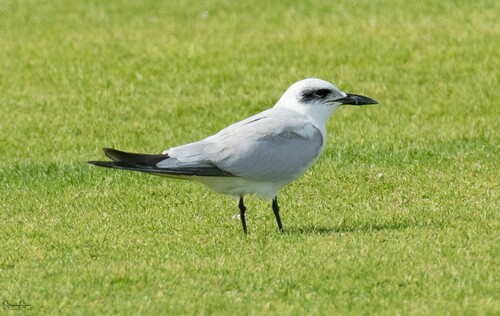 Gull-billed Tern
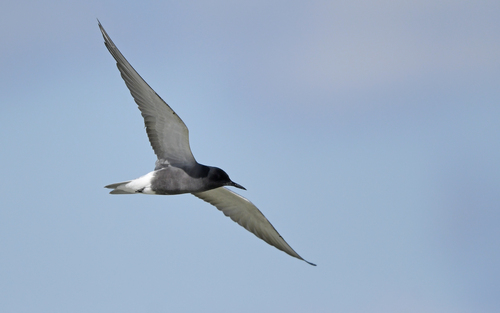 Black Tern
In short
The most reliable way to separate Gull-billed Tern from Black Tern is by structure: Gull-billed Tern is much larger, with a thick, short, gull-like bill and robust body, while Black Tern is smaller, slimmer, and has a slender, pointed bill. In flight, Black Tern appears agile and buoyant, with a distinctly slim build, while Gull-billed Tern looks broader-winged and heavier. Juvenile and non-breeding plumages can be confusing, but bill shape and size differences remain constant. Both species can show dark caps or face markings in non-breeding plumage, so relying on overall structure and bill is safest.
Identification tips
- Bill shape and size: Gull-billed Tern has a thick, short, blunt, gull-like bill (all ages/seasons), while Black Tern has a slender, pointed, slightly decurved bill nearly as long as its head. This is the most consistent field mark.
- Overall size and bulk: Gull-billed Tern is much larger and more robust than Black Tern; look for a heavy body and broad wings versus the Black Tern's slim, delicate build.
- Leg length: Gull-billed Tern has noticeably long legs, especially when standing; Black Tern's legs are short and less obvious.
- Flight style: Gull-billed Tern flies with steady, powerful wingbeats and appears broad-winged; Black Tern is agile, buoyant, and erratic in flight, with a slim silhouette.
- Breeding plumage: Black Tern is dark overall (black head, neck, belly, and dark grey back), while Gull-billed Tern is pale grey above and white below with a black cap.
- Non-breeding plumage: Both species lose the full black cap, but Gull-billed Tern shows a dark patch through the eye and a pale head; Black Tern has a dark cap but a white face, and the dark does not extend below the eye.
- Juvenile plumage: Juvenile Gull-billed Tern resembles non-breeding adults with a faint mask; juvenile Black Tern has a broad white collar and subtle grey-brown smudges on the breast sides, but these are not always obvious.
- Upperwing pattern: Neither species shows a strong, distinctive upperwing pattern (such as a black 'W' or bold panel) in any age; separation relies on structure and overall coloration.
- Tail shape: Black Tern has a short, square tail that is not deeply forked; Gull-billed Tern's tail is also not deeply forked but appears proportionally longer due to its larger size.
- Habitat context: If the bird is foraging over dry ground, fields, or brush, Gull-billed Tern is likely; if it is over freshwater marshes or lakes, especially in a flock, Black Tern is more probable.
- Perched posture: Gull-billed Tern stands tall with long legs and a thick bill; Black Tern perches low, with short legs and a slim bill.
- Voice: Listen for the 'ker-wik' of Gull-billed Tern versus the high 'kik' of Black Tern, especially if the bird is not seen well.
- Feeding behavior: Gull-billed Tern often picks prey from the ground or low vegetation, while Black Tern is almost always seen feeding over water.
- Flock behavior: Black Tern often gathers in noisy flocks, especially in migration; Gull-billed Tern is more often seen singly or in small groups.
- Pitfalls: Non-breeding and juvenile plumages can be confusing due to similar dark face markings; always check bill shape and overall size first, and use habitat and behavior as supporting clues.
Size
Gull-billed Tern is substantially larger and heavier than Black Tern. Gull-billed Tern measures 33–42 cm in length with a wingspan of 76–91 cm and a body mass of 150–292 g [wikipedia]; Black Tern is much smaller at 25 cm in length, 61 cm wingspan, and about 60 g in mass [wikidata]. The size difference is striking in direct comparison, with Gull-billed Tern appearing bulkier and more robust, while Black Tern is delicate and light.
Plumage
Juvenile and non-breeding birds of both species can show confusingly similar face patterns, with a dark cap or mask. However, Black Tern (all ages) is much darker overall in breeding plumage, with a black head, neck, and belly, and a dark grey back, whereas Gull-billed Tern in breeding plumage is pale grey above and white below with a black cap. In non-breeding plumage, Gull-billed Tern loses the full black cap, showing a dark patch through the eye, and juveniles have a faint mask but otherwise resemble winter adults. Black Tern in non-breeding plumage becomes much paler, with grey upperparts, a white face, and a dark cap that does not extend below the eye. Juvenile Black Tern has a broad white collar and greyish-brown smudges on the breast sides, but these are subtle. In flight, Black Tern always looks slim and dark-bodied, while Gull-billed Tern is pale and broad-winged. No distinctive upperwing panel or black 'W' pattern is described for either species at any age.
Behaviour
Gull-billed Tern typically forages by flying over open ground, marshes, or even brushy areas, taking insects and small prey from the surface or on the wing, but does not plunge-dive like many terns. Black Tern is more aerial and agile, foraging over water by picking insects or small fish from or near the surface, with erratic, buoyant flight. Black Tern rarely lands on the ground away from water, while Gull-billed Tern is often seen walking or standing on open flats or levees.
Habitat
Gull-billed Tern is found in a wide range of open habitats, including coastal saltwater areas, lakes, marshes, and sometimes wet fields or even dry ground, especially in North America where it is mostly coastal. Black Tern is strongly tied to freshwater marshes and lakes during breeding, rarely venturing far from water, and in migration or winter is found along coasts or large inland waters. If seen away from water, especially in dry fields, Gull-billed Tern is much more likely.
Voice
Gull-billed Tern gives a characteristic 'ker-wik' call, which is distinctive if heard. Black Tern has a high-pitched 'kik' call, and large flocks can be very noisy. The calls are quite different in tone and quality, but both are high-pitched compared to gulls.