

Greylag Goose vs Lesser White-fronted Goose
Anser anser versus Anser erythropus
Play a quiz with Greylag Goose and Lesser White-fronted Goose
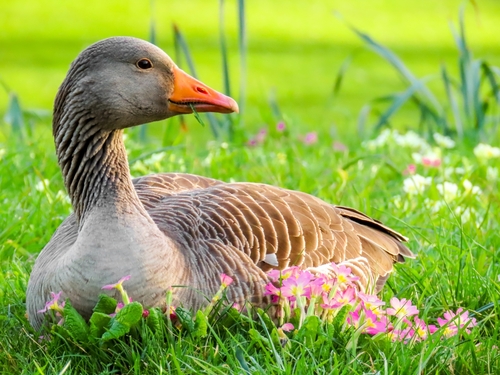 Greylag Goose
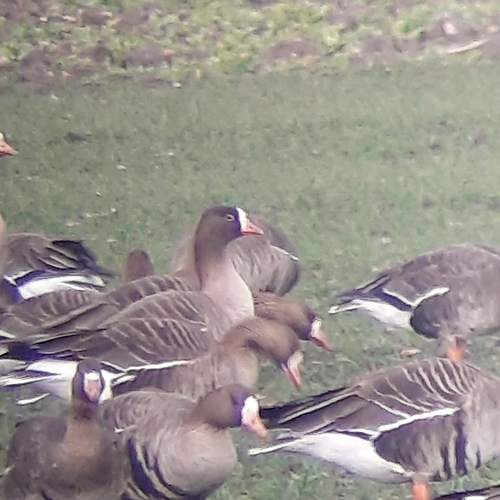 Lesser White-fronted Goose
In short
The most reliable way to separate Greylag Goose from Lesser White-fronted Goose is by size and bill/leg color: Greylag is much larger, with a bulky build, pale orange bill, and pink legs, while Lesser White-fronted Goose is distinctly smaller, with a short, stubby bill, bright orange legs, and a conspicuous white blaze on the face reaching up to the crown. In flight or at rest, Greylag shows pale bluish-grey upperwing coverts, whereas Lesser White-fronted Goose has mouse-grey coverts. Juveniles of both lack the full adult belly barring, but Lesser White-fronted still shows the white facial blaze and yellow eye-ring in adults. These features are visible at distance with binoculars and are reliable across all ages and seasons.
Identification tips
- Size is the most immediate clue: Greylag Goose is nearly twice the mass of Lesser White-fronted Goose and much longer; in any direct comparison, Greylag will look huge and heavy, while Lesser White-fronted Goose is compact and only slightly larger than a Mallard.
- Bill shape and color: Greylag has a long, pale orange bill with a gentle curve, while Lesser White-fronted Goose has a short, stubby, pinkish bill. This is especially clear at close range or with good optics.
- Leg color: Greylag's legs are pink, while Lesser White-fronted Goose has bright orange legs. This is a reliable field mark when birds are on land or swimming.
- Facial blaze: Lesser White-fronted Goose of all ages shows a bright white blaze at the bill base, extending up to the crown in adults. Greylag never has a white blaze; its face is plain grey-brown.
- Eye-ring: Adult Lesser White-fronted Goose has a conspicuous yellow eye-ring, absent in Greylag. This can be seen at moderate range in good light.
- Upperwing coverts in flight: Greylag shows pale bluish-grey upperwing coverts, contrasting with darker flight feathers and a pale rump. Lesser White-fronted Goose has mouse-grey upperwing coverts, which appear darker and less contrasting. This is best seen in flight or when stretching wings.
- Belly barring: Both species develop black bars on the belly as adults, but Lesser White-fronted Goose's are broader and more striking. Juveniles of both lack strong barring, so do not rely on this alone in young birds.
- Neck pattern: Greylag adults have a distinctive 'concertina' pattern of feather folds on the neck, which Lesser White-fronted lacks.
- General plumage: Greylag is overall paler, with a mottled and barred grey-brown appearance and a pale breast and belly. Lesser White-fronted Goose is darker, more compact, and has a neater appearance.
- Behavior and flocking: Greylag is often in large, noisy flocks in open areas, while Lesser White-fronted Goose is scarcer, shyer, and usually in small groups or at the edge of mixed flocks.
- Vocalization: Greylag's call is deep, loud, and honking, dominating mixed flocks. Lesser White-fronted Goose is quieter and higher-pitched.
- Habitat context: In most of Europe, Greylag is common and widespread, while Lesser White-fronted Goose is rare and localized. If you are in an urban park or lowland farmland, Greylag is far more likely.
- Juvenile confusion: Young Greylag lack black belly spots and have greyish legs, but still show the large size and plain face. Young Lesser White-fronted Goose still shows the white blaze, even if faint, and is much smaller.
- Mixed flocks: If you see a small, compact goose with a white face among Greylags, check for Lesser White-fronted Goose, but confirm size, bill, and leg color before concluding.
- Pitfalls: Do not confuse the white on Greylag's rump or flank with the facial blaze of Lesser White-fronted Goose; only the latter has a white face and yellow eye-ring.
Size
Greylag Goose is nearly twice as heavy as Lesser White-fronted Goose (average mass 3464.5g vs 1797g [wikidata]), and is much longer (74–91 cm vs 53–66 cm [wikipedia]). Greylag appears large, bulky, and heavy-bodied, while Lesser White-fronted is only slightly larger than a Mallard and looks compact and neat. In mixed flocks, Greylag stands out as the largest Anser, while Lesser White-fronted is noticeably smaller and more delicate.
Plumage
Juvenile and immature birds: Both species lack strong belly barring as juveniles, but Lesser White-fronted Goose always shows a white blaze at the bill base, even in young birds, and has a yellow eye-ring in adults. Greylag juveniles have a plain, grey-brown head and lack black speckling on the underparts, with greyish legs. In flight, Greylag shows pale bluish-grey upperwing coverts contrasting with darker flight feathers and a pale rump, while Lesser White-fronted Goose has mouse-grey upperwing coverts and a white face. Adults: Greylag has mottled grey-brown plumage, a pale grey forewing, and a white line on the upper flanks, with a pale orange bill and pink legs. Lesser White-fronted Goose adults have a bright white face blaze extending to the crown, a yellow eye-ring, bright orange legs, and broad black belly bars. The bill is short and stubby, pinkish, and the overall plumage is darker and more compact. Both species have some black barring on the belly as adults, but it is broader and more striking in Lesser White-fronted Goose.
Behaviour
Greylag Goose is generally more confiding and often found in large, noisy flocks, grazing openly in fields or wetlands. Lesser White-fronted Goose is shyer, more wary, and usually found in smaller groups, often associating with other geese but keeping to the edges of flocks. Greylag's movements are slower and heavier, matching its bulk, while Lesser White-fronted Goose is more agile and quick-footed.
Habitat
Both species are found in wetlands, lakes, and open fields, but Greylag Goose is far more widespread and common across Europe, often in lowland agricultural areas and urban parks. Lesser White-fronted Goose is a scarce breeder in Europe, mostly in the far north or as a rare migrant, and is much less likely to be seen outside migration or wintering hotspots. If you see a large flock of geese in farmland, Greylag is much more likely; Lesser White-fronted Goose is rare and usually mixed with other species.
Voice
Greylag Goose has a loud, cackling call, often described as 'aahng-ung-ung', which is deep and honking, similar to domestic geese. Lesser White-fronted Goose's calls are not described in detail in the notes, but are generally higher-pitched and less resonant than Greylag. In mixed flocks, Greylag's voice dominates and is more likely to be heard.
Greylag Goose · Lesser White-fronted Goose · My Tricky Birds