

Greylag Goose vs Barnacle Goose
Anser anser versus Branta leucopsis
Play a quiz with Greylag Goose and Barnacle Goose
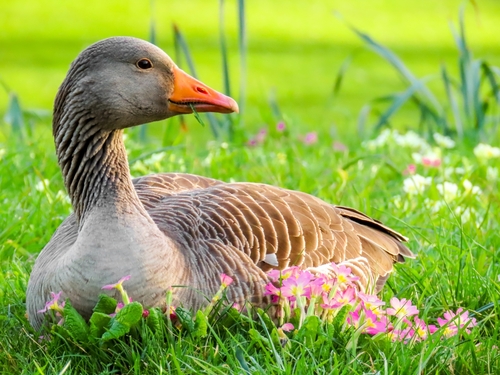 Greylag Goose
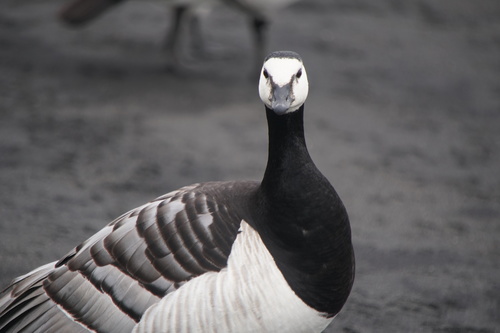 Barnacle Goose
In short
The most reliable way to separate Greylag Goose from Barnacle Goose is by overall plumage: Greylag is a large, pale grey-brown goose with an orange bill and pink legs, while Barnacle Goose is much smaller, strikingly patterned with a black neck and head, white face, and silvery barred upperparts. In flight, Greylag shows pale grey forewings and rump, contrasting with darker flight feathers, while Barnacle Goose flashes a white rump and silvery underwings. Juveniles of both are similar to adults but lack some adult markings. Structure and size are also key: Greylag is nearly twice as heavy as Barnacle, with a much larger, stouter bill. Confusion is most likely at a distance or in mixed flocks, but careful attention to head pattern, bill color, and overall size will resolve most cases.
Identification tips
- Head and neck pattern: Barnacle Goose has a striking black neck and head with a white face; Greylag Goose has a uniform grey-brown head and neck with no white face patch. This is the quickest way to separate them at any age.
- Bill color and shape: Greylag's bill is large, orange, and triangular; Barnacle's is small, black, and stubby. Bill color is visible even at a distance in good light.
- Leg color: Greylag has pink legs; Barnacle always has black legs. This is useful when birds are on land or swimming close by.
- Body size and bulk: Greylag is nearly twice as heavy and much bulkier than Barnacle. If both species are present, the size difference is obvious. Lone birds require caution, but Greylag always looks heavier and more robust.
- Wing and back pattern in flight: Greylag shows pale grey forewings and rump, contrasting with darker flight feathers; Barnacle flashes a white rump in a V-shape and silvery underwing linings. These are best seen in flying flocks or when birds stretch their wings.
- Breast and belly: Greylag's breast and belly are pale with variable black spotting (adults); Barnacle's belly is clean white, with no spotting.
- Juvenile differences: Greylag juveniles lack black speckling on the underparts and have greyish legs; Barnacle juveniles have rounded mantle and flank feathers but retain the black-and-white head pattern.
- Neck texture: Adult Greylag shows a 'concertina' pattern of feather folds on the neck, absent in Barnacle.
- Upperparts: Greylag is plain grey-brown above with pale fringes; Barnacle is barred silver-grey and black, giving a much more patterned look.
- Voice: Greylag's call is a deep, cackling honk; Barnacle's is higher-pitched and yapping. Use voice when visibility is poor.
- Habitat context: Greylag is more likely inland or in agricultural fields; Barnacle prefers coastal grasslands, but both can overlap in winter.
- Flock structure: Greylag flocks are often larger and looser; Barnacle flocks are tighter and more compact.
- Pitfalls: At great distance, a lone Barnacle can appear greyish and might be mistaken for a small Greylag, especially in poor light. Always check head and bill color first.
- Seasonal variation: Both species are similar year-round; no major seasonal plumage change affects identification.
- Rare morphs: Leucistic Barnacle Geese exist but are very rare; if you see an all-white goose with black bill and legs, consider this possibility but default to structure and bill color for ID.
Size
Greylag Goose is substantially larger, with an average body mass of about 3465 g compared to Barnacle Goose's 1687 g [wikidata]. Greylag measures 74–91 cm in length, while Barnacle is 55–70 cm long [wikipedia]. In the field, Greylag appears bulkier, with a heavier build and a much larger, orange bill. Barnacle Goose is noticeably more compact, with a smaller, stubby black bill and shorter neck. When seen together, the size gap is obvious, but lone birds can be tricky at a distance without a direct comparison.
Plumage
-
Juvenile/immature plumage: Both species' juveniles are similar to adults but with subtle differences. Greylag juveniles lack the black speckling on the breast and belly seen in adults and have greyish legs. Barnacle Goose juveniles resemble adults but have more rounded mantle and flank feathers, lacking the crispness of adult feather edges.
-
Adult plumage: Greylag Goose is overall grey-brown with a paler breast and belly, variable black spotting, and a pale grey forewing and rump visible in flight. The neck shows a 'concertina' pattern of feather folds. The bill is orange, and the legs are pink. Barnacle Goose is sharply marked: black head, neck, and upper breast, with a white face and belly. The back and wings are silver-grey with black-and-white barring. In flight, Barnacle Goose shows a V-shaped white rump patch and silvery underwing linings, contrasting with Greylag's pale grey forewing and rump. Barnacle's legs and bill are black, never pink or orange.
Behaviour
Both species are social and often seen in flocks, but Greylag Goose tends to form larger, noisier groups and is more likely to be seen grazing in open fields. Barnacle Goose flocks are tighter and often feed on short grass or coastal turf. Greylag pairs are long-term monogamous, and same-sex pairs are common; these social dynamics are less obvious in the field but may affect flock structure. Flight style is similar, but Greylag's larger size gives it a heavier, slower wingbeat.
Habitat
Greylag Goose is widespread across the Palearctic and often found in a variety of wetland habitats, including lakes, marshes, and agricultural fields. It is more likely to be seen inland. Barnacle Goose tends to favor coastal areas, estuaries, and grassy islands, especially during migration and winter. However, both species can overlap in open wet grasslands, especially in wintering areas, so habitat alone is not always diagnostic.
Voice
Greylag Goose gives a loud, cackling 'aahng-ung-ung' call, reminiscent of domestic geese, and flocks can sound like baying hounds. Barnacle Goose is not described in detail here, but its calls are generally higher-pitched and more yapping compared to the deeper, honking notes of Greylag. Voice can help when birds are flying overhead or in poor light, but is less reliable than plumage or structure.