

Grey Plover vs Pacific Golden Plover
Pluvialis squatarola versus Pluvialis fulva
Play a quiz with Grey Plover and Pacific Golden Plover
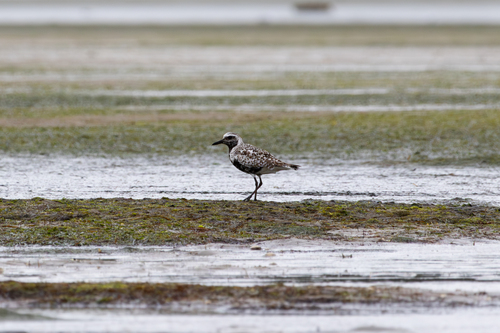 Grey Plover
 Pacific Golden Plover
In short
The most reliable field mark to separate Grey Plover from Pacific Golden Plover is seen in flight: Grey Plover of all ages shows black axillaries (the 'armpit' feathers at the base of the underwing), while Pacific Golden Plover never does. Juvenile and first-winter Grey Plovers also have a distinctive upperwing pattern with blacker backs and creamy feather edges, but the axillary mark is diagnostic for all ages. Structurally, Grey Plover is bulkier with a heavier, longer bill and a more robust jizz, while Pacific Golden Plover is slimmer and more delicate. Breeding plumage can be confusing as both show black faces and bellies with white borders, but Grey Plover is black-and-white above, while Pacific Golden Plover is gold-spangled. In nonbreeding plumage, Grey Plover is plainer grey, and Pacific Golden Plover is warmer and more golden-brown. Size and structure, along with the underwing pattern in flight, are the most reliable cues.
Identification tips
- Black axillaries in flight (all ages): Grey Plover always shows solid black axillaries and inner flanks at the base of the underwing, visible when the bird takes off or flies overhead. Pacific Golden Plover never shows this; its underwing is pale.
- Size and bulk: Grey Plover is larger, bulkier, and heavier-bodied, with a thick neck and a more upright stance. Pacific Golden Plover is noticeably slimmer and more delicate, especially in mixed flocks.
- Bill structure: Grey Plover has a heavier, longer bill (24–34 mm), which appears thick and blunt-tipped. Pacific Golden Plover's bill is finer and shorter, more in proportion to its smaller head.
- Breeding plumage above: Grey Plover is black-and-white spotted above, with a white rump and barred tail. Pacific Golden Plover is gold and black above, with a darker rump and less contrast in the tail.
- Breeding plumage below: Both species have black faces and bellies with a white border, but Grey Plover's black is more extensive and solid. Female Pacific Golden Plover has a mottled, less solid black breast.
- Nonbreeding (winter) plumage: Grey Plover is plain grey above with a white belly and grey-speckled breast. Pacific Golden Plover is warmer, with brown, grey, and yellowish tones and a more golden or buffy appearance above.
- Juvenile/first-winter upperparts: Grey Plover juveniles are darker above with creamy feather edges, giving a scaly look. Pacific Golden Plover juveniles are gold-spangled and lack the scaly pattern.
- Tail and rump: Grey Plover has a white rump and a tail with black barring, visible in flight. Pacific Golden Plover has a darker rump and less obvious tail barring.
- Leg color: Both species have dark legs, but Pacific Golden Plover's can be gray to black, while Grey Plover's are consistently black.
- Habitat preference: Grey Plover is almost always coastal; Pacific Golden Plover is often found inland on grass, lawns, or even rooftops, especially in the Pacific region.
- Flock composition: If you see a single large, robust plover among smaller, slimmer golden plovers, it's likely a Grey Plover.
- Flight style: Grey Plover appears heavier and broader-winged in flight; Pacific Golden Plover is more agile and buoyant.
- Seasonal timing: Both species migrate at similar times, but check local abundance—Pacific Golden Plover is rare in western Europe, while Grey Plover is widespread.
- Sex differences: Only Pacific Golden Plover shows obvious sexual dimorphism in breeding plumage, with females having a mottled black breast.
- When in doubt: Wait for a flight view to check the underwing—black axillaries confirm Grey Plover, pale underwing confirms Pacific Golden Plover.
Size
Grey Plover is noticeably larger and heavier than Pacific Golden Plover. Grey Plover measures 27–30 cm in length with a wingspan of 71–83 cm and can weigh up to 280–345 g before migration [wikipedia], while Pacific Golden Plover is about 25 cm long with a wingspan of 61 cm and weighs around 135 g when lean, up to 200 g pre-migration [wikidata, wikipedia]. In the field, Grey Plover looks bulkier, with a stouter body and a much heavier, longer bill. Pacific Golden Plover appears slimmer, more delicate, and longer-legged relative to its body size.
Plumage
-
Juvenile and First-winter (all ages in flight): Grey Plover always shows black axillaries and inner flanks in flight, a unique mark among Pluvialis plovers. Juveniles and first-winters have blacker backs with creamy feather edges, making them look scaly above. Pacific Golden Plover juveniles are gold-spangled above and lack black axillaries, showing pale underwings instead.
-
Breeding plumage (spring/summer): Both species show black faces and bellies bordered with white, but Grey Plover is black-and-white spotted above with a white rump and tail with black barring. Pacific Golden Plover is gold and black above, with a darker rump and less contrasty tail. Female Pacific Golden Plover has a mottled, less solid black breast.
-
Nonbreeding plumage (fall/winter): Grey Plover is plain grey above with a grey-speckled breast and white belly. Pacific Golden Plover is warmer-toned, with brown, grey, and yellowish patterning above and lighter underparts. Both sexes of Pacific Golden Plover look alike in this plumage.
Behaviour
Both species forage in open areas, but Grey Plover is more likely to be seen on open mudflats and coastal shorelines, often standing upright and appearing more robust. Pacific Golden Plover is more active and can be found feeding on short grass, lawns, or even rooftops in some regions, moving with a lighter, quicker gait. In flight, Grey Plover appears broader-winged and heavier, while Pacific Golden Plover is more agile and buoyant.
Habitat
Grey Plover favors coastal mudflats, estuaries, and sandy beaches during migration and winter, rarely venturing far inland. Pacific Golden Plover, while also found on coasts, is more likely to be seen inland on open grassy areas, parks, golf courses, and even urban environments, especially in the Pacific region. Habitat overlap occurs on migration, but Pacific Golden Plover is more adaptable to human-altered landscapes.