
Grey Plover vs European Golden Plover
Pluvialis squatarola versus Pluvialis apricaria
Play a quiz with Grey Plover and European Golden Plover
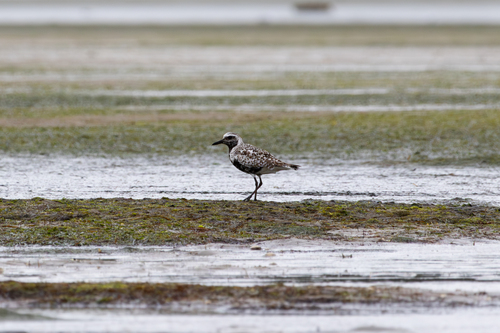 Grey Plover
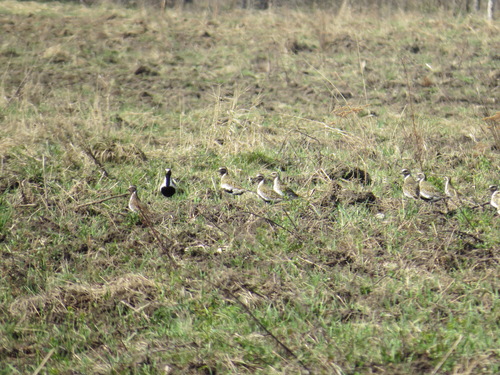 European Golden Plover
In short
The most reliable field mark to separate Grey Plover from European Golden Plover is seen in flight: Grey Plover of all ages shows solid black axillaries (armpit feathers), while European Golden Plover has pale (white to grey) axillaries. This underwing feature is diagnostic even for juveniles and immatures. Structurally, Grey Plover is bulkier with a heavier bill, and in breeding plumage, it shows a striking black belly and face with a white border, unlike the golden spangled upperparts and S-shaped white flank line of European Golden Plover. In non-breeding and immature plumages, both can appear greyish, but careful attention to bill size, underwing pattern, and overall shape will separate them. Voice and habitat can help in context but are less reliable than plumage and structure.
Identification tips
- Check the underwing in flight: Grey Plover of all ages shows solid black axillaries (armpit feathers) and inner flanks; European Golden Plover always has pale (white to grey) axillaries. This is the single most reliable field mark, especially for immatures and non-breeding birds.
- Bill size and shape: Grey Plover has a noticeably larger, heavier, and stouter bill (24–34 mm) than European Golden Plover. Use this especially when birds are side-by-side or at close range.
- Overall structure: Grey Plover looks bulkier, with a bigger head and more upright stance. European Golden Plover is thickset but more compact, with a shorter bill and tail.
- Breeding plumage (spring/summer): Grey Plover shows a black face, neck, breast, and belly with a sharp white border and a white rump. European Golden Plover has a black face, breast, and belly, but the border is a white S-shaped line from forehead to flanks, and the upperparts are golden-spangled.
- Non-breeding/immature plumage: Both can look greyish above, but Grey Plover is plainer, colder grey, while European Golden Plover retains some golden tones and spangling. Juvenile Grey Plover has blackish back feathers with creamy edges; juvenile European Golden Plover is more golden-spangled.
- Tail pattern: Grey Plover has a white tail with black barring; European Golden Plover's tail is shorter and less distinctly patterned.
- Leg color: Both species have dark legs; this is not a reliable separator.
- Flight style: Grey Plover appears heavier and more powerful in flight, with broader wings; European Golden Plover is rapid and agile but less heavy-looking.
- Habitat: Grey Plover is more strictly coastal outside the breeding season; European Golden Plover is more likely inland on fields or moorland, especially in winter.
- Voice: If heard, European Golden Plover gives a soft, descending 'tuu' call. Grey Plover's call is not described here.
- Seasonal context: In spring and summer, look for the bold black and white pattern of Grey Plover versus the golden spangling and S-shaped white border of European Golden Plover.
- Pitfalls with immatures: Immature and non-breeding birds of both species can look similar on the ground. Always try to see the underwing in flight or when stretching.
- When side-by-side: The size and bill differences are most obvious when both species are together, but can be subtle at a distance.
- Rump and tail in flight: Grey Plover has a white rump and tail base, visible in flight; European Golden Plover's rump is less contrasting.
- When in doubt: Prioritize the underwing axillary color and bill size for the most reliable separation, especially in poor light or at a distance.
Size
Grey Plover is generally larger and heavier than European Golden Plover. While direct measurements are only available for European Golden Plover (175 g), Grey Plover is described as the largest Pluvialis plover, with a noticeably heavier build and a larger, stouter bill. In the field, Grey Plover appears bulkier, with a more robust head and bill, while European Golden Plover is more compact and thickset, but not as hefty overall.
Plumage
- Juvenile and First-winter: Both species can appear similar on the ground, with greyish or golden-spangled upperparts. The key difference is in flight: Grey Plover (all ages) shows solid black axillaries and inner flanks, while European Golden Plover has pale (white to grey) axillaries. Juvenile Grey Plovers have blacker backs with creamy white edging, while juvenile European Golden Plovers show more golden spangling.
- Non-breeding (winter) adults: Both species become plainer above, but Grey Plover is a cold, plain grey with a speckled breast and white belly; European Golden Plover retains some golden spangling and is generally warmer-toned above. Underwing pattern remains diagnostic.
- Breeding (summer) adults: Grey Plover is boldly patterned with a black face, neck, breast, and belly, bordered by a sharp white line, and a white rump. European Golden Plover has a black face, breast, and belly as well, but the black is bordered by a distinctive white S-shaped line from the forehead to the flanks, and the upperparts are golden-spangled rather than spotted black and white. The tail of Grey Plover is white with black barring; European Golden Plover has a shorter tail with less contrast.
Behaviour
Both species are strong, fast flyers, but Grey Plover tends to appear heavier and more deliberate in flight, with broader wings and a more powerful, direct flight style. European Golden Plover is described as rapid and powerful, but slightly more agile and less heavy-looking. On the ground, Grey Plover often stands more upright and appears larger-headed, while European Golden Plover is more compact and thickset.
Habitat
Grey Plover is most often found along coastal mudflats and estuaries outside the breeding season, with a nearly worldwide coastal distribution. European Golden Plover is more likely to be found inland on moorland, grassland, or tundra during breeding, and in winter can be found on wet fields as well as coastal areas, but is generally less tied to the immediate coast than Grey Plover.
Voice
European Golden Plover gives a monosyllabic, slightly descending, melancholic 'tuu' call. No distinctive call is described for Grey Plover in the provided notes, so voice is less reliable for separation in this case.