

Grey Phalarope vs Common Sandpiper
Phalaropus fulicarius versus Actitis hypoleucos
Play a quiz with Grey Phalarope and Common Sandpiper
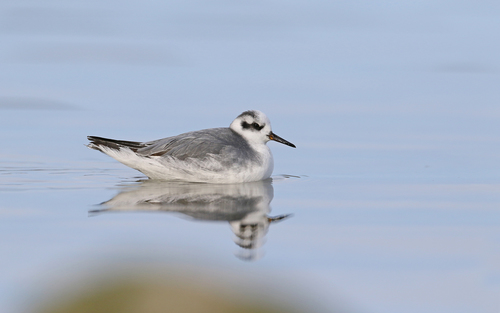 Grey Phalarope
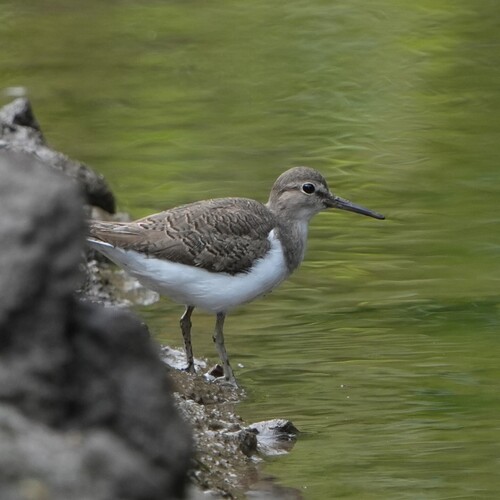 Common Sandpiper
In short
The most reliable field mark to separate Grey Phalarope (Red Phalarope) from Common Sandpiper is the overall body shape and bill structure, especially in non-breeding and juvenile plumages when both can appear grey and white. Juvenile and winter Grey Phalaropes are chunkier, with a thicker, straight bill and a distinctive black eyepatch, while Common Sandpipers are slimmer, with a finer bill and lack the eyepatch. In flight, Common Sandpipers show a strong white wingbar and more barring on the upperparts, especially as juveniles, whereas Grey Phalarope lacks these features. Context and behavior also help: Grey Phalarope often swims and spins on water, while Common Sandpiper is almost always seen walking along shorelines.
Identification tips
- Eyepatch: Grey Phalarope (all ages, especially juvenile and winter) shows a strong black eyepatch; Common Sandpiper never has this feature.
- Bill shape: Grey Phalarope has a thicker, straight bill (yellow with black tip in breeding, all black in winter); Common Sandpiper's bill is finer, with a pale base and dark tip.
- Body shape: Grey Phalarope is chunkier and rounder, especially when swimming; Common Sandpiper is slimmer and more elongated, with a longer tail projection.
- Leg color: Common Sandpiper has short, dark-yellowish legs; Grey Phalarope's legs are less distinctive, often hidden when swimming.
- Wing pattern (flight): Common Sandpiper (all ages) shows a crisp white wingbar and more barring on the wings, especially as a juvenile; Grey Phalarope lacks a wingbar and has plainer wings.
- Juvenile upperparts: Juvenile Common Sandpiper is heavily barred above with buff edges to wing feathers; Grey Phalarope juvenile is plain grey and brown above.
- Behavior: Grey Phalarope often swims and spins in circles on water; Common Sandpiper almost never swims and is seen walking along shorelines, bobbing its tail.
- Habitat: If the bird is swimming on open water, especially away from shore, suspect Grey Phalarope; if walking along the edge, suspect Common Sandpiper.
- Flight jizz: Common Sandpiper has a stiff-winged, low flight over water; Grey Phalarope's flight is more direct and less stiff.
- Plumage seasonality: In breeding plumage, Grey Phalarope is unmistakable (red underparts, white cheek patches, yellow-tipped bill); Common Sandpiper is always brown above and white below.
- Flock behavior: Grey Phalarope may be seen in flocks, especially at sea; Common Sandpiper is usually solitary or in small groups.
- Approachability: Grey Phalarope is often very tame and approachable; Common Sandpiper is more wary and flushes easily.
- Tail projection: Common Sandpiper's tail projects beyond the wing tips when perched; Grey Phalarope's tail is shorter and less noticeable.
- Vocalization: If heard, Common Sandpiper gives a sharp 'weet-weet-weet', especially in flight; Grey Phalarope gives a short 'beek' but is usually silent.
- Sexual dimorphism: Only relevant in breeding season—female Grey Phalarope is larger and brighter than male, but this is not a confusion issue with Common Sandpiper.
Size
Grey Phalarope is slightly larger and bulkier, measuring about 21 cm in length [wikipedia], while Common Sandpiper is 18–20 cm [wikipedia]. The difference is subtle but Grey Phalarope appears rounder and more compact, especially when seen on water. Common Sandpiper is more elongated, with a longer tail projection and shorter legs. Both are small waders, but the phalarope's proportions are more reminiscent of a small gull or a swimming bird, while the sandpiper is clearly a shore-walking species.
Plumage
- Juvenile/First-winter: Juvenile Grey Phalarope is light grey and brown above, with buff underparts and a distinctive dark eyepatch; no strong wingbar or barring on the wings. Juvenile Common Sandpiper is more heavily barred above, with buff edges to the wing feathers and lacks the eyepatch. In flight, Common Sandpiper shows a crisp white wingbar and more obvious upperwing pattern, while Grey Phalarope's wings are plainer.
- Adult non-breeding (winter): Both species are grey above and white below, but Grey Phalarope keeps its black eyepatch and has a black bill in winter, while Common Sandpiper has a pale-based bill and no eyepatch. Common Sandpiper's wings show subtle barring and a white wingbar, especially visible in flight; Grey Phalarope's wings remain plain.
- Adult breeding: Not usually confused, as Grey Phalarope is strikingly red below with white cheek patches and a yellow-tipped bill, while Common Sandpiper remains brownish above and white below.
Behaviour
Grey Phalarope is often seen swimming, sometimes spinning rapidly in circles to create a feeding vortex, and is very tame and approachable. It may also be seen in flocks, especially at sea. Common Sandpiper is almost always seen walking along the water's edge, bobbing its tail and moving in short bursts; it rarely swims. In flight, Common Sandpiper has a distinctive stiff-winged, low flight over water, while Grey Phalarope's flight is more direct and less stiff.
Habitat
Grey Phalarope is most often found on open water, especially at sea or on large inland lakes during migration, and breeds in the Arctic. Common Sandpiper is a bird of shorelines, rivers, and lakes, usually seen walking along muddy or stony edges, and is rarely found far from land or on open water. During migration, Grey Phalarope may turn up on inland waters but is still more likely to be seen swimming, while Common Sandpiper sticks to the edges.
Voice
Grey Phalarope gives a short 'beek' call, but is generally quiet and unobtrusive. Common Sandpiper is also not especially vocal, but may give a sharp, repeated 'weet-weet-weet' in flight or when flushed. Vocalizations are not usually the primary separation feature, but Common Sandpiper's call is more likely to be heard along shorelines.