

Motmot

Grey Junglefowl vs Pallas's Sandgrouse

Gallus sonneratii versus Syrrhaptes paradoxus

Play a quiz with Grey Junglefowl and Pallas's Sandgrouse
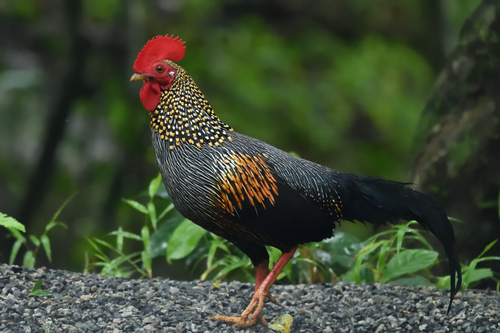
Grey Junglefowl (Gallus sonneratii) Grey Junglefowl
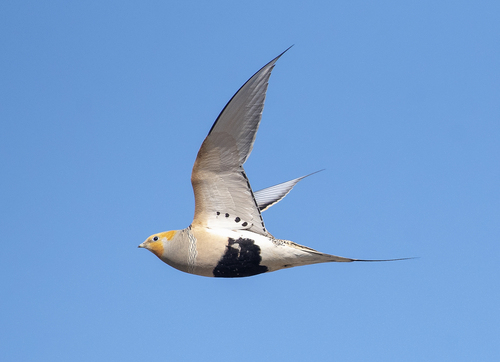
Pallas's Sandgrouse (Syrrhaptes paradoxus) Pallas's Sandgrouse

Media

Loading…

In short

The most reliable way to separate Grey Junglefowl from Pallas's Sandgrouse is by overall structure and plumage: junglefowl are chicken-like with a patterned grey body, red facial skin, and long sickle-shaped tail feathers, while sandgrouse are compact, pigeon-headed birds with buff, barred upperparts, a black belly patch, and long pointed wings and tail. In flight, Pallas's Sandgrouse shows pale underwings and a striking black belly, while Grey Junglefowl appears heavier and lacks these flight marks. Females of both species are duller, but the junglefowl still shows streaked underparts and yellow legs, unlike the sandgrouse's feathered legs and fused toes. Habitat and behavior also differ greatly: junglefowl are forest ground birds, sandgrouse are steppe specialists often seen in large flocks flying to water.

Identification tips

  1. Flight pattern: Pallas's Sandgrouse in flight shows pale underwings and a bold black belly patch, visible in all ages and sexes; Grey Junglefowl lacks these marks and appears heavier and less streamlined in flight.
  2. Overall structure: Junglefowl are chicken-shaped, with a large body, small head, and long, curved tail feathers; sandgrouse are compact, with a small pigeon-like head, long pointed wings, and a long, pointed tail.
  3. Legs and feet: Grey Junglefowl males have red, bare legs with spurs; females have yellow, bare legs. Pallas's Sandgrouse has feathered legs and toes, with three fused front toes and no hind toe, resembling a paw rather than a typical bird foot.
  4. Facial features: Junglefowl males show red facial skin, wattles, and comb (less developed than Red Junglefowl); sandgrouse have no bare facial skin, wattles, or comb.
  5. Neck hackles: Male Grey Junglefowl have distinctive elongated neck feathers ending in yellowish plates, used in fly-tying; sandgrouse lack any such hackles.
  6. Body plumage: Junglefowl males are finely patterned grey with ochre spots and a black cape; females are streaked below. Sandgrouse are buff with barring above, and males have a grey head and breast with an orange face and a grey breast band (female lacks band, more barred above).
  7. Tail shape: Junglefowl have long, sickle-shaped central tail feathers; sandgrouse have long, pointed tails but not sickle-shaped.
  8. Underparts: Female Grey Junglefowl show black and white streaking on the underparts; sandgrouse females are more uniformly buff and barred, lacking streaked bellies.
  9. Habitat: Junglefowl are found in forests and dense scrub; sandgrouse are only in open steppe, semi-desert, and grassland, never in forest.
  10. Behavior: Junglefowl forage on the ground in small groups, fly only to escape or roost; sandgrouse form large flocks and fly long distances to water.
  11. Vocalization: Junglefowl call is loud and chicken-like, usually at dawn/dusk, without wing-flapping; sandgrouse calls are soft, rolling, and usually given in flight.
  12. Sexual dimorphism: Both species show duller females, but only junglefowl females have yellow legs and streaked underparts; sandgrouse females lack the breast band and have more barring above.
  13. Seasonal plumage: Male junglefowl have an eclipse plumage after breeding, losing colorful neck feathers; sandgrouse do not show a comparable seasonal change.
  14. Size: Junglefowl are much heavier and bulkier; sandgrouse are lighter, more streamlined, and built for rapid, sustained flight.
  15. Feet in the field: If seen on the ground, sandgrouse's paw-like, feathered feet are unique and unlike the bare, chicken-like toes of junglefowl.

Size

Grey Junglefowl is significantly heavier (average 857.5g [wikidata]) and bulkier, with a classic chicken-like build. Pallas's Sandgrouse, though long (30–41 cm), is much lighter and more compact, with a small head and neck, and a streamlined, aerodynamic body built for fast, sustained flight. The sandgrouse's long pointed wings and tail further accentuate its slender, elongated appearance, contrasting with the junglefowl's rounded wings and long, curved tail feathers.

Plumage

No age-specific upperwing or flight marks are described for Grey Junglefowl, but Pallas's Sandgrouse of all ages shows pale underwings and a black belly patch in flight, which are key for separation. Adult male Grey Junglefowl have a black cape with ochre spots, finely patterned grey body, and unique neck hackles ending in yellowish plates; females are duller with black and white streaked underparts and yellow legs. In contrast, male Pallas's Sandgrouse has a grey head and breast, orange face, and a grey breast band, while the female is duller, lacks the breast band, and has more barring above. Sandgrouse plumage is overall buff with barring, and both sexes have feathered legs and toes, unlike the bare-legged junglefowl. The junglefowl's red facial skin and wattles (less developed than Red Junglefowl) are also absent in sandgrouse.

Behaviour

Grey Junglefowl are mostly terrestrial, foraging in small groups on the ground and flying up to trees only to escape danger or roost. They are wary and often skulk in forest undergrowth. Pallas's Sandgrouse are highly gregarious, forming large flocks that fly long distances rapidly to reach water sources at dawn and dusk. Their flight is fast and direct, and they spend much time on open ground. Males carry water in their breast feathers for chicks, a behavior not seen in junglefowl.

Habitat

Grey Junglefowl inhabit forested areas, including scrub and woodland, and are rarely found far from cover. In contrast, Pallas's Sandgrouse are birds of open dry steppe, semi-desert, and grassland, avoiding forested habitats. Sandgrouse are often seen in open country, especially near waterholes, while junglefowl are almost always in or near dense vegetation.

Voice

Grey Junglefowl gives a loud, distinctive 'Ku-kayak-kyuk-kyuk' call, usually at dawn or dusk, and unlike Red Junglefowl, does not flap its wings before calling. Pallas's Sandgrouse calls are not described in detail here, but their vocalizations are generally soft, rolling, and given in flight, often as flocks approach water. The junglefowl's call is much louder and more chicken-like than any sandgrouse sound.

Submit a better description

Use the same sections as the comparison. Your text is published immediately.

The most reliable way to separate Grey Junglefowl from Pallas's Sandgrouse is by overall structure and plumage: junglefowl are chicken-like with a patterned grey body, red facial skin, and long sickle-shaped tail feathers, while sandgrouse are compact, pigeon-headed birds with buff, barred upperparts, a black belly patch, and long pointed wings and tail. In flight, Pallas's Sandgrouse shows pale underwings and a striking black belly, while Grey Junglefowl appears heavier and lacks these flight marks. Females of both species are duller, but the junglefowl still shows streaked underparts and yellow legs, unlike the sandgrouse's feathered legs and fused toes. Habitat and behavior also differ greatly: junglefowl are forest ground birds, sandgrouse are steppe specialists often seen in large flocks flying to water.

  1. Flight pattern: Pallas's Sandgrouse in flight shows pale underwings and a bold black belly patch, visible in all ages and sexes; Grey Junglefowl lacks these marks and appears heavier and less streamlined in flight.
  2. Overall structure: Junglefowl are chicken-shaped, with a large body, small head, and long, curved tail feathers; sandgrouse are compact, with a small pigeon-like head, long pointed wings, and a long, pointed tail.
  3. Legs and feet: Grey Junglefowl males have red, bare legs with spurs; females have yellow, bare legs. Pallas's Sandgrouse has feathered legs and toes, with three fused front toes and no hind toe, resembling a paw rather than a typical bird foot.
  4. Facial features: Junglefowl males show red facial skin, wattles, and comb (less developed than Red Junglefowl); sandgrouse have no bare facial skin, wattles, or comb.
  5. Neck hackles: Male Grey Junglefowl have distinctive elongated neck feathers ending in yellowish plates, used in fly-tying; sandgrouse lack any such hackles.
  6. Body plumage: Junglefowl males are finely patterned grey with ochre spots and a black cape; females are streaked below. Sandgrouse are buff with barring above, and males have a grey head and breast with an orange face and a grey breast band (female lacks band, more barred above).
  7. Tail shape: Junglefowl have long, sickle-shaped central tail feathers; sandgrouse have long, pointed tails but not sickle-shaped.
  8. Underparts: Female Grey Junglefowl show black and white streaking on the underparts; sandgrouse females are more uniformly buff and barred, lacking streaked bellies.
  9. Habitat: Junglefowl are found in forests and dense scrub; sandgrouse are only in open steppe, semi-desert, and grassland, never in forest.
  10. Behavior: Junglefowl forage on the ground in small groups, fly only to escape or roost; sandgrouse form large flocks and fly long distances to water.
  11. Vocalization: Junglefowl call is loud and chicken-like, usually at dawn/dusk, without wing-flapping; sandgrouse calls are soft, rolling, and usually given in flight.
  12. Sexual dimorphism: Both species show duller females, but only junglefowl females have yellow legs and streaked underparts; sandgrouse females lack the breast band and have more barring above.
  13. Seasonal plumage: Male junglefowl have an eclipse plumage after breeding, losing colorful neck feathers; sandgrouse do not show a comparable seasonal change.
  14. Size: Junglefowl are much heavier and bulkier; sandgrouse are lighter, more streamlined, and built for rapid, sustained flight.
  15. Feet in the field: If seen on the ground, sandgrouse's paw-like, feathered feet are unique and unlike the bare, chicken-like toes of junglefowl.

Grey Junglefowl is significantly heavier (average 857.5g [wikidata]) and bulkier, with a classic chicken-like build. Pallas's Sandgrouse, though long (30–41 cm), is much lighter and more compact, with a small head and neck, and a streamlined, aerodynamic body built for fast, sustained flight. The sandgrouse's long pointed wings and tail further accentuate its slender, elongated appearance, contrasting with the junglefowl's rounded wings and long, curved tail feathers.

No age-specific upperwing or flight marks are described for Grey Junglefowl, but Pallas's Sandgrouse of all ages shows pale underwings and a black belly patch in flight, which are key for separation. Adult male Grey Junglefowl have a black cape with ochre spots, finely patterned grey body, and unique neck hackles ending in yellowish plates; females are duller with black and white streaked underparts and yellow legs. In contrast, male Pallas's Sandgrouse has a grey head and breast, orange face, and a grey breast band, while the female is duller, lacks the breast band, and has more barring above. Sandgrouse plumage is overall buff with barring, and both sexes have feathered legs and toes, unlike the bare-legged junglefowl. The junglefowl's red facial skin and wattles (less developed than Red Junglefowl) are also absent in sandgrouse.

Grey Junglefowl are mostly terrestrial, foraging in small groups on the ground and flying up to trees only to escape danger or roost. They are wary and often skulk in forest undergrowth. Pallas's Sandgrouse are highly gregarious, forming large flocks that fly long distances rapidly to reach water sources at dawn and dusk. Their flight is fast and direct, and they spend much time on open ground. Males carry water in their breast feathers for chicks, a behavior not seen in junglefowl.

Grey Junglefowl inhabit forested areas, including scrub and woodland, and are rarely found far from cover. In contrast, Pallas's Sandgrouse are birds of open dry steppe, semi-desert, and grassland, avoiding forested habitats. Sandgrouse are often seen in open country, especially near waterholes, while junglefowl are almost always in or near dense vegetation.

Grey Junglefowl gives a loud, distinctive 'Ku-kayak-kyuk-kyuk' call, usually at dawn or dusk, and unlike Red Junglefowl, does not flap its wings before calling. Pallas's Sandgrouse calls are not described in detail here, but their vocalizations are generally soft, rolling, and given in flight, often as flocks approach water. The junglefowl's call is much louder and more chicken-like than any sandgrouse sound.

Discard your changes?

You have unsaved edits. If you leave now, those changes will be lost.

Grey Junglefowl · Pallas's Sandgrouse · My Tricky Birds