

Grey Heron vs Purple Heron
Ardea cinerea versus Ardea purpurea
Play a quiz with Grey Heron and Purple Heron
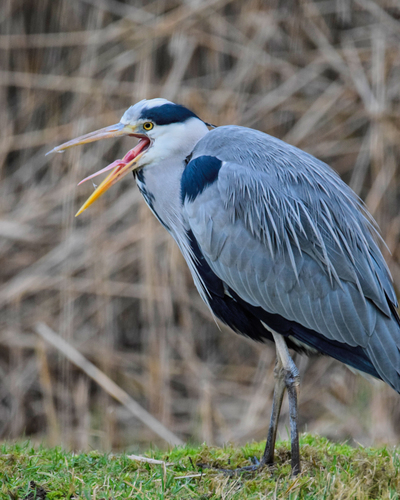 Grey Heron
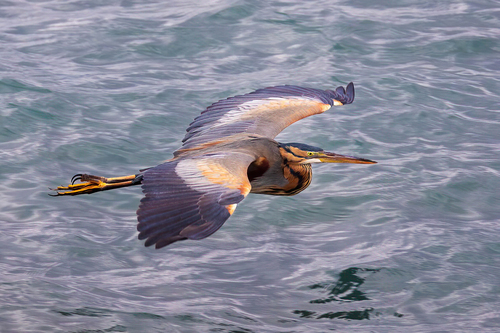 Purple Heron
In short
The most reliable field mark to separate Grey Heron from Purple Heron is overall coloration: Grey Heron is much paler, with ashy-grey upperparts and a striking white head and neck with a bold black supercilium, while Purple Heron is darker, with rich reddish-brown and chestnut tones, a black crown, and a much more chestnut-streaked neck. In flight, both species retract their necks, but Purple Heron appears more slender, with a narrower, snake-like neck and longer toes trailing behind. Juvenile Grey Herons are duller and lack the crisp black head stripe of adults, but still appear much paler and greyer than any Purple Heron. Size can help: Grey Heron is bulkier and taller, but beware overlap. Habitat and behavior also differ: Grey Heron is bolder and often in the open, while Purple Heron is secretive, skulking in reed beds.
Identification tips
- Overall coloration: Grey Heron is much paler, with ashy-grey upperparts and a white head and neck; Purple Heron is darker, with rich reddish-brown, chestnut, and buff tones, especially on the neck and breast (all ages).
- Head pattern (adult): Grey Heron has a bold black supercilium and crest on a white head; Purple Heron has a black crown and forehead, with a dark stripe down the back of the neck and a shorter crest.
- Neck pattern: Purple Heron shows strong chestnut and dark streaking along the sides of the neck, with a paler front; Grey Heron has bluish-black streaks on a mostly white neck.
- Juvenile marks: Juvenile Grey Herons have a grey (not black) head stripe and paler grey face, but still lack the rich chestnut tones of Purple Heron; both are duller than adults, but Grey Heron juveniles remain much paler overall.
- Crest length: Grey Heron's crest is longer and more prominent; Purple Heron's is shorter and less noticeable.
- Bill color: Grey Heron's bill is pinkish-yellow (brighter in breeding season); Purple Heron's is brownish-yellow, less pinkish.
- Body structure: Grey Heron is bulkier and more robust, with a thick neck and heavy body; Purple Heron is slimmer, with a narrower, more snake-like neck and a hollow-chested look.
- Legs and toes: Purple Heron has very long toes, often visible trailing well beyond the tail in flight or when walking on floating vegetation; Grey Heron's toes are proportionally shorter.
- Flight jizz: Both fly with necks retracted, but Purple Heron looks more slender and elongated, with longer toes trailing; Grey Heron appears heavier and broader-winged.
- Behavior: Grey Heron is often out in the open, standing still at water's edge; Purple Heron prefers to skulk in reeds and is rarely seen away from dense cover.
- Habitat: Grey Heron is found in a wide range of wetland habitats, including open water and even coastal sites; Purple Heron is more restricted to dense reed beds and marshes.
- Vocalization: Grey Heron's call is louder and more guttural; Purple Heron's is quieter, higher-pitched, and less frequently heard.
- Size: Grey Heron is larger and heavier (up to 100 cm tall, 2 kg); Purple Heron is smaller and slimmer (up to 94 cm tall, 1.35 kg), but beware overlap in the field.
- Posture: Purple Heron often adopts a more oblique neck posture, even when at rest; Grey Heron usually stands with its neck more upright or retracted.
- Confusion risk: In poor light or at distance, juvenile Grey Herons can look dull, but never show the rich chestnut and dark neck streaking of Purple Heron. Always check for head pattern and overall tone.
Size
Grey Heron is the larger and heavier species: adults stand up to 100 cm tall, measure 84–102 cm in length, and have a wingspan of 155–195 cm, with a body mass of 1.02–2.08 kg [wikipedia][avonet]. Purple Heron is distinctly slimmer and lighter, standing 70–94 cm tall, 78–97 cm long, with a wingspan of 120–152 cm, and weighs only 0.5–1.35 kg [wikipedia][avonet]. In the field, Grey Heron often looks bulkier and more robust, while Purple Heron appears more elongated and delicate, especially in the neck and body.
Plumage
- Juvenile/immature plumage: Juvenile Grey Herons are duller than adults, with a grey (not black) head stripe and a paler grey face, but still show a much paler overall appearance than Purple Heron. Juvenile Purple Herons are not described in detail here, but all ages show a darker, more chestnut-toned plumage compared to Grey Heron.
- Adult plumage: Grey Heron adults are ashy-grey above and greyish-white below, with a white head and neck, a bold black supercilium and crest, and bluish-black streaks on the neck. Purple Heron adults are darker, with a black crown, chestnut and buff-streaked neck, and a grey-brown back and mantle. The breast is chestnut brown with black sides, and the underparts are darker, especially the belly and undertail. The Purple Heron's crest is shorter than the Grey Heron's. Both have long, straight bills, but Purple Heron's is browner, and Grey Heron's is pinkish-yellow.
Behaviour
Grey Heron is typically bolder and more conspicuous, often seen standing motionless in the open at water edges, or flying with slow, deep wingbeats and a retracted neck. Purple Heron is much more secretive, preferring to skulk in dense reed beds or among vegetation, and is less likely to be seen in the open. Purple Heron often adopts a more oblique neck posture, and its long toes allow it to walk on floating vegetation or even over bushes. In flight, both species retract the neck, but Purple Heron looks more slender, with a narrower, snake-like neck and longer toes trailing far behind.
Habitat
Both species are wetland birds, but Grey Heron is more adaptable and widespread, found around lakes, rivers, ponds, marshes, and even coastal areas, often in open habitats. Purple Heron is more specialized, favoring extensive reed beds, canebrakes, or dense marsh vegetation, and is less likely to be seen away from cover. Where both occur, Purple Heron is usually the more secretive and habitat-restricted of the two.
Voice
Both species give harsh calls, but Grey Heron's call is louder and more guttural, while Purple Heron's 'frarnk' is quieter and higher-pitched. Purple Heron is generally less vocal overall, and its calls are less likely to be heard unless near the nest or in flight. Both can give similar guttural sounds at colonies, but Grey Heron's voice is more robust.