

Grey-fronted Dove vs Silver-beaked Tanager
Leptotila rufaxilla versus Ramphocelus carbo
Play a quiz with Grey-fronted Dove and Silver-beaked Tanager
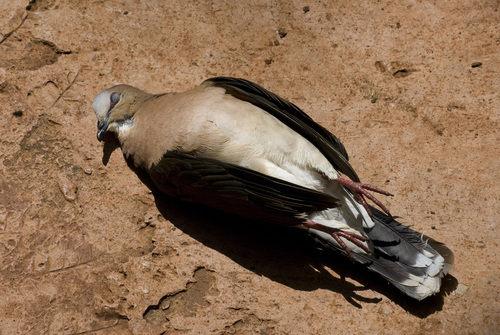 Grey-fronted Dove
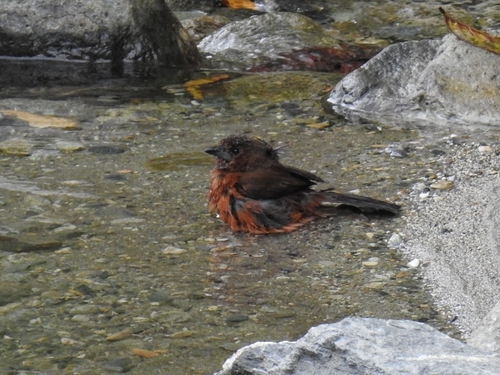 Silver-beaked Tanager
In short
The most reliable field mark to separate Grey-fronted Dove from Silver-beaked Tanager is overall structure and bill: the dove is much larger, heavier-bodied, and has a slender, straight black bill, while the tanager is smaller, more compact, and has a thick, broad-based bill with a silvery lower mandible in males. Juvenile doves show rusty-edged upperparts and barred breasts, unlike any tanager. In adults, the dove’s olive-brown upperparts and red eye-ring contrast with the tanager’s plush, deep crimson or rusty-red plumage and dark face. Both can show reddish tones, but the dove’s posture, shape, and white-tipped tail are distinctive. Mistakes are most likely with perched birds in poor light, especially female and immature tanagers, but careful attention to size, bill, and tail pattern will resolve most confusion.
Identification tips
- Size and shape: Grey-fronted Dove is much larger and heavier than Silver-beaked Tanager; look for a long, robust body and a pigeon-like stance in the dove versus a compact, short-tailed tanager.
- Bill structure: The dove’s bill is slender, straight, and black; the tanager’s bill is thick, broad-based, and in adult males, has a silvery white lower mandible with a black tip (females have a brownish dusky bill). This is a key mark at close range.
- Tail pattern: Dove shows white tips on the outer tail feathers, especially obvious in flight or when fanned; tanager’s tail is uniformly dusky and lacks white tips.
- Juvenile plumage: Juvenile Grey-fronted Dove has rusty and drab brown bars on the breast and rusty-edged upperparts—never seen in tanager of any age. Use this mark for any barred-breasted bird.
- Adult male plumage: Dove males have a grayish to bluish forehead and crown, olive-brown upperparts, and a pinkish white throat with a red bare eye-ring. Tanager males are deep crimson to carmine with a plush, velvety look and a striking two-toned bill.
- Adult female/immature confusion: Female/immature tanagers are rich dark rusty-red to reddish brown, with a grayish tinge on the breast and dusky wings with rufescent brown edges. Female doves are browner and more olive, with green-tinged upperparts and lack the tanager’s reddish tones.
- Eye and face: Dove has a yellow or brown eye with a prominent red bare eye-ring and surrounding pinkish white feathers; tanager’s iris is reddish brown, with no bare skin or facial feathering contrast.
- Leg and foot color: Dove has red legs and feet; tanager’s legs are dark horn-gray. This can help if the bird is perched in good light.
- Behavior: Dove is usually seen walking on the ground or low in dense cover, moving slowly and deliberately. Tanager is active, foraging in low vegetation or fruiting trees, often in small groups.
- Perched posture: Dove sits more horizontally and appears relaxed; tanager is upright and alert.
- Flight style: Dove’s flight is strong, direct, and often low to the ground, with broad, rounded wings and a long tail. Tanager makes short, quick flights between perches, with a more fluttery action.
- Habitat context: If seen deep in forest understory or walking on the ground, dove is more likely; tanager prefers edges, gardens, and open woodland, usually above ground level.
- Sexual dimorphism: Only the tanager is strongly sexually dimorphic; males are much brighter and more plush than females. Doves show only subtle sex differences (females browner, more olive).
- Common pitfalls: Female and immature tanagers can appear dull and may be mistaken for doves in poor light, but the bill, size, and tail pattern remain reliable. Juvenile doves with barred breasts should never be confused with tanagers.
- When in doubt: Focus on bill shape and color, tail pattern, and overall size. If you see a white-tipped tail or a red bare eye-ring, it’s a dove. If the bill is thick and silvery below (male), it’s a tanager.
Size
Grey-fronted Dove is much larger and heavier (28 cm, 115–183 g) than Silver-beaked Tanager (16–17 cm, 21–37.5 g) [wikipedia]. The dove appears long-bodied and robust, with a proportionally longer tail and legs. The tanager is compact, with a shorter tail and a noticeably thick, heavy bill. Even at a distance or in mixed flocks, the dove’s bulk and pigeon-like proportions stand out against the smaller, more agile tanager.
Plumage
-
Juvenile/immature: Juvenile Grey-fronted Dove shows rusty and drab brown bars on the breast and rusty-edged feathers on the upperparts, which are never present in any age of Silver-beaked Tanager. Juvenile and female tanagers resemble each other, lacking barring and showing overall reddish-brown tones.
-
Adult males: Grey-fronted Dove males have a grayish to bluish forehead, bluish gray crown, olive-brown upperparts with faint bronze or purplish on the mantle, and a red bare eye-ring surrounded by pinkish white feathers. The breast is greyish pink fading to white on the belly, and the tail has olive-brown central feathers and blackish outer feathers with obvious white tips. Silver-beaked Tanager males are deep carmine to crimson on the head, throat, and breast, with carmine-black upperparts and a plush, velvety look. Their bill is striking: dark blue-gray above and silvery white below with a black tip.
-
Adult females: Female Grey-fronted Dove is browner, with more olive on the flanks and green-tinged upperparts. Female Silver-beaked Tanager is rich dark rusty-red on the head and upper back, redder on the lower back and rump, and reddish brown to warm brown below with a grayish tinge on the breast. The tanager’s wings are dusky with rufescent brown edges, and the bill is entirely brownish dusky.
-
Tail: Dove’s tail is long, with white tips on the outer feathers; tanager’s tail is shorter, dusky, and lacks white tips.
-
Eye and face: Dove has a yellow or brown eye with a red bare eye-ring and pinkish white facial feathers; tanager has a reddish brown iris and no bare skin around the eye.
Behaviour
Grey-fronted Dove typically walks on the ground, moving deliberately and often pausing to feed, with a pigeon-like gait. It is usually solitary or in pairs, rarely joining mixed flocks. In flight, the dove is strong and direct, with broad, rounded wings and a long tail. Silver-beaked Tanager is much more active and social, often seen in small groups or mixed-species flocks, foraging in low vegetation or at fruiting trees. It moves with quick hops and short flights, rarely walking on the ground. Perched, the tanager appears alert and upright, while the dove is more horizontal and relaxed.
Habitat
Both species can be found on Trinidad and throughout much of South America (except Chile), but their microhabitat preferences differ. Grey-fronted Dove favors forest understory, edges, and dense thickets, often close to the ground. Silver-beaked Tanager is more flexible, frequenting forest edges, second growth, gardens, and open woodlands, usually at low to mid-levels in vegetation. Overlap is possible at forest edges, but the dove is more likely in deep shade or on the ground, while the tanager is more visible in open or semi-open areas.