
Green-throated Carib vs Antillean Crested Hummingbird
Eulampis holosericeus versus Orthorhyncus cristatus
Play a quiz with Green-throated Carib and Antillean Crested Hummingbird
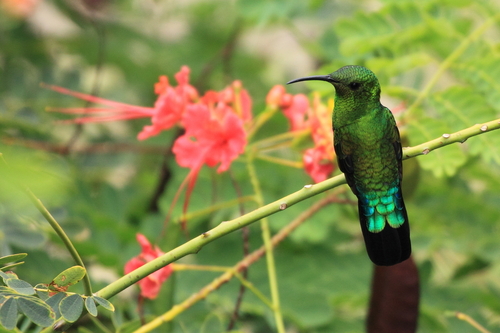 Green-throated Carib
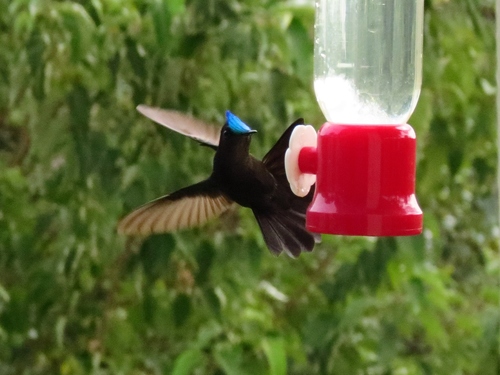 Antillean Crested Hummingbird
In short
The most reliable field mark to separate these two is the presence of a prominent green or blue-green crest on the male Antillean Crested Hummingbird, which is entirely absent in Green-throated Carib of any age or sex. Green-throated Carib is also much larger and bulkier, with a noticeably longer and more decurved bill, especially in females. In the field, note the Carib’s bright green gorget and black belly versus the Crested’s sooty underparts (male) or pale grey underparts (female). Tail pattern and bill shape are also helpful, but beware of dull females and poor light masking some colors. Juvenile or immature-specific wing patterns are not described for either species, so focus on structure and head pattern first.
Identification tips
- Crest presence (males only): Male Antillean Crested Hummingbird shows a prominent metallic green to blue-green crest—no crest in Green-throated Carib of any age or sex.
- Bill shape and length: Carib has a noticeably longer and more decurved bill, especially in females; Crested’s bill is short, straight, and black in both sexes. Use this when birds are perched or feeding.
- Size and structure: Carib is much larger and bulkier (6.2 g, 10.5–12 cm), with a robust body and heavier jizz. Crested is smaller, lighter, and more delicate in build.
- Gorget and throat color: Carib of both sexes has a bright green gorget (with a blue border in males, usually not obvious); Crested males have a sooty black throat and underparts, females have pale grey underparts.
- Back color: Both have greenish backs, but Carib’s is brighter and more uniform; Crested’s is dull metallic bronze-green.
- Underparts (females): Female Carib has a dark belly; female Crested has pale grey underparts, often contrasting with bronzy-green upperparts.
- Tail pattern: Carib’s tail is dark blue (often appears black), lacks pale tips. Female Crested shows broad whitish-grey tips on four outer tail feathers—unique among these two.
- Tail shape: Both have rounded tails, but Crested’s is proportionally shorter and more compact.
- Head pattern (females): Female Crested lacks any crest, but has a bronzy-green forehead and crown; Carib females have a plain green crown, matching the back.
- Voice: Carib’s sharp 'chup!' or 'chuwp!' is less musical than Crested’s 'tsip/tzip' and 'tslee-tslee-tslee' series. Use with caution, as calls can be hard to separate in the field.
- Behavior: Both are territorial, but Crested is especially aggressive, sometimes attacking non-bird species. Carib males defend territories year-round, females mainly in non-breeding season.
- Flight style: Carib appears heavier and more powerful in flight; Crested is quicker and more agile.
- Habitat: Overlapping, so not diagnostic, but both are common in gardens and disturbed areas.
- Pitfalls: Dull female Caribs can appear less vibrant, and poor light may obscure the Carib’s blue tail or green gorget. Female Crested’s pale underparts and tail tips are reliable when seen well.
- No age-specific wing pattern: Neither species has a distinctive juvenile/immature upperwing or flight mark, so rely on crest, bill, and underpart/tail pattern for all ages.
Size
Green-throated Carib is significantly larger and heavier (body mass about 6.2 g [wikidata]) and measures 10.5–12 cm in length. Antillean Crested Hummingbird is distinctly smaller and more delicate, with a noticeably shorter bill and more compact jizz. In direct comparison, Carib will look bulkier and more robust, while the Crested appears petite and agile.
Plumage
- Juvenile/immature wing pattern: No distinctive age-specific upperwing or flight marks are described for either species, so these are not reliable for separation.
- Adult males: Green-throated Carib males have a bright green gorget bordered by blue (though the border is usually not obvious), a bright green back, black belly, green vent, and a dark blue tail that can appear black. Antillean Crested Hummingbird males have a metallic green to blue-green crest, dull metallic bronze-green upperparts, sooty black underparts, and a black rounded tail. The crest is the key difference.
- Adult females: Female Caribs are similar to males but with a duller green back and a longer, more strongly decurved bill. Their underparts remain dark. Female Crested Hummingbirds lack a crest, have metallic bronzy-green upperparts, light grey underparts, and a blackish tail with four outer feathers broadly tipped whitish grey. This pale tail tip is unique among these two.
- Tail: Carib’s tail is dark blue (often looks black), while Crested’s is blackish and rounded, with females showing distinctive white tips on the outer feathers.
- Bill: Carib’s bill is longer and more decurved (especially in females); Crested’s is short, straight, and black in both sexes.
Behaviour
Both species are territorial and aggressive, but Antillean Crested Hummingbird is noted for attacking not only other hummingbirds but also non-bird species, sometimes reducing local diversity. Green-throated Carib males defend feeding territories year-round, while females do so mainly outside the breeding season. Both species feed on nectar and small arthropods, often catching insects on the wing. In flight, Carib appears heavier and more powerful, while Crested is quicker and more nimble.
Habitat
Both species share a range from Puerto Rico through the Lesser Antilles and can be found in gardens, second growth, and vegetation around homes. Green-throated Carib adapts well to human-affected habitats and is generally common where present. Antillean Crested Hummingbird has a similar range and habitat preference, but is also recorded as a vagrant in Florida. Habitat alone is not a reliable separator between these two.
Voice
Green-throated Carib gives a sharp 'chup!' or 'chuwp!' call, and during disputes, produces rattles and wing whirs. Antillean Crested Hummingbird calls are short 'tsip' or 'tzip' notes, plus a longer 'tslee-tslee-tslee-tslee' series. The Carib’s call is sharper and less musical, while the Crested’s is higher-pitched and more repetitive. However, calls are not always diagnostic in the field due to overlap and observer experience.
Green-throated Carib · Antillean Crested Hummingbird · My Tricky Birds