

Green Heron vs Chinese Pond Heron
Butorides virescens versus Ardeola bacchus
Play a quiz with Green Heron and Chinese Pond Heron
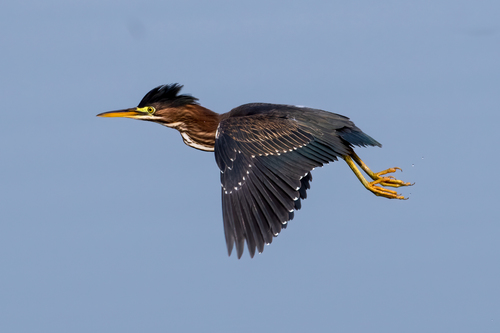 Green Heron
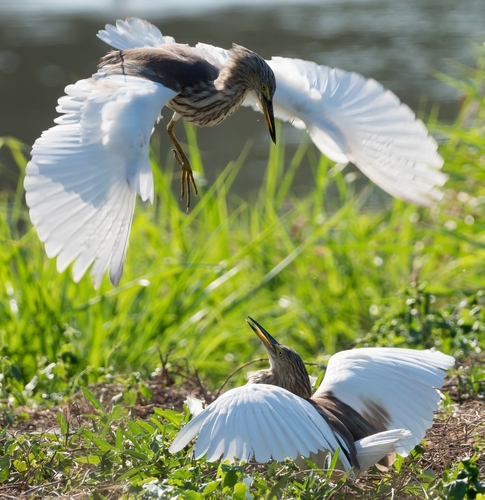 Chinese Pond Heron
In short
The most reliable field mark between Green Heron and Chinese Pond Heron is the striking difference in wing coloration in all plumages: Chinese Pond Heron always shows bright white wings (especially obvious in flight), while Green Heron has dark gray-black wings with green or blue tones and no white. This contrast is especially useful for separating juveniles and non-breeding birds, which can otherwise look similarly streaky and brown. Green Heron is smaller, stockier, and often appears hunched with a short neck, while Chinese Pond Heron is longer and more upright. Bill and leg color, as well as overall body color in breeding adults, also help, but the white wing of Chinese Pond Heron is the fastest and most reliable field mark in any season or age.
Identification tips
- White Wings in Flight (All Ages): Chinese Pond Heron always shows bright white wings, both in flight and at rest, regardless of age or season. Green Heron never shows white in the wings; its wings are always dark gray-black with green or blue tones. This is the single most reliable field mark.
- Juvenile/Non-breeding Confusion: Both species can look streaky brown and white below as juveniles or in non-breeding plumage, but only Chinese Pond Heron flashes white wings. Green Heron juveniles have tan-splotched backs and coverts, but no white in the wings.
- Breeding Adult Plumage: Chinese Pond Heron adults in breeding plumage are boldly colored with red, blue, and white, and have white wings. Green Heron adults have a chestnut neck with white lines, greenish-black cap, and iridescent greenish back, but no white in the wings.
- Bill Color: Chinese Pond Heron has a yellow bill with a black tip. Green Heron has a mostly dark, sharply pointed bill. This is best used in good light at close range.
- Leg Color: Both species have yellow legs as adults, but Green Heron juveniles have greenish-yellow legs. Leg color is not as reliable as wing pattern but can help support an ID.
- Size and Structure: Green Heron is smaller, chunkier, and often appears hunched with a short neck, especially when perched. Chinese Pond Heron is longer and more upright, with a proportionally longer neck and body.
- Perched Posture: Green Heron often sits with neck tightly retracted, giving a compact, squat appearance. Chinese Pond Heron is more likely to stand upright, especially when alert.
- Foraging Behavior: Green Heron is solitary and territorial when feeding, rarely seen in groups. Chinese Pond Heron may be seen with other herons, especially at nesting colonies.
- Range: Green Heron is native to the Americas, Chinese Pond Heron to East Asia. If seen outside normal range, rely on plumage and structure, not range.
- Voice: Green Heron's 'kyow' and 'kuk' calls are distinctive if heard, but Chinese Pond Heron's calls are not described here, so use with caution.
- Sexual Dimorphism: Female Green Herons are slightly smaller and duller than males, but this difference is subtle and less useful than wing color.
- Seasonal Changes: Both species change plumage with season, but the white wing of Chinese Pond Heron is present year-round and is always diagnostic.
- Upperparts Color: Green Heron adults have an iridescent greenish back, while Chinese Pond Heron is brownish outside breeding season and boldly colored in breeding plumage.
- Habitat Context: Green Heron is more likely to be found alone along wooded water edges; Chinese Pond Heron is more likely in open wetlands and sometimes in colonies.
- Pitfall: Do not rely on overall brown or streaky appearance in juveniles—always check for white in the wings (present only in Chinese Pond Heron).
Size
Green Heron is slightly smaller and more compact, measuring 41–46 cm in length with a wingspan of 64–68 cm and weighing about 240 g [wikipedia]. Chinese Pond Heron is a bit larger at 47 cm in length [wikipedia]. Both are small herons, but Chinese Pond Heron tends to look longer and less chunky, especially when perched. Green Heron often appears short-necked and squat, especially when the neck is retracted.
Plumage
- Juvenile/Non-breeding Plumage: Chinese Pond Heron juveniles and non-breeding adults are brownish and streaky with white flecks, but always show bright white wings in flight and at rest. Green Heron juveniles are brown and white streaked below, with tan-splotched backs and wing coverts, but their wings are dark gray-black with greenish or bluish tones and no white patches. This wing contrast is diagnostic in all ages and seasons.
- Adult Breeding Plumage: Chinese Pond Heron adults in breeding plumage are boldly colored with red, blue, and white, and the white wings stand out even more. Green Heron adults have a glossy greenish-black cap, iridescent greenish back, gray-black wings, chestnut neck with white lines, and gray underparts. Female Green Herons are duller and lighter, especially in breeding season.
- Bill and Legs: Chinese Pond Heron has a yellow bill with a black tip and yellow legs. Green Heron has a dark, sharply pointed bill and short yellow legs (greenish-yellow in juveniles).
Behaviour
Green Heron is solitary and intolerant of other birds while feeding, rarely foraging in groups. It often stands still at the water's edge or perches on branches, waiting for prey, and is known for using bait to fish. Chinese Pond Heron is more likely to be seen in mixed-species heronries, especially when nesting, and may be less solitary in general. Both species forage in shallow water and use similar hunting techniques, but Green Heron's bait-fishing is notable.
Habitat
Green Heron is found in North and Central America, favoring riparian zones, wetlands, ponds, lakes, and sometimes human-made canals and ditches. Chinese Pond Heron is an East Asian species, found in shallow fresh and saltwater wetlands and ponds, mostly in lowland areas. The two species do not overlap in native range, but vagrancy is possible, so field marks are still important. Green Heron is more likely to be seen alone, while Chinese Pond Heron often nests in colonies.
Voice
Green Heron gives a loud, sudden 'kyow' call and a series of subdued 'kuk' calls. During courtship, males make noisy wingbeats and various calls, including 'raah-rahh,' 'whoom-whoom-whoom,' and 'roo-roo.' Chinese Pond Heron's calls are not described in the provided notes, so vocalization is not a reliable separator based on available information.