

Green-fronted Hummingbird vs Blue-vented Hummingbird
Ramosomyia viridifrons versus Saucerottia hoffmanni
Play a quiz with Green-fronted Hummingbird and Blue-vented Hummingbird
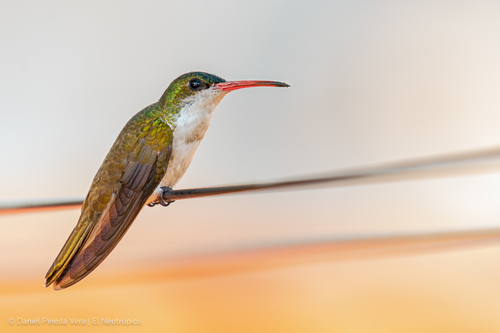 Green-fronted Hummingbird
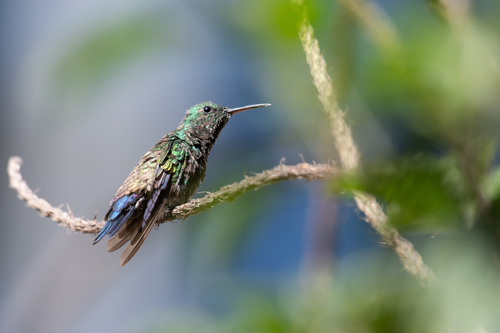 Blue-vented Hummingbird
In short
The most reliable field mark between Green-fronted and Blue-vented Hummingbirds is the color and pattern of the underparts: Green-fronted shows clean, pure white underparts with green flanks, while Blue-vented is much darker below, with glittering golden-green underparts and blue or greenish undertail coverts. Bill color is also a key difference: Green-fronted has an all-red bill with a black tip, while Blue-vented has a blackish upper mandible and coral-red lower mandible. Juvenile Blue-vented Hummingbirds are duller and darker below than adults, with a grayish-brown belly and darkish gray throat, which can cause confusion with female or young Green-fronted, but the Green-fronted always shows white underparts. Tail color and structure also differ, with Green-fronted showing coppery to purplish tails and Blue-vented a pale steel blue, slightly forked tail. Both species are in the 'emeralds' group, but their ranges do not overlap: Green-fronted is found in Mexico (possibly Guatemala), while Blue-vented is found from southern Nicaragua to central Costa Rica.
Identification tips
- Underparts color: Green-fronted Hummingbird always shows pure white underparts with green sides or flanks, regardless of age or sex. Blue-vented Hummingbird is much darker below, with glittering golden-green underparts in adults and duller, grayish-brown belly in juveniles. This is the most reliable field mark.
- Bill color: Green-fronted has a red bill with a black tip (both mandibles red except for the tip). Blue-vented has a blackish upper mandible and a coral-red lower mandible with a dark tip. This is visible at close range or in good light.
- Crown color (adult males): Green-fronted males have a glittering bluish-green crown, while Blue-vented males have golden-green upperparts without the blue crown.
- Tail color and shape: Green-fronted's tail is coppery to purplish with bronze green edges, notched but not deeply forked. Blue-vented's tail is pale steel blue, slightly forked, and in females, the outer feathers have purplish tips. This can be seen in flight or when the tail is spread.
- Rump and uppertail coverts: Both species can show coppery or purplish tones here, but Blue-vented's are more consistently coppery to purplish, while Green-fronted's are grayish brown to bronze.
- Sex differences: Female Green-fronted is similar to male but with a dark green crown and bronze to golden green tail. Female Blue-vented is duller below, with white bars near the end of throat feathers and grayish-buff vent feather edges.
- Juvenile Blue-vented: Duller and darker than adults, with a grayish-brown belly and darkish gray throat. Juvenile Green-fronted is not described, but all ages show white underparts, never brownish or grayish below.
- Size: Green-fronted is slightly larger and heavier, but this is subtle and not always reliable in the field.
- Habitat and range: If seen in Mexico (possibly Guatemala), it is Green-fronted; if in southern Nicaragua to central Costa Rica, it is Blue-vented. There is no overlap.
- Vocalizations: Only Blue-vented's song and calls are described; if you hear a repeated buzzy, squeaky phrase or high, sharp "tsit"/"chit" calls, it is likely Blue-vented. Silence or unknown song does not help.
- Flank color: Green-fronted shows green flanks against white underparts, while Blue-vented's underparts are uniformly darker green or golden-green.
- Undertail coverts: Blue-vented has greenish to steel blue undertail coverts; Green-fronted's are white with green flanks.
- Throat pattern (female Blue-vented): Look for white bars near the end of throat feathers in female Blue-vented; Green-fronted females do not show this pattern.
- Tail feather tips (female Blue-vented): Purplish tips to the outer tail feathers are unique to female Blue-vented.
- Behavior: Both species defend feeding territories and forage for nectar and insects; behavior is not a reliable separator.
Size
Green-fronted Hummingbird is slightly larger and heavier, measuring 10–11.5 cm in length and weighing about 6.3 g. Blue-vented Hummingbird is a bit smaller and lighter, at 8–11 cm and averaging 4.45 g. In the field, this size difference is subtle and may not be obvious unless both species are seen together, but Green-fronted generally appears a bit bulkier.
Plumage
- Juveniles/Immatures: Juvenile Blue-vented Hummingbirds are noticeably darker and duller below than adults, with a grayish-brown belly and darkish gray throat, and brownish edges to back and rump feathers. Green-fronted juveniles are not described in detail, but all ages show white underparts with green flanks, never the dull brownish or grayish belly of juvenile Blue-vented.
- Adult males: Green-fronted males have a glittering bluish-green crown, emerald to bronze green nape and back, and pure white underparts with green sides. Their tail is coppery to purplish with bronze green edges. Blue-vented males have golden-green upperparts, coppery to purplish rump, and dark glittering golden-green underparts with greenish to steel blue undertail coverts. Their tail is pale steel blue and slightly forked.
- Adult females: Female Green-fronted are similar to males but with a dark green crown and a bronze to golden green tail. Female Blue-vented are duller green below, with white bars near the end of throat feathers, grayish-buff edges to vent feathers, and purplish tips to the outer tail feathers. Both sexes of Green-fronted always show white underparts, while Blue-vented females are darker below with some white barring on the throat.
- Tail: Green-fronted's tail is coppery to purplish and notched; Blue-vented's is pale steel blue, slightly forked, and has purplish tips on outer feathers in females.
Behaviour
Both species forage for nectar and insects, often defending feeding territories. Blue-vented tends to forage up to the tops of small trees and is known to feed from the surface of water. There are no distinctive behavioral differences in flight or foraging style noted in the sources that would reliably separate the two in the field.
Habitat
Green-fronted Hummingbird is found in Mexico (possibly Guatemala), while Blue-vented is found from southern Nicaragua to central Costa Rica. Blue-vented prefers semi-open landscapes such as scrublands, savanna, forest edges, secondary forest, and gardens, usually in drier habitats except during the dry season when it moves to moister areas. Green-fronted's habitat is not described in detail, but its range does not overlap with Blue-vented. Elevationally, Blue-vented is found from sea level up to 1,800 m.
Voice
Only Blue-vented Hummingbird's vocalizations are described: its song is a repeated buzzy, squeaky phrase ("tzi-tzee-tzup"), sometimes followed by lower-pitched notes, and its calls are high, sharp "tsit" or dry "chit" notes. There are no vocalization details for Green-fronted Hummingbird in the provided sources, so voice is not a reliable separator unless Blue-vented's distinctive song is heard.
Green-fronted Hummingbird · Blue-vented Hummingbird · My Tricky Birds