

Green-billed Coucal vs Indian Cuckoo
Centropus chlororhynchos versus Cuculus micropterus
Play a quiz with Green-billed Coucal and Indian Cuckoo
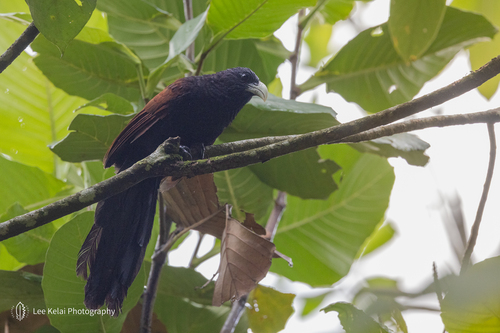 Green-billed Coucal
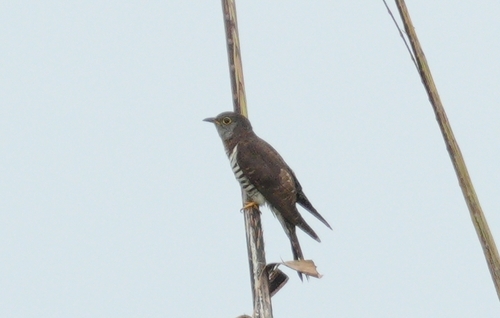 Indian Cuckoo
In short
The most reliable field mark to separate Green-billed Coucal from Indian Cuckoo is the coucal’s distinctive light green bill combined with its dark, glossy purple-black body and long dark green tail, versus the Indian Cuckoo’s grey upperparts, barred underparts, and yellowish eye-ring. Juvenile plumages are also quite different: young coucals are duller and streaked, while juvenile Indian Cuckoos are browner with white markings on the crown and broad white tips to head and wing feathers. In flight or perched, the coucal appears heavier and longer-tailed, while the cuckoo is slimmer and more hawk-like. Habitat can help: Green-billed Coucal is a Sri Lankan rainforest specialist, while Indian Cuckoo is widespread in open woodlands and forests across Asia.
Identification tips
- Bill color: Green-billed Coucal always shows a distinctive pale green bill, unique among Sri Lankan birds. Indian Cuckoo has a dark bill; this is the quickest field check if the bill is visible.
- Body color: Coucal is overall glossy purple-black with maroon wings and a dark green tail; Indian Cuckoo is plain grey above with barred underparts and a barred tail with a white tip.
- Juvenile plumage: Young coucals are dull and streaked but still dark overall. Juvenile Indian Cuckoos are brownish with white markings on the crown and broad white tips to head and wing feathers—look for these pale accents in young cuckoos.
- Tail: Coucal’s tail is long, dark green, and unbarred; Indian Cuckoo’s tail is shorter, with a broad subterminal dark band and a white tip. In flight or perched, the coucal’s tail looks heavier and more rounded.
- Eye-ring and iris: Indian Cuckoo has a gray to yellow eye-ring and a light brown to reddish iris, which can be visible at close range. Coucal’s eye is dark and lacks a colored eye-ring.
- Wing pattern in flight: Coucal’s wings are maroon above and black below, with no barring; Indian Cuckoo’s wings are plain grey above, with no maroon or black contrast, and the underparts are barred.
- Structure: Green-billed Coucal is bulkier, with a heavier body and longer tail. Indian Cuckoo is slimmer, more hawk-like, and appears more streamlined in flight.
- Behavior: Coucal is usually hidden in dense rainforest undergrowth, moving slowly and rarely flying far. Indian Cuckoo is more likely to be seen perched openly or flying between trees in open woodland or forest edge.
- Habitat: In Sri Lanka, Green-billed Coucal is restricted to wet zone rainforests; Indian Cuckoo is found in a wider range of wooded habitats, including open woodland and higher elevations.
- Sex differences: Both species are similar between sexes, but female Indian Cuckoo may be slightly paler on the throat and browner on the breast and tail—this is subtle and not reliable for field separation.
- Vocalization: Not described in the notes; do not rely on voice for separation based on this information.
- Pitfalls: In poor light, coucal’s dark plumage may appear plain, but the green bill and maroon wings are still diagnostic. Juvenile Indian Cuckoo’s white markings and brownish tones are unlike any coucal plumage.
- Perched vs. flight views: In flight, coucal is heavy and slow with broad wings and a long tail; Indian Cuckoo is more direct and agile, with a slimmer profile.
- Range: If outside southwest Sri Lankan rainforest, Green-billed Coucal is very unlikely; Indian Cuckoo is widespread across Asia and more likely in varied habitats.
- Nestlings: Only relevant if observed at the nest; Indian Cuckoo nestlings have orange-red mouths and yellow gape flanges, which are not seen in coucal.
Size
Green-billed Coucal is a medium to large bird at about 43 cm in length [wikipedia], giving it a heavier, bulkier impression than the Indian Cuckoo, which is described as medium-sized but with no precise measurement in the notes. Coucal’s longer tail and heavier body are evident when perched or in flight, while Indian Cuckoo appears slimmer and more streamlined. Both sexes are similar in size within each species.
Plumage
- Juveniles: Green-billed Coucal juveniles are duller than adults and show streaking, but retain the overall dark, muted look. Indian Cuckoo juveniles are brownish, with white markings on the crown and broad white tips to the head and wing feathers, making them appear more patterned and paler-headed than coucal juveniles.
- Adults: Green-billed Coucal adults have a striking combination of purple-black head and body, maroon upperwings, black underwings, and a long, dark green tail. The bill is a diagnostic pale green. Indian Cuckoo adults have plain grey upperparts, broad black barring on the underparts, and a tail with a broad subterminal dark band and white tip. The eye-ring is gray to yellow, and the iris is light brown to reddish. Females are slightly paler on the throat and browner on the breast and tail, but this is subtle.
- Flight views: Coucal’s wings are maroon above and black below, with no barring or pale panels. Indian Cuckoo shows a barred tail and underparts, and the wings are not described as contrasting.
- Sexes: Both species are similar between sexes, with only minor differences in Indian Cuckoo females (slightly paler throat, more brown on breast/tail).
Behaviour
Green-billed Coucal is secretive and tends to skulk in dense rainforest undergrowth, rarely flying far and often remaining hidden. Its movement is heavy and deliberate, both on the ground and in low vegetation. Indian Cuckoo is also shy and solitary but more likely to be seen perched openly or flying between trees in open woodland or forest edge. In flight, Indian Cuckoo is more direct and hawk-like, while coucal is heavier and less agile.
Habitat
Green-billed Coucal is strictly found in the tall, dense rainforests of southwest Sri Lanka, rarely venturing into open areas. Indian Cuckoo, in contrast, occupies a much broader range, from India to China and Southeast Asia, and is found in both forests and open woodlands, sometimes at high elevations (up to 3,600 m). In Sri Lanka, Indian Cuckoo can occur in a wider variety of wooded habitats than the coucal.