

Green-backed Camaroptera vs Black-faced Apalis
Camaroptera brachyura versus Apalis personata
Play a quiz with Green-backed Camaroptera and Black-faced Apalis
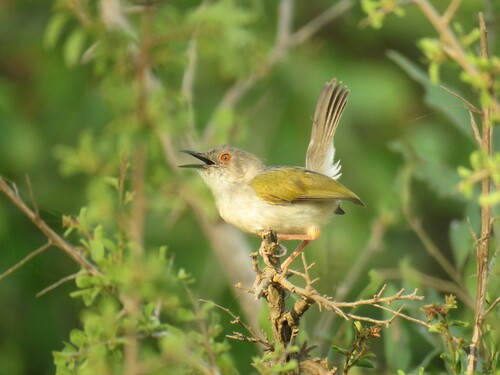 Green-backed Camaroptera
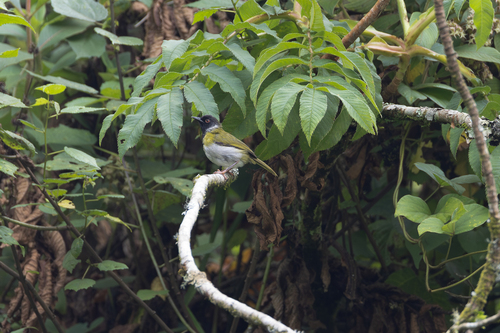 Black-faced Apalis
In short
The most reliable field mark between Green-backed Camaroptera and Black-faced Apalis is the presence of a distinctive black face mask on the Black-faced Apalis, which is entirely absent in Green-backed Camaroptera. Both are small, greenish warblers, but the Camaroptera shows uniform green upperparts and lacks any facial mask, while the Apalis is marked by a striking black face and contrasting underparts. Juvenile Camaroptera can be paler yellow below, but never show a face mask. Both species are similar in size and can be found in dense vegetation, but their plumage differences—especially around the face—are the key to separation.
Identification tips
- Face pattern is decisive: Black-faced Apalis always shows a bold black face mask; Green-backed Camaroptera never does. If you see a black mask, it is Apalis.
- Upperpart color: Camaroptera has uniform green upperparts and olive wings, while Apalis is less green and more contrasting, especially around the face.
- Underparts: Camaroptera's underparts are whitish-grey, with juveniles showing a paler yellow wash on the breast. Apalis has paler underparts but the face mask dominates the impression.
- Juvenile Camaroptera: Look for a paler yellowish breast in young birds, but still no facial mask. Juvenile Apalis is not described, but absence of a mask would be unexpected.
- No wing or flight pattern clues: Neither species is described as having distinctive upperwing or flight marks in any age, so do not rely on in-flight pattern for separation.
- Size is not helpful: Both are tiny warblers, with only a 1g difference in mass. Ignore size as a separator.
- Sexes similar in Camaroptera: Both male and female Camaroptera look alike, so facial markings are not a sex-based feature.
- Habitat context: If in montane forest, especially in the Albertine Rift, suspect Black-faced Apalis. In lowland dense scrub or bush, Camaroptera is more likely.
- Behavior: Camaroptera is more likely to be seen skulking low in dense cover, rarely out in the open. Apalis may be more active in mid-levels of forest.
- Nest location (if observed): Camaroptera binds leaves together low in bushes for nesting—unique if you see this behavior.
- No reliable vocal clues: No vocalizations are described here; do not rely on song or call for separation based on these notes.
- No seasonal or sex-based confusion: Both species are resident and do not have described seasonal plumage changes that would cause confusion.
- Quiz pitfall: The main confusion arises from similar size and greenish tones, but the facial mask (or lack thereof) is always the best check.
- When in doubt: If you cannot see the face well, look for the context—dense lowland bush (Camaroptera) vs. montane forest (Apalis).
Size
Both species are very close in size, with Green-backed Camaroptera averaging 10.0g and Black-faced Apalis 11.0g [wikidata]. In the field, this difference is negligible; both appear as small, active warblers. Length is not provided for Apalis, but Camaroptera is about 11.5 cm long [wikipedia]. Structure is not a reliable separator based on available information.
Plumage
- Juvenile/immature birds: Green-backed Camaroptera juveniles are paler yellow on the breast, but otherwise resemble adults with green upperparts and olive wings. There is no mention of a distinctive juvenile wing or flight pattern for either species, so age-specific upperwing marks are not diagnostic here.
- Adults: Green-backed Camaroptera shows green upperparts, olive wings, and whitish-grey underparts, with no facial markings. Black-faced Apalis (mountain masked apalis) is defined by a bold black face mask, contrasting with paler underparts and presumably less green overall (though exact upperpart color is not detailed here). Both sexes of Camaroptera look similar, while Apalis is named for its facial mask, which is present in adults.
- Key contrast: The black face mask of Apalis is the single most obvious difference at all ages except possibly for juveniles (not described), while Camaroptera always lacks any such facial pattern.
Behaviour
Green-backed Camaroptera is described as a skulking species, typically found low in dense cover and often binding leaves together for nesting [wikipedia]. There is no specific behavioral note for Black-faced Apalis, but both are small insectivorous warblers in the same family, so general foraging behavior is likely similar. Camaroptera may be more secretive and less likely to be seen in the open.
Habitat
Green-backed Camaroptera is a resident breeder in Africa south of the Sahara, found in dense cover and low vegetation [wikipedia]. Black-faced Apalis is native to the Albertine Rift montane forests, suggesting a preference for higher elevation, forested habitats. In overlap zones, Camaroptera is more likely in lowland thickets and bush, while Apalis is tied to montane forest.
Green-backed Camaroptera · Black-faced Apalis · My Tricky Birds