

Greater White-fronted Goose vs Tundra Bean Goose
Anser albifrons versus Anser serrirostris
Play a quiz with Greater White-fronted Goose and Tundra Bean Goose
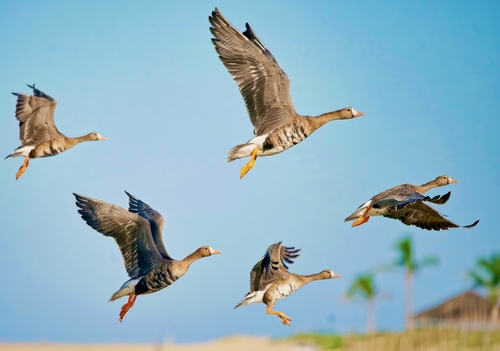 Greater White-fronted Goose
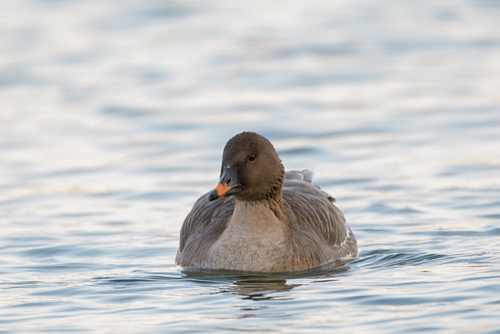 Tundra Bean Goose
In short
The most reliable field mark to separate Greater White-fronted Goose from Tundra Bean Goose is the bill: Greater White-fronted has a pinkish bill, while Tundra Bean Goose shows a black bill with a distinct orange band. In flight or at rest, Greater White-fronted also shows a bold white blaze at the base of the bill and, in most subspecies, a broad white flank line and prominent white wing bars, contrasting with the more uniform, dark upperwing of Tundra Bean Goose. Both species have orange legs, but overall structure and size can overlap, so focus on bill color and face pattern first. Immature and adult birds can be confused, especially in mixed flocks, but careful attention to these marks will usually clinch the ID.
Identification tips
- Bill color and pattern: Greater White-fronted Goose has a pinkish bill (sometimes with a hint of dark nail), while Tundra Bean Goose shows a black bill with a distinct orange band across the middle. This is the most consistent field mark for all ages and seasons.
- White facial blaze: Only Greater White-fronted Goose shows a bold white blaze at the base of the bill, extending up onto the forehead. Tundra Bean Goose lacks this entirely; its face is plain brownish-grey.
- Wing bars in flight and at rest: Adult Greater White-fronted (especially A. a. albifrons) shows broad, white-tipped upperwing coverts creating a strong wing bar. Greenland birds (A. a. flavirostris) have narrower, less obvious bars but still more than Tundra Bean Goose, which only shows narrow white fringes and a much duller wing.
- Flank line: Greater White-fronted has a broad, bright white flank line, especially in A. a. albifrons, while Tundra Bean Goose’s flanks are plainer and lack this mark.
- Tail pattern: Greater White-fronted shows a dark grey tail with a broad white tip and sides; Tundra Bean Goose’s tail is less distinctly marked, with only narrow white fringes.
- Leg color: Both species have bright orange legs—do not use this as a separator.
- Belly barring: Adult Greater White-fronted often shows dark blotches and bars on the belly, but this varies and is not reliable alone, as some birds lack barring and Tundra Bean Goose can appear blotched when dirty.
- Size and structure: Tundra Bean Goose is on average larger and bulkier, but overlap is extensive. Bill shape can help: Tundra Bean Goose’s bill is typically longer and stouter, especially in the East Siberian A. s. serrirostris, but beware small female beans and large male white-fronts.
- Voice: Listen for the high-pitched, laughing cackle of Greater White-fronted versus the deeper, nasal honk of Tundra Bean Goose. Useful in flight or in large, noisy flocks.
- Juvenile/first-winter birds: Both can appear duller and more uniform, but the bill color and presence/absence of the white facial blaze remain reliable. Juvenile Greater White-fronted may lack belly barring but still shows the face pattern and (in most) some wing bar.
- Seasonal context: Both species are migratory and may overlap in wintering grounds. In North America, Tundra Bean Goose is very rare; in Eurasia, both can occur together.
- Sex and age: Both sexes are similar in plumage; males are slightly larger, but this is not reliable in the field. Age-related variation is mostly in belly barring and wing bar strength, but bill and face pattern remain key.
- Pitfalls: Dirty or wet birds can obscure flank and belly marks; distant birds may make bill color hard to judge, so try for multiple views. Mixed flocks are common in Eurasia—always check each bird carefully.
- Perched vs. in flight: All key marks (bill, face blaze, wing bar) are visible both perched and in flight, but flight views may help with wing bar and tail pattern, especially in flocks.
- When in doubt: Focus on the bill color and face pattern first, then check for wing bar and flank line. If these are ambiguous, voice and context may help, but do not rely on size or leg color.
Size
Tundra Bean Goose is generally larger, with a length of 68–90 cm and wingspan of 140–174 cm, compared to Greater White-fronted Goose at 64–81 cm length and 130–165 cm wingspan. Tundra Bean Goose also averages heavier (males up to 3.2 kg, females 2.84 kg or more), while Greater White-fronted typically weighs 1.93–3.31 kg. However, size overlap is significant and not reliable for lone or distant birds. Both species are smaller than Greylag Goose but can appear similar in bulk and posture.
Plumage
For all ages, Greater White-fronted Goose shows a prominent white blaze at the base of the bill, lacking in Tundra Bean Goose. On the wing, adult Greater White-fronted (especially the European A. a. albifrons) has broad, conspicuous white fringes on the upperwing coverts, creating bold wing bars visible in flight and at rest; Greenland birds (A. a. flavirostris) have more subdued wing bars but still contrast with Tundra Bean Goose. Tundra Bean Goose has dark brown upperwing coverts with only narrow white fringes, resulting in a much less obvious wing bar. The tail of Greater White-fronted is dark grey with a broad white tip and sides, while Tundra Bean Goose’s tail is less distinctly marked. Both species have orange legs, but Greater White-fronted shows a pinkish bill (sometimes with a hint of dark nail), while Tundra Bean Goose has a black bill with a central orange band. Belly barring is variable in Greater White-fronted but not a reliable separator due to overlap and individual variation. Juvenile and first-winter birds of both species can be more uniform and dull, but the bill and face pattern remain key.
Behaviour
Both species are typically seen in flocks, often grazing in open fields or wetlands. Flight style is similar—steady, direct, and strong, with necks outstretched. Both can be wary and quick to flush. Neither species shows distinctive behavioral differences in the field that aid separation, though Greater White-fronted may appear slightly more agile or active when feeding.
Habitat
Both species breed in Arctic or subarctic tundra and migrate to winter in temperate lowlands, often sharing similar habitats such as wet meadows, agricultural fields, and marshes. In Europe and Asia, flocks may mix in wintering areas. Context is not usually diagnostic unless only one species is expected locally; check eBird for regional abundance.
Voice
Greater White-fronted Goose gives a high-pitched, laughing cackle, often described as 'he-he', with a distinct break between notes. Tundra Bean Goose has a deeper, more nasal honking call, less musical and more monotone than Greater White-fronted. Calls can be useful in mixed flocks but are not always easy to distinguish at distance or in noisy conditions.
Greater White-fronted Goose · Tundra Bean Goose · My Tricky Birds