

Motmot

Greater White-fronted Goose vs Brent Goose

Anser albifrons versus Branta bernicla

Play a quiz with Greater White-fronted Goose and Brent Goose
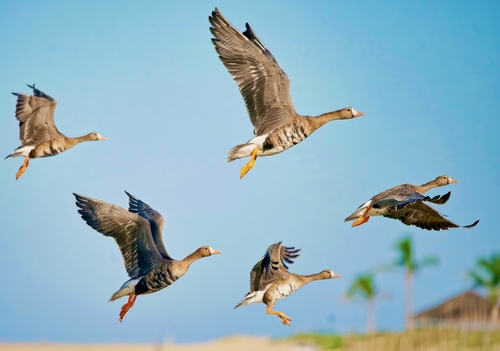
Greater White-fronted Goose (Anser albifrons) Greater White-fronted Goose
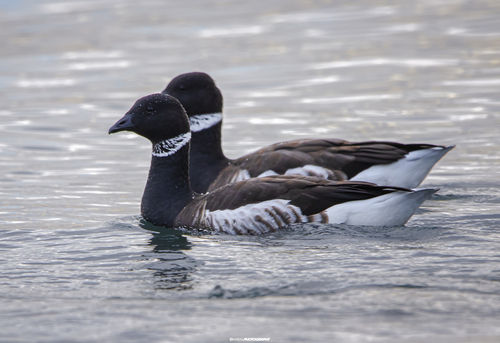
Brent Goose (Branta bernicla) Brent Goose

Media

Loading…

In short

The most reliable field mark between Greater White-fronted Goose and Brent Goose is the combination of bill color and facial pattern: Greater White-fronted Goose shows a pinkish or orange bill with a white blaze at the base, while Brent Goose has a short, dark bill and lacks any white on the face, instead showing a small white patch on the neck. In flight or at rest, Greater White-fronted Goose is larger, longer-necked, and bulkier, with orange legs, while Brent Goose is compact, short-necked, and has black legs. Juvenile and adult wing patterns are not strongly contrasting between the two, but the overall jizz and structural features are distinctive. Both species can be found together in winter coastal habitats, but Brent Goose is more strictly coastal and marine.

Identification tips

  1. Bill color and shape: Greater White-fronted Goose has a pinkish or orange bill (sometimes with a dark nail), which is longer and stouter than the Brent Goose's short, stubby, all-dark bill. This is reliable at all ages and distances with good light.
  2. Facial pattern: White-fronted Goose shows a white blaze at the base of the bill, extending up onto the forehead, present in all but juveniles. Brent Goose lacks any white on the face, instead showing a small white patch on the side of the neck (adults and most subspecies), never a blaze. Juvenile Brent Geese may lack the neck patch but still have a plain dark face.
  3. Leg color: White-fronted Goose has bright orange legs, while Brent Goose has black legs. This is a strong field mark when legs are visible.
  4. Overall structure: White-fronted Goose is larger, longer-necked, and bulkier, with a more upright stance. Brent Goose is compact, short-necked, and appears almost 'dumpy' by comparison. In flight, White-fronted's neck and body are more stretched, Brent's are compact.
  5. Upperwing pattern: White-fronted Goose (especially A. a. albifrons) shows pale fringes and prominent white tips to upperwing coverts, creating a wing-barred appearance in all ages. Brent Goose's upperwing is uniformly dark, lacking any pale barring or wing bars.
  6. Tail pattern: White-fronted Goose has a dark grey tail with a broad white tip and sides; Brent Goose has a very short, all-black tail with a pure white under-tail. The shortness and blackness of Brent's tail is unique among geese.
  7. Belly barring: Adult White-fronted Geese have variable dark belly bars or blotches, sometimes extensive, but this is not always reliable due to individual variation and can be absent in juveniles. Brent Goose never shows belly barring.
  8. Head and neck color: White-fronted Goose has a brownish head and neck (with white blaze), while Brent Goose has a black head and neck with a white neck patch. This contrast is especially strong in the black brant subspecies.
  9. Habitat: Brent Goose is almost always coastal in winter, feeding on saltmarshes and tidal flats; White-fronted Goose is more likely inland or in freshwater wetlands and fields. If seen far from the sea, Brent Goose is unlikely.
  10. Flock structure: White-fronted Goose flocks are often loose and mixed with other grey geese; Brent Goose flocks are tight, dense, and usually pure.
  11. Vocalizations: Listen for the high-pitched, laughing 'he-he' cackle of White-fronted Goose versus the softer, guttural 'rronk' of Brent Goose.
  12. Juvenile confusion: Juvenile White-fronted Geese lack the white blaze and may show less belly barring, but still have orange legs and a pale-tipped bill. Juvenile Brent Geese lack the neck patch but remain dark, compact, and short-billed.
  13. Subspecies variation: Be aware that Greenland White-fronted Geese (A. a. flavirostris) have a more orange-yellow bill and less obvious wing bars, but still show the white blaze and orange legs. Brent Goose subspecies vary in belly and flank color, but none ever show a white blaze or orange legs.
  14. Pitfalls: At long range or in poor light, the size and bill color may be hard to judge. Use a combination of structure, leg color, and facial pattern for best results.
  15. Sex and season: Both species are sexually monomorphic (males and females look alike), so sex is not useful for separation. Most field marks apply year-round, but juvenile White-fronted Geese may lack the white blaze in autumn.

Size

Greater White-fronted Goose is substantially larger: 64–81 cm in length, 130–165 cm wingspan, and 1.93–3.31 kg in weight [wikipedia][avonet][wikidata]. Brent Goose is smaller and more compact, at 55–66 cm length, 106–121 cm wingspan, and 0.88–2.2 kg in weight. In the field, White-fronted Goose appears longer-necked and heavier-bodied, while Brent Goose looks short-necked, stubby, and much lighter. Size alone is a strong clue if both are seen together.

Plumage

Juvenile and immature wing patterns are not highlighted as key separation points in these species, but some differences exist in upperwing and body plumage. Greater White-fronted Goose (especially the European A. a. albifrons subspecies) shows obvious pale fringes on the mantle, scapulars, and upperwing coverts, creating a barred or wing-barred effect in all ages, with prominent white tips to greater coverts. Brent Goose, in all subspecies and ages, lacks these pale fringes and wing bars; its upperparts and upperwing coverts are uniformly dark grey-brown to sooty-black, with no pale barring or wing bars. The tail of Greater White-fronted Goose is dark grey with a broad white tip and sides, while Brent Goose has a very short, all-black tail with a pure white under-tail. Adult Greater White-fronted Geese have a white facial blaze at the bill base and variable dark belly barring (more extensive in some subspecies), while Brent Goose has a black head and neck with a small white neck patch (not a blaze), and the rest of the body is dark grey-brown to blackish, depending on subspecies. Juvenile Brent Geese lack the white neck patch but still show the overall dark, compact look. Bill color is also diagnostic: Greater White-fronted Goose has a pinkish or orange bill (with some variation), while Brent Goose always has a short, dark bill.

Behaviour

Greater White-fronted Goose is often seen grazing in open fields, marshes, or wet grasslands, usually in large, loosely spaced flocks. They walk with a steady, upright gait and may mix with other grey geese. Brent Goose is strictly coastal in winter, feeding on saltmarshes, tidal flats, and estuaries, often in dense, tight flocks. Their feeding is more hunched and compact, and they rarely venture far from saltwater. In flight, Greater White-fronted Goose appears longer-necked and more stretched, while Brent Goose is compact and short-necked, with rapid, shallow wingbeats.

Habitat

Habitat is a strong clue: Greater White-fronted Goose is found in a wide range of wetland habitats, including inland lakes, marshes, and agricultural fields, especially in winter. Brent Goose is almost exclusively coastal in winter, favoring saltmarshes, tidal flats, and estuaries. If the bird is far inland, it is much more likely to be Greater White-fronted Goose. Overlap can occur in coastal areas, but Brent Goose is rarely seen away from the sea.

Voice

Greater White-fronted Goose gives a high-pitched, laughing cackle, often transcribed as 'he-he', with a distinctive break between notes. Brent Goose is generally quieter, but when vocal, gives a soft, guttural 'rronk' or 'cronk', lacking the high-pitched cackle of White-fronted. Calls are useful if a flock is flushed or calling in flight.

Submit a better description

Use the same sections as the comparison. Your text is published immediately.

The most reliable field mark between Greater White-fronted Goose and Brent Goose is the combination of bill color and facial pattern: Greater White-fronted Goose shows a pinkish or orange bill with a white blaze at the base, while Brent Goose has a short, dark bill and lacks any white on the face, instead showing a small white patch on the neck. In flight or at rest, Greater White-fronted Goose is larger, longer-necked, and bulkier, with orange legs, while Brent Goose is compact, short-necked, and has black legs. Juvenile and adult wing patterns are not strongly contrasting between the two, but the overall jizz and structural features are distinctive. Both species can be found together in winter coastal habitats, but Brent Goose is more strictly coastal and marine.

  1. Bill color and shape: Greater White-fronted Goose has a pinkish or orange bill (sometimes with a dark nail), which is longer and stouter than the Brent Goose's short, stubby, all-dark bill. This is reliable at all ages and distances with good light.
  2. Facial pattern: White-fronted Goose shows a white blaze at the base of the bill, extending up onto the forehead, present in all but juveniles. Brent Goose lacks any white on the face, instead showing a small white patch on the side of the neck (adults and most subspecies), never a blaze. Juvenile Brent Geese may lack the neck patch but still have a plain dark face.
  3. Leg color: White-fronted Goose has bright orange legs, while Brent Goose has black legs. This is a strong field mark when legs are visible.
  4. Overall structure: White-fronted Goose is larger, longer-necked, and bulkier, with a more upright stance. Brent Goose is compact, short-necked, and appears almost 'dumpy' by comparison. In flight, White-fronted's neck and body are more stretched, Brent's are compact.
  5. Upperwing pattern: White-fronted Goose (especially A. a. albifrons) shows pale fringes and prominent white tips to upperwing coverts, creating a wing-barred appearance in all ages. Brent Goose's upperwing is uniformly dark, lacking any pale barring or wing bars.
  6. Tail pattern: White-fronted Goose has a dark grey tail with a broad white tip and sides; Brent Goose has a very short, all-black tail with a pure white under-tail. The shortness and blackness of Brent's tail is unique among geese.
  7. Belly barring: Adult White-fronted Geese have variable dark belly bars or blotches, sometimes extensive, but this is not always reliable due to individual variation and can be absent in juveniles. Brent Goose never shows belly barring.
  8. Head and neck color: White-fronted Goose has a brownish head and neck (with white blaze), while Brent Goose has a black head and neck with a white neck patch. This contrast is especially strong in the black brant subspecies.
  9. Habitat: Brent Goose is almost always coastal in winter, feeding on saltmarshes and tidal flats; White-fronted Goose is more likely inland or in freshwater wetlands and fields. If seen far from the sea, Brent Goose is unlikely.
  10. Flock structure: White-fronted Goose flocks are often loose and mixed with other grey geese; Brent Goose flocks are tight, dense, and usually pure.
  11. Vocalizations: Listen for the high-pitched, laughing 'he-he' cackle of White-fronted Goose versus the softer, guttural 'rronk' of Brent Goose.
  12. Juvenile confusion: Juvenile White-fronted Geese lack the white blaze and may show less belly barring, but still have orange legs and a pale-tipped bill. Juvenile Brent Geese lack the neck patch but remain dark, compact, and short-billed.
  13. Subspecies variation: Be aware that Greenland White-fronted Geese (A. a. flavirostris) have a more orange-yellow bill and less obvious wing bars, but still show the white blaze and orange legs. Brent Goose subspecies vary in belly and flank color, but none ever show a white blaze or orange legs.
  14. Pitfalls: At long range or in poor light, the size and bill color may be hard to judge. Use a combination of structure, leg color, and facial pattern for best results.
  15. Sex and season: Both species are sexually monomorphic (males and females look alike), so sex is not useful for separation. Most field marks apply year-round, but juvenile White-fronted Geese may lack the white blaze in autumn.

Greater White-fronted Goose is substantially larger: 64–81 cm in length, 130–165 cm wingspan, and 1.93–3.31 kg in weight [wikipedia][avonet][wikidata]. Brent Goose is smaller and more compact, at 55–66 cm length, 106–121 cm wingspan, and 0.88–2.2 kg in weight. In the field, White-fronted Goose appears longer-necked and heavier-bodied, while Brent Goose looks short-necked, stubby, and much lighter. Size alone is a strong clue if both are seen together.

Juvenile and immature wing patterns are not highlighted as key separation points in these species, but some differences exist in upperwing and body plumage. Greater White-fronted Goose (especially the European A. a. albifrons subspecies) shows obvious pale fringes on the mantle, scapulars, and upperwing coverts, creating a barred or wing-barred effect in all ages, with prominent white tips to greater coverts. Brent Goose, in all subspecies and ages, lacks these pale fringes and wing bars; its upperparts and upperwing coverts are uniformly dark grey-brown to sooty-black, with no pale barring or wing bars. The tail of Greater White-fronted Goose is dark grey with a broad white tip and sides, while Brent Goose has a very short, all-black tail with a pure white under-tail. Adult Greater White-fronted Geese have a white facial blaze at the bill base and variable dark belly barring (more extensive in some subspecies), while Brent Goose has a black head and neck with a small white neck patch (not a blaze), and the rest of the body is dark grey-brown to blackish, depending on subspecies. Juvenile Brent Geese lack the white neck patch but still show the overall dark, compact look. Bill color is also diagnostic: Greater White-fronted Goose has a pinkish or orange bill (with some variation), while Brent Goose always has a short, dark bill.

Greater White-fronted Goose is often seen grazing in open fields, marshes, or wet grasslands, usually in large, loosely spaced flocks. They walk with a steady, upright gait and may mix with other grey geese. Brent Goose is strictly coastal in winter, feeding on saltmarshes, tidal flats, and estuaries, often in dense, tight flocks. Their feeding is more hunched and compact, and they rarely venture far from saltwater. In flight, Greater White-fronted Goose appears longer-necked and more stretched, while Brent Goose is compact and short-necked, with rapid, shallow wingbeats.

Habitat is a strong clue: Greater White-fronted Goose is found in a wide range of wetland habitats, including inland lakes, marshes, and agricultural fields, especially in winter. Brent Goose is almost exclusively coastal in winter, favoring saltmarshes, tidal flats, and estuaries. If the bird is far inland, it is much more likely to be Greater White-fronted Goose. Overlap can occur in coastal areas, but Brent Goose is rarely seen away from the sea.

Greater White-fronted Goose gives a high-pitched, laughing cackle, often transcribed as 'he-he', with a distinctive break between notes. Brent Goose is generally quieter, but when vocal, gives a soft, guttural 'rronk' or 'cronk', lacking the high-pitched cackle of White-fronted. Calls are useful if a flock is flushed or calling in flight.

Discard your changes?

You have unsaved edits. If you leave now, those changes will be lost.

Greater White-fronted Goose · Brent Goose · My Tricky Birds