

Greater White-fronted Goose vs Barnacle Goose
Anser albifrons versus Branta leucopsis
Play a quiz with Greater White-fronted Goose and Barnacle Goose
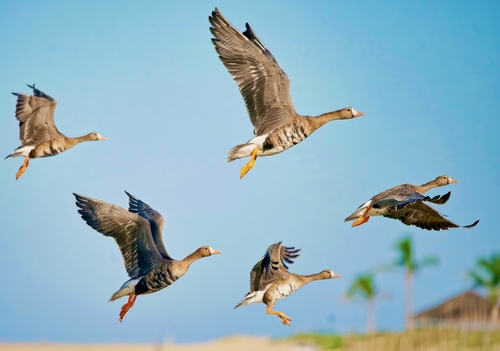 Greater White-fronted Goose
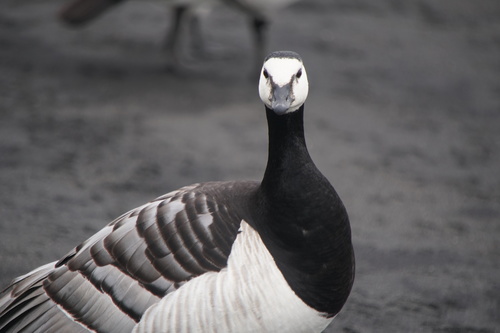 Barnacle Goose
In short
The most reliable field mark to separate Greater White-fronted Goose from Barnacle Goose is the head and neck pattern: Barnacle Goose has a striking black neck and head with a white face, while Greater White-fronted Goose shows a plain brownish-gray head and neck with a white blaze at the bill base. In flight, Barnacle Goose reveals a bold white rump and silvery underwings, whereas Greater White-fronted Goose lacks these features and shows more uniform mouse-gray upperwings. Juveniles of both species are similar to adults, but Barnacle Goose juveniles have more rounded mantle and flank feathers. Structurally, Greater White-fronted Goose is larger and longer-billed, with orange legs and a pinkish bill, while Barnacle Goose is smaller, with a short, stubby black bill and black legs. These differences are visible both on the ground and in flight.
Identification tips
- Head and Neck Pattern: Barnacle Goose always shows a black neck and head with a white face patch; Greater White-fronted Goose has a plain brownish-gray head and neck with a white blaze at the bill base only. This is the fastest field check at any age.
- Bill Color and Shape: Greater White-fronted Goose has a pinkish bill (sometimes orange-yellow in Greenland birds), longer and stouter than the small, stubby black bill of Barnacle Goose. Bill color is especially useful at close range.
- Leg Color: Greater White-fronted Goose has bright orange legs, while Barnacle Goose has black legs. This is visible when birds are on the ground or swimming.
- Body Color and Pattern: Barnacle Goose is sharply patterned with a white belly, black breast, and silver-grey barred upperparts; Greater White-fronted Goose is overall brownish-grey with variable dark belly barring and lacks the crisp contrast of Barnacle.
- Upperwing in Flight: Barnacle Goose shows a silvery-grey underwing and a striking white rump patch in flight; Greater White-fronted Goose has mouse-colored upperwing coverts and lacks a white rump, appearing more uniform and duller above.
- Juvenile Plumage: Juvenile Barnacle Geese have more rounded mantle and flank feathers but already show the black-and-white face/neck pattern; Greater White-fronted juveniles look similar to adults but lack strong facial contrast.
- Tail Pattern: Barnacle Goose has a white rump and tail sides forming a V in flight; Greater White-fronted Goose has a darker tail with a white tip and sides, but these are narrower and less obvious.
- Size and Structure: Greater White-fronted Goose is larger, longer-necked, and heavier-bodied than Barnacle Goose, which is more compact and short-necked. In mixed flocks, the size difference is clear.
- Jizz in Flight: Barnacle Goose flocks look neater, more compact, and show more black-and-white contrast; Greater White-fronted flocks are browner and less sharply marked.
- Voice: Listen for the high-pitched cackling of Greater White-fronted vs. the yapping, barking calls of Barnacle, but use with caution in noisy flocks.
- White Blaze: The white blaze on Greater White-fronted Goose is limited to the base of the bill and does not extend up the face, unlike the full white face of Barnacle Goose.
- Belly Barring: While Greater White-fronted Goose often shows dark belly bars, this is variable and not always present; Barnacle Goose has a clean white belly.
- Bill Nail: Barnacle Goose's bill is entirely black; Greater White-fronted may show a dark nail, but the bill is otherwise pinkish or orange-yellow.
- Context: If you see a flock with both species, use the combination of head pattern, bill color, and size for rapid separation.
- Pitfalls: Do not rely on habitat or flocking behavior alone, as both species can occur together in winter fields and wetlands.
Size
Greater White-fronted Goose is distinctly larger and heavier than Barnacle Goose. While exact AVONET mass is not given for Greater White-fronted, it typically weighs 1.93–3.31 kg and measures 64–81 cm in length with a wingspan of 130–165 cm. Barnacle Goose is lighter, with a mean body mass of 1687 g (1.21–2.23 kg), length of 55–70 cm, and wingspan of 120–145 cm. In mixed flocks, Greater White-fronted will stand out as the bulkier, longer-necked bird.
Plumage
Juvenile and adult Barnacle Geese both show a bold white face and black neck, which is never matched by Greater White-fronted Goose at any age. In flight, Barnacle Goose has a conspicuous V-shaped white rump patch and silvery-grey underwing linings, while Greater White-fronted Goose lacks a white rump and instead shows mouse-colored upperwing coverts and a more uniform upperwing. Greater White-fronted Goose adults have a white blaze at the bill base (not extending far up the face), orange legs, and a pinkish bill; their body is grey-brown with dark belly bars, but belly barring is variable and not always reliable. Barnacle Goose has a white belly, black breast, and barred silver-grey upperparts, with black legs and a small black bill. Juvenile Barnacle Geese can be told by their rounded mantle and flank feathers, but their face and neck pattern is already distinctive. There is no seasonal or sex-based plumage difference in either species that would cause confusion.
Behaviour
Both species are social and often seen in flocks, especially during migration and winter. Greater White-fronted Goose tends to feed in open fields and marshes, often with other Anser geese, and can appear more wary and alert. Barnacle Goose is also gregarious but may be more approachable in some areas. In flight, Barnacle Goose flocks can appear neater and more compact, with their striking black-and-white pattern visible at a distance, while Greater White-fronted Goose flocks look browner and less contrasting.
Habitat
Both species can be found in similar wetland and agricultural habitats in winter, especially in Europe. Greater White-fronted Goose breeds in Arctic tundra and winters in lowland fields, marshes, and lakes. Barnacle Goose also breeds in the Arctic but is more coastal in its breeding range and winters in similar lowland habitats. Habitat alone is not a reliable separator where their ranges overlap.
Voice
Greater White-fronted Goose gives a high-pitched cackling call, often described as 'he-he', with a distinct break between notes. Barnacle Goose has a more yapping, barking call, higher-pitched and less cackling than Greater White-fronted. However, calls are not always diagnostic at a distance or in mixed flocks.
Greater White-fronted Goose · Barnacle Goose · My Tricky Birds