
Greater Spotted Eagle vs Golden Eagle
Clanga clanga versus Aquila chrysaetos
Play a quiz with Greater Spotted Eagle and Golden Eagle
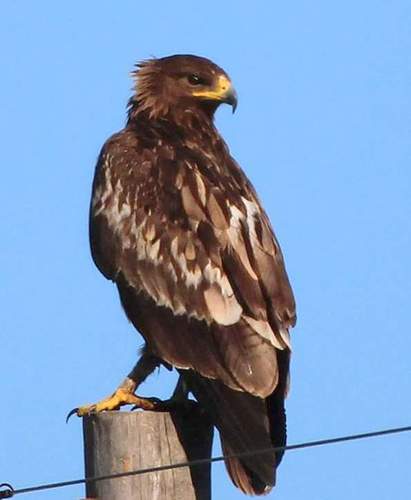 Greater Spotted Eagle
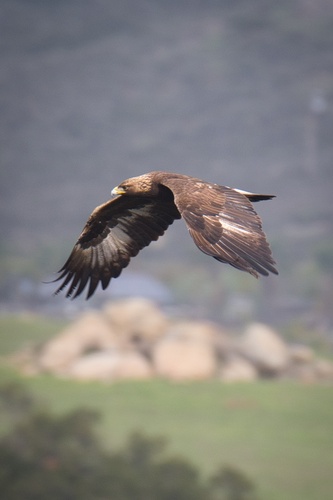 Golden Eagle
In short
The most reliable field mark between Greater Spotted Eagle and Golden Eagle is the combination of overall size and wing structure: Golden Eagles are much larger, with longer tails and broader, more rectangular wings, while Greater Spotted Eagles are smaller and more compact, with relatively shorter tails and broader wings for their size. In flight, juvenile Golden Eagles show distinctive white patches at the base of the primaries and tail, which are never as extensive or clean-cut in Greater Spotted Eagle. Adult Golden Eagles have a golden nape, lacking in Greater Spotted Eagle, which is overall darker and more uniform. Structural differences, especially in perched birds, and the presence or absence of white in the wings and tail of immatures, are key for separation.
Identification tips
- Juvenile wing and tail pattern: Juvenile Golden Eagles show large, sharply defined white patches at the base of the primaries and a broad white band at the base of the tail; Greater Spotted Eagle juveniles lack these bold white areas, showing instead some pale spots or bars but never such extensive white. This is the single most reliable mark in flight for immatures.
- Adult nape color: Adult Golden Eagles have a golden or rufous nape forming a 'shawl', visible at close range or in good light; Greater Spotted Eagles lack this, with the nape only slightly paler than the rest of the plumage at best.
- Overall size and structure: Golden Eagles are much larger and bulkier, with longer tails and broader, more rectangular wings; Greater Spotted Eagles are smaller, with shorter tails and relatively broader wings for their size, giving a more compact, less elongated impression.
- Wing shape in flight: Golden Eagles have long, broad wings with a straight trailing edge and a pronounced dihedral (V-shape) when soaring; Greater Spotted Eagles have shorter, broader wings, often appearing more rounded and less angular, and do not typically soar with such a pronounced dihedral.
- Tail length: The tail of a Golden Eagle is noticeably longer, often appearing two to three times the length of the head in flight; Greater Spotted Eagle has a shorter, squarer tail.
- Upperwing coverts: Greater Spotted Eagles have uniform, dark upperwing coverts, lacking the rusty or paler tones sometimes seen in Golden Eagles.
- Plumage contrast: Golden Eagles, especially adults, show a richer brown with golden nape, while Greater Spotted Eagles are more uniformly dark, almost blackish-brown, with less contrast overall.
- Head and bill: Golden Eagles have a larger, more protruding head and a heavier bill; Greater Spotted Eagles have a smaller head and bill, contributing to their more compact look.
- Flight style: Golden Eagles fly with powerful, steady wingbeats and long glides; Greater Spotted Eagles have a more buoyant, less forceful flight.
- Perched posture: Golden Eagles appear larger, more upright, and longer-necked when perched; Greater Spotted Eagles are more hunched and compact.
- Habitat context: Golden Eagles are more likely in upland, mountainous, or open moorland habitats; Greater Spotted Eagles are more often found near wetlands, river valleys, or forest edges, especially in migration.
- Juvenile nape patch: Juvenile Greater Spotted Eagles may show a slightly paler nape, but never the rich golden or rufous of Golden Eagle; this can help in close views.
- Underwing pattern: Golden Eagles lack the strong barring or spotting sometimes present in juvenile Greater Spotted Eagles, which may show more patterning on the underwing coverts.
- Sex and age overlap: Female Greater Spotted Eagles can approach the size of small male Golden Eagles, but the structural and plumage differences above remain reliable.
- Beware hybrids and outliers: Some hybrids or aberrant individuals may show intermediate features; always use a combination of marks, especially structure and age-specific wing/tail patterns.
Size
Golden Eagle is dramatically larger than Greater Spotted Eagle, with an average adult mass of about 4383 g [wikidata], compared to the smaller, unlisted but significantly lighter Greater Spotted Eagle. Golden Eagles have a much longer wingspan and tail, and appear bulkier and more imposing both in flight and perched. Even the largest female Greater Spotted Eagle is notably smaller than a typical Golden Eagle, and the difference is usually obvious with experience, though distant or lone birds can be misleading.
Plumage
Juvenile Golden Eagles (and some immatures) show bold white patches at the base of the primaries and a broad white band at the base of the tail, contrasting with otherwise dark wings and body. These white areas are sharply defined and extensive, especially in the first year or two, and are not matched by Greater Spotted Eagle, whose juveniles may show some pale spots but never such large, clean white panels. Juvenile Greater Spotted Eagles are overall dark brown, sometimes with paler tips to the coverts and a slightly paler nape, but never with the golden nape of adult Golden Eagle. Adult Golden Eagles are dark brown with a golden to rufous nape and lack the uniform dark upperwing coverts of Greater Spotted Eagle. Greater Spotted Eagles, both adult and juvenile, are more uniformly dark, with less contrast and no golden nape; their upperwing coverts are dark and uniform, not rusty or pale. In all ages, Golden Eagles have a longer tail and a more pronounced golden nape, while Greater Spotted Eagles remain more compact and darker overall.
Behaviour
Golden Eagles often soar with wings held in a shallow dihedral (V-shape), and their flight is powerful and steady. They may also glide with wings flat, but the long tail and broad wings are distinctive. Greater Spotted Eagles have broader, shorter wings relative to their body and a shorter tail, giving a more compact impression in flight. Their flight is less forceful and more buoyant, and they may appear less steady than Golden Eagles. Perched, Golden Eagles look larger and more upright, with a longer tail and neck, while Greater Spotted Eagles are more compact and hunched.
Habitat
Both species can occur in open country, but Golden Eagles are more typically associated with mountainous or hilly terrain, open moorland, and large expanses of wilderness. Greater Spotted Eagles are more often found in lowland wetlands, river valleys, and forest edges, especially during migration and winter. Habitat can provide a clue, but is not diagnostic where ranges overlap or during migration.