

Greater Flamingo vs James's Flamingo
Phoenicopterus roseus versus Phoenicoparrus jamesi
Play a quiz with Greater Flamingo and James's Flamingo
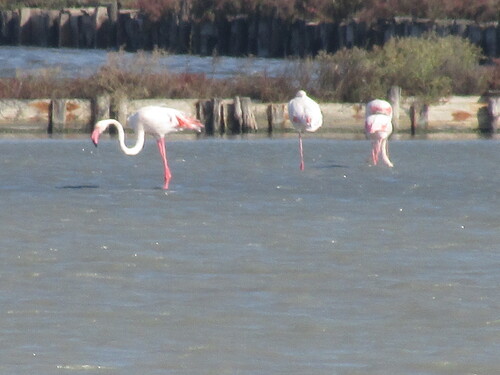 Greater Flamingo
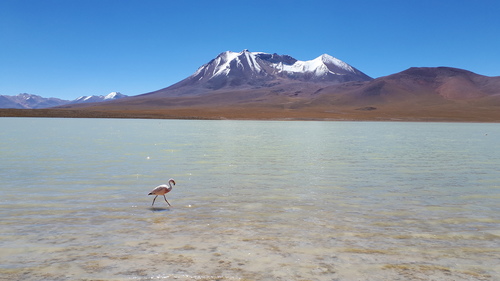 James's Flamingo
In short
The most reliable field mark to separate Greater Flamingo from James's Flamingo is the bill and leg coloration in adults: Greater Flamingo shows a pink bill with only a black tip and entirely pink legs, while James's Flamingo has a bright yellow bill with a black tip and brick-red legs. In flight or when perched, Greater Flamingo displays red wing coverts and black primaries/secondaries, whereas James's Flamingo's pale pink plumage is accented by bright carmine streaks on the neck and back, and only a small amount of black is visible in the wings when perched. Immature birds of both species are paler, but the bill and leg colors remain the best clues. Greater Flamingo is much larger and bulkier than James's Flamingo, which is more delicate and shorter-necked. Habitat also helps: Greater Flamingo is found in lowland saline lagoons and mudflats of the Old World, while James's Flamingo is restricted to high Andean plateaus of South America.
Identification tips
- Bill color and pattern: Adult Greater Flamingo has a pink bill with a restricted black tip; James's Flamingo has a bright yellow bill with a black tip. This is the most consistent mark at all ages except chicks.
- Leg color: Greater Flamingo's legs are entirely pink in adults; James's Flamingo's are brick red. Subadult Greater Flamingos may have dark legs, but never brick red.
- Size and structure: Greater Flamingo is much larger and bulkier, with a longer neck and legs. James's Flamingo is smaller, more delicate, and shorter-necked. This is most obvious when both species are together, but can be judged with experience.
- Wing coverts and flight feathers (adults): In flight, Greater Flamingo shows red wing coverts and black primaries/secondaries; James's Flamingo shows pale wings with carmine streaks and only a small amount of black (flight feathers) visible when perched.
- Plumage tone: Greater Flamingo is pinkish-white overall, with red highlights limited to the wing coverts. James's Flamingo is very pale pink with bright carmine streaks on the neck and back.
- Juvenile/immature birds: Both are paler than adults, but Greater Flamingo juveniles are grey with dark legs, while James's Flamingo juveniles are grey or white and gradually become pale pink with age. Bill color remains a key clue as it develops early.
- Eye and face: James's Flamingo has bright red skin around the eyes and yellow irises in adults; this is less obvious in the field but can help at close range.
- Feet: James's Flamingo (and all Phoenicoparrus flamingos) lack a hind toe (hallux), while Greater Flamingo has three forward-facing toes plus a hallux. This is only visible at very close range or in photos.
- Habitat: Greater Flamingo is found in lowland saline lagoons and mudflats (Old World); James's Flamingo is restricted to high Andean saline lakes (South America).
- Geographic range: If observed outside the Andes, James's Flamingo is extremely unlikely; if outside the Old World, Greater Flamingo is unlikely.
- Voice: Greater Flamingo's loud, goose-like honking is distinctive; James's Flamingo's calls are less well described and not a primary field mark.
- Group composition: Greater Flamingos often form very large, dense flocks; James's Flamingos also flock but usually in smaller numbers and only at high-altitude lakes.
- Courtship display: Both species display in groups, but display complexity and group size are more pronounced in Greater Flamingo colonies.
- Seasonal variation: Both species' adults become brighter in the breeding season due to increased preening with pigmented oils, but the basic color differences remain.
- Sexual dimorphism: Neither species shows sex-based plumage differences; all field marks apply to both sexes.
Size
Greater Flamingo is substantially larger, with a body length averaging 1325 mm (132.5 cm) [wikidata], compared to James's Flamingo, which measures about 900–920 mm (90–92 cm) [wikipedia]. Greater Flamingo is also heavier (2–4 kg vs. about 2 kg for James's). In the field, Greater Flamingo looks taller, bulkier, and longer-necked, while James's Flamingo is more compact and delicate. When seen together, the size difference is striking, but beware that lone birds or distant flocks can make size hard to judge.
Plumage
Juvenile and immature Greater Flamingos are pale grey with dark legs, lacking the strong pink tones of adults, and their wing coverts are not yet red; chicks are grey and fluffy. Subadults are paler overall but still larger and bulkier than James's. Adult Greater Flamingos have pinkish-white bodies, red wing coverts, and black primaries and secondaries; legs are entirely pink, and the bill is pink with a black tip. James's Flamingo, in contrast, is very pale pink overall with bright carmine streaks on the neck and back, and only a small amount of black visible in the wings when perched (the black flight feathers). The bill is bright yellow with a black tip, and the legs are brick red. Both species' chicks are grey or white and gradually acquire pink tones by 2–3 years of age, but James's Flamingo never attains the deep pink or red wing coverts of Greater Flamingo. There is no sexual dimorphism in either species. In flight, Greater Flamingo's red wing coverts and black flight feathers are obvious, while James's Flamingo shows pale wings with carmine streaks and limited black.
Behaviour
Both species feed by stirring up mud and filtering food through their specialized bills with their heads down. Greater Flamingo is often seen in large, noisy flocks in shallow coastal lagoons and mudflats, while James's Flamingo forms colonies at high-elevation Andean lakes. Courtship displays are elaborate in both, involving synchronized group movements. Greater Flamingo is known for its loud, goose-like honking, especially in feeding or breeding groups. James's Flamingo's display involves neck stretching and vocalizations, but specific calls are not described in the notes.
Habitat
Habitat is a strong separator. Greater Flamingo inhabits lowland saline lagoons, mudflats, and shallow coastal waters in the Old World (Africa, southern Europe, Middle East, Indian subcontinent). James's Flamingo is restricted to high-altitude Andean plateaus (Peru, Chile, Bolivia, NW Argentina), breeding and feeding at saline lakes above 3500 meters. If you see a flamingo in the Old World or at sea level, it is almost certainly Greater Flamingo; if at a high Andean lake, it is James's Flamingo.
Voice
Greater Flamingo gives a loud, goose-like honking call, often heard in flight or in feeding flocks. There is no detailed description of James's Flamingo's calls in the notes, but their display includes vocalizations. In practice, vocalizations are not the most reliable field mark for separating these two species.