

Motmot

Greater Coucal vs Lesser Coucal

Centropus sinensis versus Centropus bengalensis

Play a quiz with Greater Coucal and Lesser Coucal

Greater Coucal (Centropus sinensis) Greater Coucal
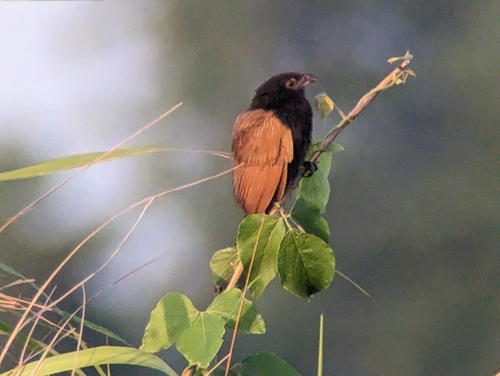
Lesser Coucal (Centropus bengalensis) Lesser Coucal

Media

Loading…

In short

The most reliable field mark between Greater Coucal and Lesser Coucal is the presence of pale shaft streaks on the head and back feathers in Lesser Coucal (especially in non-breeding plumage), which are absent in Greater Coucal. Juvenile Lesser Coucals show barred and spotted underparts and tail, while juvenile Greater Coucals (northern races) have whitish barring below but are otherwise duller black. Adults of Greater Coucal are distinctly larger, with a heavier, crow-like build, ruby-red eyes, and unmarked glossy black upperparts contrasting with rich chestnut wings. Lesser Coucal is noticeably smaller, with a shorter bill, darker brown iris, and a much longer hind claw. Both species can overlap in habitat, but Lesser Coucal is more often found in marshy grasslands, while Greater Coucal is more adaptable to gardens and denser cover.

Identification tips

  1. Pale shaft streaks (Lesser Coucal only): In non-breeding plumage, Lesser Coucal shows obvious pale shaft streaks on the head, back, and wing coverts; Greater Coucal never shows these at any age or season.
  2. Iris color: Greater Coucal has striking ruby-red eyes in adults, while Lesser Coucal’s iris is dark brown. This is visible at close range or in good light.
  3. Size and structure: Greater Coucal is much larger and heavier, with a longer tail and more robust, crow-like build. Lesser Coucal is smaller, more slender, with a shorter bill and a very long hind claw (sometimes visible when perched).
  4. Bill shape: Greater Coucal has a heavier, deeper bill; Lesser Coucal’s bill is shorter and less bulky.
  5. Juvenile pattern: Juvenile Greater Coucal (northern races) shows whitish barring below and on the tail, while southern race juveniles are unmarked dull black below. Juvenile Lesser Coucal is browner with black spots and bars on the body and tail.
  6. Wing color: Both have rufous or chestnut wings, but Greater Coucal’s wings are richer coppery brown, while Lesser Coucal’s are paler and may show pale shaft streaks (especially in non-breeding plumage).
  7. Tail gloss: Greater Coucal’s tail is glossy with a purple or greenish sheen; Lesser Coucal’s tail is less glossy and may show barring in juveniles.
  8. Hind claw: Lesser Coucal’s hind claw is exceptionally long (the longest in the genus), sometimes visible in perched birds; Greater Coucal’s is shorter.
  9. Habitat: If seen in marshy grassland or reedbeds, Lesser Coucal is more likely; in gardens, dense scrub, or forest edge, Greater Coucal is more likely, but both can overlap.
  10. Flight style: Greater Coucal flies with heavy, floppy wingbeats and long glides; Lesser Coucal is more secretive and rarely flies far in the open.
  11. Voice: Greater Coucal’s deep, resonant 'coop-coop-coop' contrasts with Lesser Coucal’s softer, double 'whoot-woot' or 'kurook' notes.
  12. Sexes: Both sexes are similar in plumage; size difference is not useful in the field.
  13. Seasonal change: Only Lesser Coucal shows marked seasonal plumage change (breeding vs non-breeding) with pale shaft streaks appearing in non-breeding birds.
  14. Subspecies confusion: Some races of Greater Coucal (e.g., parroti) may have more brownish or blue-glossed underparts, but still lack pale shaft streaks and have red eyes.
  15. Common pitfalls: Immature Greater Coucal (southern races) can appear very dark and unmarked, but will still lack the pale shaft streaks and have a bulkier build and red eyes; Lesser Coucal’s pale shaft streaks and long hind claw are the best clues.

Size

Greater Coucal is significantly larger and heavier (body mass ~283g) with a more robust, crow-like structure and a longer tail. Lesser Coucal is smaller and more slender, with a noticeably shorter bill and a much longer hind claw (the longest in the genus). The size difference is usually apparent when seen side by side, but can be subtle if only one bird is observed. Females of both species are slightly larger than males, but this is not useful in field separation.

Plumage

Juvenile and immature birds are often confused. Juvenile Greater Coucal (northern races) shows duller black plumage with spots on the crown and whitish bars on the underside and tail; southern race juveniles are unmarked dull black below and have dusky chestnut wings. Juvenile Lesser Coucal is browner overall, with black spots and bars on the body and tail. In adults, Greater Coucal has a glossy black head, upper mantle, and underparts with a purple sheen, and rich chestnut (coppery brown) wings; there are no pale shaft streaks. Lesser Coucal adults in breeding plumage have a glossy blackish head and back with dark feather shafts, but in non-breeding plumage, the pale feather shafts on the head and back create obvious whitish streaks, and the wing coverts also show pale shafts. The iris is ruby red in Greater Coucal and dark brown in Lesser Coucal. Both have rufous wings, but the wing color is paler rufous in some Greater Coucal races (e.g., bubutus).

Behaviour

Greater Coucal is often seen moving slowly in dense vegetation, gardens, or open country, sometimes flying with heavy, floppy wingbeats and long glides. Lesser Coucal is more secretive, usually found singly or in pairs low in marshy grass or reedbeds, rarely venturing into open spaces. Lesser Coucal’s extremely long hind claw is sometimes visible when perched. Both species are non-parasitic cuckoos and build domed nests in dense cover.

Habitat

Both species overlap widely in the Indian subcontinent and Southeast Asia. Greater Coucal is more of a habitat generalist, found in jungles, cultivation, and urban gardens, while Lesser Coucal prefers marshy land with grass and scattered trees, and is less likely in urban or heavily wooded areas. In the Western Ghats and some other regions, both may occur together, but Lesser Coucal is more tied to wet, grassy habitats.

Voice

Greater Coucal’s calls vary by race but are generally deep, resonant 'coop-coop-coop' or 'whoop' notes, often repeated and carrying far. Lesser Coucal gives a series of low, double 'whoot-woot' or 'kurook' notes that speed up and descend in pitch. The difference is subtle but, with experience, Lesser Coucal’s call is softer and less resonant than Greater Coucal’s.

Submit a better description

Use the same sections as the comparison. Your text is published immediately.

The most reliable field mark between Greater Coucal and Lesser Coucal is the presence of pale shaft streaks on the head and back feathers in Lesser Coucal (especially in non-breeding plumage), which are absent in Greater Coucal. Juvenile Lesser Coucals show barred and spotted underparts and tail, while juvenile Greater Coucals (northern races) have whitish barring below but are otherwise duller black. Adults of Greater Coucal are distinctly larger, with a heavier, crow-like build, ruby-red eyes, and unmarked glossy black upperparts contrasting with rich chestnut wings. Lesser Coucal is noticeably smaller, with a shorter bill, darker brown iris, and a much longer hind claw. Both species can overlap in habitat, but Lesser Coucal is more often found in marshy grasslands, while Greater Coucal is more adaptable to gardens and denser cover.

  1. Pale shaft streaks (Lesser Coucal only): In non-breeding plumage, Lesser Coucal shows obvious pale shaft streaks on the head, back, and wing coverts; Greater Coucal never shows these at any age or season.
  2. Iris color: Greater Coucal has striking ruby-red eyes in adults, while Lesser Coucal’s iris is dark brown. This is visible at close range or in good light.
  3. Size and structure: Greater Coucal is much larger and heavier, with a longer tail and more robust, crow-like build. Lesser Coucal is smaller, more slender, with a shorter bill and a very long hind claw (sometimes visible when perched).
  4. Bill shape: Greater Coucal has a heavier, deeper bill; Lesser Coucal’s bill is shorter and less bulky.
  5. Juvenile pattern: Juvenile Greater Coucal (northern races) shows whitish barring below and on the tail, while southern race juveniles are unmarked dull black below. Juvenile Lesser Coucal is browner with black spots and bars on the body and tail.
  6. Wing color: Both have rufous or chestnut wings, but Greater Coucal’s wings are richer coppery brown, while Lesser Coucal’s are paler and may show pale shaft streaks (especially in non-breeding plumage).
  7. Tail gloss: Greater Coucal’s tail is glossy with a purple or greenish sheen; Lesser Coucal’s tail is less glossy and may show barring in juveniles.
  8. Hind claw: Lesser Coucal’s hind claw is exceptionally long (the longest in the genus), sometimes visible in perched birds; Greater Coucal’s is shorter.
  9. Habitat: If seen in marshy grassland or reedbeds, Lesser Coucal is more likely; in gardens, dense scrub, or forest edge, Greater Coucal is more likely, but both can overlap.
  10. Flight style: Greater Coucal flies with heavy, floppy wingbeats and long glides; Lesser Coucal is more secretive and rarely flies far in the open.
  11. Voice: Greater Coucal’s deep, resonant 'coop-coop-coop' contrasts with Lesser Coucal’s softer, double 'whoot-woot' or 'kurook' notes.
  12. Sexes: Both sexes are similar in plumage; size difference is not useful in the field.
  13. Seasonal change: Only Lesser Coucal shows marked seasonal plumage change (breeding vs non-breeding) with pale shaft streaks appearing in non-breeding birds.
  14. Subspecies confusion: Some races of Greater Coucal (e.g., parroti) may have more brownish or blue-glossed underparts, but still lack pale shaft streaks and have red eyes.
  15. Common pitfalls: Immature Greater Coucal (southern races) can appear very dark and unmarked, but will still lack the pale shaft streaks and have a bulkier build and red eyes; Lesser Coucal’s pale shaft streaks and long hind claw are the best clues.

Greater Coucal is significantly larger and heavier (body mass ~283g) with a more robust, crow-like structure and a longer tail. Lesser Coucal is smaller and more slender, with a noticeably shorter bill and a much longer hind claw (the longest in the genus). The size difference is usually apparent when seen side by side, but can be subtle if only one bird is observed. Females of both species are slightly larger than males, but this is not useful in field separation.

Juvenile and immature birds are often confused. Juvenile Greater Coucal (northern races) shows duller black plumage with spots on the crown and whitish bars on the underside and tail; southern race juveniles are unmarked dull black below and have dusky chestnut wings. Juvenile Lesser Coucal is browner overall, with black spots and bars on the body and tail. In adults, Greater Coucal has a glossy black head, upper mantle, and underparts with a purple sheen, and rich chestnut (coppery brown) wings; there are no pale shaft streaks. Lesser Coucal adults in breeding plumage have a glossy blackish head and back with dark feather shafts, but in non-breeding plumage, the pale feather shafts on the head and back create obvious whitish streaks, and the wing coverts also show pale shafts. The iris is ruby red in Greater Coucal and dark brown in Lesser Coucal. Both have rufous wings, but the wing color is paler rufous in some Greater Coucal races (e.g., bubutus).

Greater Coucal is often seen moving slowly in dense vegetation, gardens, or open country, sometimes flying with heavy, floppy wingbeats and long glides. Lesser Coucal is more secretive, usually found singly or in pairs low in marshy grass or reedbeds, rarely venturing into open spaces. Lesser Coucal’s extremely long hind claw is sometimes visible when perched. Both species are non-parasitic cuckoos and build domed nests in dense cover.

Both species overlap widely in the Indian subcontinent and Southeast Asia. Greater Coucal is more of a habitat generalist, found in jungles, cultivation, and urban gardens, while Lesser Coucal prefers marshy land with grass and scattered trees, and is less likely in urban or heavily wooded areas. In the Western Ghats and some other regions, both may occur together, but Lesser Coucal is more tied to wet, grassy habitats.

Greater Coucal’s calls vary by race but are generally deep, resonant 'coop-coop-coop' or 'whoop' notes, often repeated and carrying far. Lesser Coucal gives a series of low, double 'whoot-woot' or 'kurook' notes that speed up and descend in pitch. The difference is subtle but, with experience, Lesser Coucal’s call is softer and less resonant than Greater Coucal’s.

Discard your changes?

You have unsaved edits. If you leave now, those changes will be lost.

Greater Coucal · Lesser Coucal · My Tricky Birds