

Greater Coucal vs Dark-necked Tailorbird
Centropus sinensis versus Orthotomus atrogularis
Play a quiz with Greater Coucal and Dark-necked Tailorbird
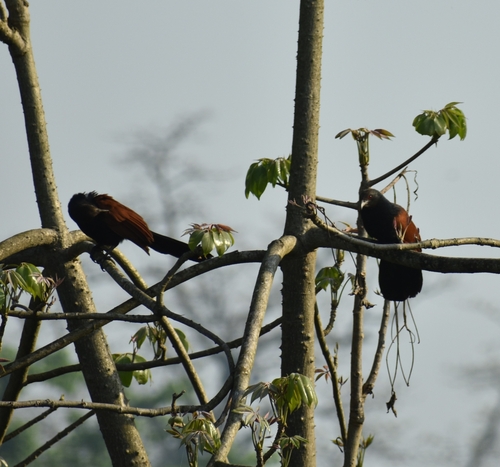 Greater Coucal
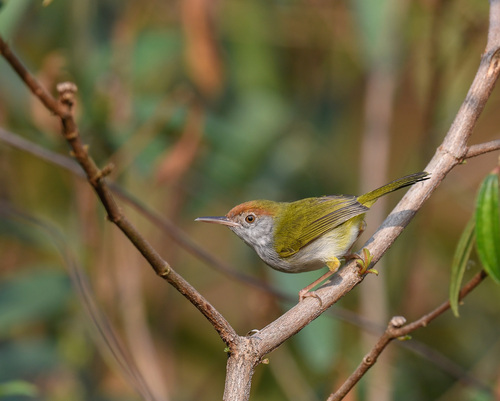 Dark-necked Tailorbird
In short
The most reliable way to separate Greater Coucal from Dark-necked Tailorbird is by size and structure: Greater Coucal is a massive, crow-sized bird with a long, heavy tail and coppery-brown wings, while Dark-necked Tailorbird is a tiny, active songbird. Juvenile Greater Coucals have barred underparts and tails, unlike any tailorbird. In all plumages, Coucals show a striking contrast between blackish head/body and chestnut wings, whereas Dark-necked Tailorbird is much smaller, with a warbler-like jizz and lacks the Coucal's heavy bill and long tail. Even at a distance, the size and silhouette difference is unmistakable.
Identification tips
- Size is the most immediate clue: Greater Coucal is enormous compared to Dark-necked Tailorbird; if you see a bird anywhere near crow or myna size, it cannot be a tailorbird.
- Tail shape and length: Coucal has a long, broad, graduated tail that often drags behind in flight or when perched. Tailorbird's tail is short, narrow, and often held cocked.
- Bill structure: Coucal's bill is thick, heavy, and slightly decurved, suited for a cuckoo. Tailorbird's bill is fine, straight, and pointed, typical of insectivorous warblers.
- Plumage contrast: Adult Coucal shows a striking contrast between glossy black head/body and rich chestnut wings. Tailorbird never shows this combination; it is greenish above and pale below, with a dark throat patch in males.
- Juvenile Coucal: Look for barred underparts and tail, and spots on the crown. No tailorbird shows this pattern at any age.
- Eye color: Coucal has ruby red eyes (adults); tailorbird's eye is dark and does not stand out.
- Behavior: Coucal moves slowly, often on the ground or low in dense cover; tailorbird is hyperactive, flitting and tail-flicking in low shrubs.
- Flight style: Coucal's flight is heavy, with slow, deep wingbeats and a long tail trailing; tailorbird's flight is weak, direct, and very brief.
- Habitat context: If seen in open fields, gardens, or edge habitats, Coucal is more likely; tailorbird is almost always in dense, tangled undergrowth.
- Sex differences: Both species are sexually similar in most respects, but male tailorbird has a darker throat patch; Coucal sexes are nearly identical, with females slightly larger.
- Vocalizations: While not detailed here, Coucal's call is deep and resonant, tailorbird's is high-pitched and rapid; confusion by voice is unlikely.
- Wing pattern: No distinctive upperwing pattern in flight for either species that would cause confusion, but Coucal's chestnut wings are obvious even in flight.
- Pitfalls: Do not confuse juvenile Coucal with tailorbird—size and tail length are always diagnostic. Tailorbird is never larger than a sparrow.
- Seasonal variation: Coucal's southern race (parroti) may look slightly browner on the head and underparts, but never approaches tailorbird's coloration or size.
- Geographic variation: Both species have races, but none overlap in appearance; Coucal races vary mainly in size and shade of chestnut, not in overall pattern.
Size
Greater Coucal is vastly larger (body mass ~283 g) and up to 48 cm long, approaching the size of a small crow. It has a long, broad tail and heavy, decurved bill. In contrast, Dark-necked Tailorbird is a very small songbird (no mass given, but typical tailorbirds are under 10 g and ~13 cm long), with a slim, short tail and fine, pointed bill. Even without direct comparison, the size gap is dramatic: Coucal dwarfs even the largest warblers or bulbuls, while Tailorbird is among the smallest birds in its range.
Plumage
Juvenile Greater Coucal is duller black with spots on the crown and whitish bars on the underside and tail, sometimes with unbarred wings in southern races. Adults have a glossy black head, upper mantle, and underparts, with rich chestnut wings and a long black tail. No pale shaft streaks on the coverts. The eye is ruby red. In contrast, Dark-necked Tailorbird lacks any black-and-chestnut combination or barring on underparts/tail. Its plumage is typical of tailorbirds: greenish or olive upperparts, paler underparts, and a dark (not glossy black) throat patch in males. No age of tailorbird shows the Coucal's heavy contrast or barring. Sexes are similar in Coucal; Tailorbird males have a darker throat. Juvenile Coucals can be confused with other coucals but not with tailorbirds.
Behaviour
Greater Coucal is often seen walking slowly on the ground or clambering through dense vegetation, sometimes flying with heavy, floppy wingbeats and long tail trailing. It is sluggish and deliberate. Dark-necked Tailorbird is extremely active, flitting rapidly through low foliage, often flicking its tail and rarely sitting still. Its flight is weak and direct, with short bursts between cover. The Coucal's slow, ground-based movement is unlike the restless, arboreal behavior of the tailorbird.
Habitat
Both species can occur in overlapping regions of South and Southeast Asia, but Greater Coucal prefers a wide range of habitats from dense jungle to cultivation and even urban gardens, often in thicker cover. Dark-necked Tailorbird is more restricted to subtropical or tropical moist lowland forests and mangroves, usually in dense undergrowth. Coucal is more likely in open or edge habitats, while tailorbird is a specialist of dense, tangled vegetation.
Voice
No direct comparison is available in the notes. Both species are vocal, but their calls are very different: Coucal gives deep, resonant 'coop-coop-coop' notes (not described here), while tailorbirds typically give high-pitched, rapid, warbler-like calls. Vocalizations alone are unlikely to cause confusion.