

Greater Coucal vs Baya Weaver
Centropus sinensis versus Ploceus philippinus
Play a quiz with Greater Coucal and Baya Weaver
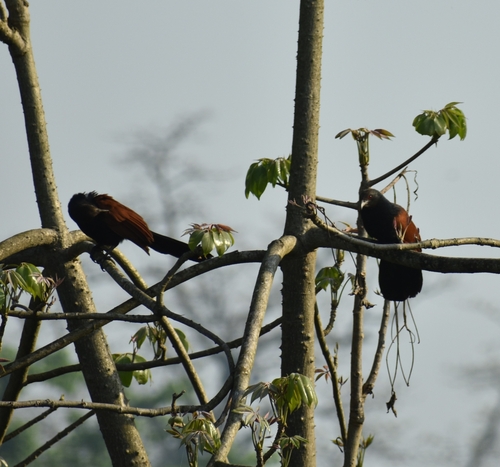 Greater Coucal
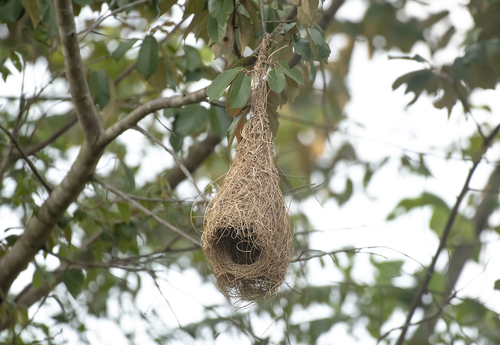 Baya Weaver
In short
The most reliable way to separate Greater Coucal from Baya Weaver is by overall size and structure: Greater Coucal is a massive, long-tailed, crow-sized bird with coppery-brown wings and a glossy black body, while Baya Weaver is a small, sparrow-sized, compact weaverbird. Juvenile Greater Coucals show barred underparts and tail, while juvenile Baya Weavers are plain and lack such markings. In flight or perched, the Coucal’s long tail and heavy bill are unmistakable compared to the short-tailed, conical-billed Baya Weaver. Both species can occur in similar open habitats, but their jizz, size, and plumage are dramatically different at all ages.
Identification tips
- Size is the quickest separator: Greater Coucal is nearly 10 times heavier than Baya Weaver; if the bird looks crow-sized, it cannot be a weaver.
- Tail length and shape: Coucal has a long, broad, graduated tail; Baya Weaver’s tail is short and square.
- Bill shape: Coucal’s bill is long, heavy, and slightly decurved; Baya Weaver’s is short, thick, and conical, typical of seed-eaters.
- Plumage (adult): Coucal adults are glossy black with coppery-chestnut wings; Baya Weaver adults are streaky brown above and pale below (non-breeding), or have a yellow crown (breeding male), but never show black gloss or chestnut wings.
- Plumage (juvenile): Juvenile Coucal shows barred underparts and tail, sometimes with spots on the crown; Baya Weaver juveniles are plain and lack barring or spots.
- Eye color: Coucal has striking ruby red eyes in adults; Baya Weaver’s eyes are dark and unremarkable.
- Flight style: Coucal flies with slow, heavy wingbeats and a long tail trailing; Baya Weaver’s flight is fast, bounding, and agile, with a short tail.
- Social behavior: Coucal is solitary or in pairs, rarely in groups; Baya Weaver is gregarious, often in flocks or nesting colonies.
- Habitat cues: Coucal prefers dense cover and is often seen skulking; Baya Weaver is more likely in open grassland or at nest colonies in trees near water.
- Nesting evidence: Hanging, retort-shaped nests in colonies are diagnostic for Baya Weaver; Coucal nests are hidden, cup-shaped, and never woven.
- Voice: Coucal’s deep, booming ‘coop-coop’ calls are unlike the Baya Weaver’s high-pitched chatters.
- Sex differences: Both species show little sexual dimorphism in the field except for the yellow crown of breeding male Baya Weavers; Coucal sexes are similar, though females are slightly larger.
- Seasonal changes: Only Baya Weaver males show a bright yellow crown in breeding season; Coucal does not change plumage seasonally.
- Common pitfalls: Immature Coucals may appear duller and less glossy, but still show barring and a long tail; Baya Weaver immatures never show barring or a long tail.
- Geographic variation: Coucal races differ subtly in gloss and chestnut tone, but always remain much larger and structurally distinct from any Baya Weaver.
Size
Greater Coucal is vastly larger, weighing about 283 g and reaching up to 48 cm in length, with a long, broad tail and heavy, slightly decurved bill [wikidata][wikipedia]. Baya Weaver is much smaller, about 25 g, with a compact, sparrow-like body and a short, thick, conical bill [wikidata]. Even at a distance, Coucal’s size and proportions are closer to a small crow, while Baya Weaver is never larger than a typical weaver or sparrow.
Plumage
- Juvenile/immature birds: Juvenile Greater Coucal is duller black with spots on the crown and whitish bars on the underside and tail, sometimes with unbarred wings (race-dependent). Baya Weaver juveniles are plain, lacking barring or spots, and resemble drab sparrows.
- Adults: Adult Greater Coucal has a glossy black head, upper mantle, and underparts with coppery-chestnut wings and a long, blackish tail. The eyes are striking ruby red. Baya Weaver adults (non-breeding) are streaky brown above and pale below, with no black gloss or chestnut wings; breeding males have a bright yellow crown and nape, but never show black gloss or chestnut in the wings.
- In flight: Coucal’s broad, rounded wings flash chestnut, and the long tail is obvious. Baya Weaver’s flight is fast and bounding, with short, rounded wings and a stubby tail; no chestnut or black gloss is visible.
Behaviour
Greater Coucal is typically solitary or in pairs, moving slowly and often skulking in dense vegetation, sometimes walking on the ground or flying with heavy, labored wingbeats and a long tail trailing behind. Baya Weaver is highly social, usually in flocks, and is most often seen actively feeding in grasslands or weaving nests in colonies. The Coucal’s flight is slow and direct, while Baya Weaver’s is quick, bounding, and agile.
Habitat
Both species can be found in open country, cultivated areas, and near human habitation across the Indian subcontinent and Southeast Asia [wikipedia]. Greater Coucal prefers dense undergrowth, thickets, and gardens, often close to cover. Baya Weaver favors grasslands, open scrub, and especially areas with suitable trees for nesting, often near water. The presence of hanging, retort-shaped nests in colonies is a strong indicator of Baya Weaver.
Voice
Greater Coucal gives deep, resonant, booming calls, often described as ‘coop-coop-coop’ or ‘whoop’ notes, which carry far and are usually delivered from cover. Baya Weaver’s calls are high-pitched, rapid, and chattering, often heard in flocks or at nesting colonies. Their vocalizations are completely different in tone and delivery.