

Great Spotted Woodpecker vs Thekla's Lark
Dendrocopos major versus Galerida theklae
Play a quiz with Great Spotted Woodpecker and Thekla's Lark
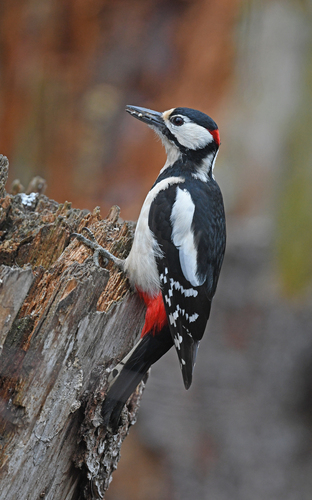 Great Spotted Woodpecker
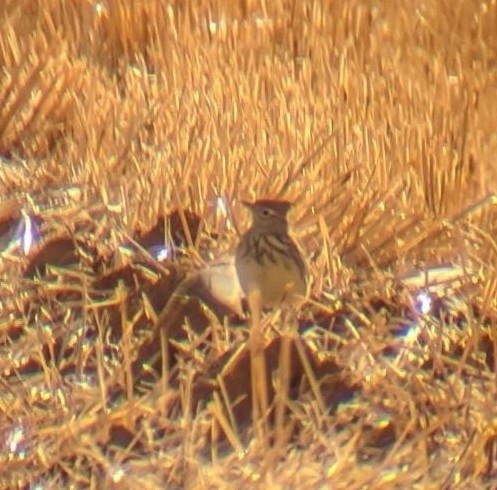 Thekla's Lark
In short
The most reliable way to separate Great Spotted Woodpecker from Thekla's Lark is by overall structure and plumage: the woodpecker is a medium-sized, boldly black-and-white bird with a red vent and (in males/juveniles) red on the head, while Thekla's Lark is a smaller, brownish-grey, streaky bird with a spiky crest and no red anywhere. In flight, the woodpecker shows strong black-and-white barring on the wings and a large white shoulder patch, while Thekla's Lark has plain grey underwings and lacks any bold white patches. Juvenile woodpeckers may look duller but still show the distinctive pattern and structure. Even at a distance, the woodpecker's undulating flight and tree-climbing behavior contrast with the lark's fluttery, ground-oriented movements.
Identification tips
- Bold black-and-white pattern vs. streaky brownish-grey: Great Spotted Woodpecker always shows strong black-and-white contrast with a large white shoulder patch and barred wings; Thekla's Lark is overall brownish-grey with dark streaks and no white patches.
- Red markings: Only the woodpecker ever shows red—on the vent (all ages), nape (adult males), or crown (juveniles). Thekla's Lark never has any red.
- Crest shape: Thekla's Lark has a long, spiky, erectile crest, often raised; the woodpecker has a smooth crown with no crest.
- Bill structure: Woodpecker has a strong, straight, chisel-like bill for drilling wood; Thekla's Lark has a shorter, finer, conical bill for seeds and insects.
- Wing pattern in flight: Woodpecker shows black-and-white barring and a large white shoulder patch; Thekla's Lark has plain grey underwings and no white in the wing or tail.
- Juvenile confusion: Young woodpeckers are duller and less glossy, with a red crown and pinkish vent, but still show the black-and-white pattern; Thekla's Lark juveniles are similar to adults and never show red or bold white patches.
- Tail pattern: Woodpecker's tail is barred black and white; Thekla's Lark has a plain tail with no white edges.
- Perching and movement: Woodpecker climbs vertically on trunks and branches; Thekla's Lark walks or runs on the ground and rarely perches above low rocks or shrubs.
- Flight style: Woodpecker flies in a bounding, undulating path; Thekla's Lark has a more direct, fluttery flight, often low over the ground.
- Habitat: Woodpecker in wooded areas, especially with mature trees; Thekla's Lark in dry, open, often rocky or scrubby country.
- Sex differences: Only male and juvenile woodpeckers have red on the head; Thekla's Lark sexes are identical.
- Size impression: Woodpecker is bulkier and longer; Thekla's Lark is smaller and more delicate.
- Face pattern: Woodpecker has white on the face and neck with a black cheek bar; Thekla's Lark has a plain face with a streaked breast and no cheek bar.
- Underparts: Woodpecker's underparts are white with a red vent; Thekla's Lark is whitish below with dark streaks on the breast.
- Context: If you see a bird on a tree trunk or branch, especially in a wooded area, it's almost certainly a woodpecker; on open ground in dry country, it's a lark.
Size
Great Spotted Woodpecker is significantly heavier (average 89 g) and longer (20–24 cm) than Thekla's Lark, which is described as 'smallish' and slightly smaller than Eurasian Skylark (which averages 16–18 cm). The woodpecker has a robust, compact build with a strong bill, while the lark is more delicate and slender. In the field, the woodpecker appears bulkier and more upright, especially when perched on a trunk, whereas the lark is more horizontal and slight.
Plumage
Juvenile Great Spotted Woodpeckers can be confused with other woodpeckers but not with Thekla's Lark: even young birds retain the black-and-white upperparts, white face patches, and red on the crown (juveniles) or nape (adult males), with a red or pinkish vent. Thekla's Lark, by contrast, is brownish-grey above with dark streaks, a streaked breast, and plain whitish underparts—never any red or bold white patches. In flight, adult and juvenile woodpeckers show barred black-and-white wings and a large white shoulder patch, while Thekla's Lark shows plain grey underwings and no white in the wing or tail. The lark's spiky crest is unique and visible both at rest and in display. Sexes are similar in both species, but only male and juvenile woodpeckers show red on the head.
Behaviour
Great Spotted Woodpecker is almost always seen climbing on tree trunks or branches, hitching upwards or hanging on the side of wood, and flies in a bounding, undulating path between trees. Thekla's Lark is a ground-dweller, walking or running on open soil, often in dry, rocky or scrubby areas, and rarely perches in trees. Its flight is fluttery and direct, often low over the ground, and it frequently raises its crest. The woodpecker's behavior is arboreal and acrobatic, while the lark is terrestrial and unobtrusive.
Habitat
Great Spotted Woodpecker is found in wooded habitats, including forests, parks, and gardens with mature trees, across the Palearctic. Thekla's Lark is restricted to dry, open country—often at altitude—on the Iberian Peninsula and North/East Africa, avoiding dense woodland. If seen in open, treeless, rocky or scrubby terrain, Thekla's Lark is far more likely; in mature woodland or on tree trunks, the woodpecker is expected.