

Great Sapphirewing vs Great Jacamar
Pterophanes cyanopterus versus Jacamerops aureus
Play a quiz with Great Sapphirewing and Great Jacamar
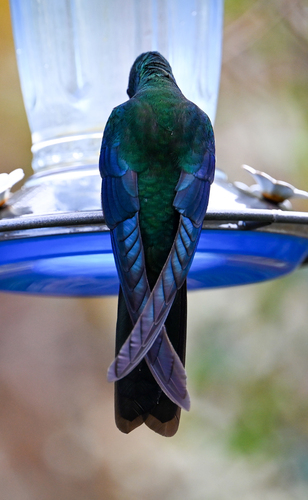 Great Sapphirewing
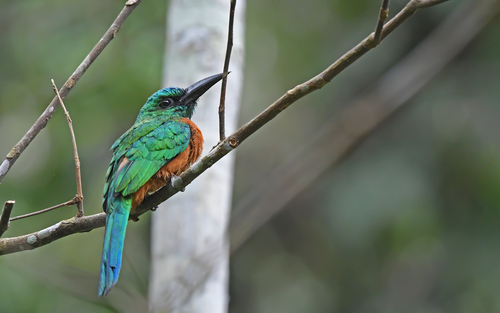 Great Jacamar
In short
The most reliable way to separate Great Sapphirewing from Great Jacamar is by overall structure and habitat: the sapphirewing is a giant hummingbird of high Andean forests and páramo with metallic blue wings, while the jacamar is a much bulkier, long-billed insect-eater of lowland rainforest canopies. In the field, Great Sapphirewing males show brilliant blue wings and greenish-blue body, while females have a cinnamon belly and blue wing coverts; Great Jacamar adults are metallic green above with a rufous belly and, in males, a white throat patch. The sapphirewing is much lighter and more slender, with a short bill and rapid, hummingbird-like flight, while the jacamar is heavy-bodied, long-billed, and perches upright in the mid-canopy. If you see a large, metallic bird at high elevation with blue wings, it's a sapphirewing; a heavy, rufous-bellied, green-backed bird in the lowland rainforest is a jacamar.
Identification tips
- Habitat and elevation: If you are above 2,600 m in the Andes, you are almost certainly seeing a Great Sapphirewing; Great Jacamar is restricted to lowland forests below 500 m. This is the fastest way to separate them in the field.
- Overall structure: Great Jacamar is much larger, bulkier, and longer-billed than any hummingbird, including the sapphirewing. Its bill is straight, heavy, and dagger-like, while the sapphirewing's is short and slightly decurved.
- Flight style: Sapphirewing has rapid, agile, hovering flight typical of hummingbirds; jacamar flies more directly and perches upright for long periods, rarely hovering.
- Wing and tail color (adult males): Sapphirewing males have brilliant blue wings and a greenish-black tail; jacamar males have black wings (primaries) and a blue-black tail, never showing the sapphirewing's blue shimmer in flight or at rest.
- Underparts color (adult males): Sapphirewing is blue-green below; jacamar is deep rufous below with a contrasting white throat patch (male only).
- Female plumage: Female sapphirewing has a cinnamon belly with green sides and blue only on the wing coverts; female jacamar is rufous below but lacks the white throat patch.
- White spot behind eye: Both sexes of sapphirewing show a small white spot behind the eye, absent in jacamar.
- Bill color and shape: Sapphirewing's bill is short, straight, and black; jacamar's is long, heavy, and black, adapted for catching insects.
- Perching posture: Jacamar perches upright, often on exposed mid-canopy branches; sapphirewing typically perches more horizontally, often near flowers.
- Tail pattern (female sapphirewing): Female sapphirewing has much white on the outer tail feathers, especially in the nominate subspecies; jacamar's tail is uniformly blue-black.
- Crown color: Female sapphirewing has a dusky gray crown; jacamar has a metallic green or blueish crown.
- Feeding behavior: Sapphirewing is seen feeding at flowers, often hovering; jacamar is seen sallying for insects and returning to a perch.
- Size in the field: Even though sapphirewing is large for a hummingbird, it is dwarfed by the jacamar, which is nearly three times heavier and much longer.
- Contextual clues: Sapphirewing is often seen in open, shrubby, or edge habitats at high elevation; jacamar is deep in lowland forest, often near water.
- Voice: No vocalizations are described in the notes, so do not rely on voice for separation.
Size
Great Sapphirewing is a large hummingbird (males 9.6–11.2 g, females 8.4–11 g, length 15.5–19 cm), but is dwarfed by the Great Jacamar, which weighs about 63 g and measures 25–30 cm in length. The jacamar is not only longer but also much bulkier, with a robust body and a proportionally much longer, heavier bill. In hand or perched, the jacamar appears almost thrush-sized, while the sapphirewing, though large for a hummingbird, is still much more delicate and slender.
Plumage
No age-specific upperwing patterns are described for either species, so focus on adult plumage. Adult male Great Sapphirewing is dark blue-green above with brilliant blue wings and a greenish-black tail; underparts are blue-green, slightly bluer than the back. Both sexes have a small white spot behind the eye. Females have mostly dark metallic green upperparts, a dusky gray crown, blue only on the wing coverts, and a cinnamon belly with green sides; their tail is greenish-black with much white on the outer feathers. Great Jacamar adult males are metallic green above with gold and blueish tints, a white lower throat, and deep rufous underparts; the tail is blue-black. Females are similar but lack the white throat. The jacamar's wings are black (primaries), and the tail is blue-black, lacking the sapphirewing's blue or greenish tones. Juvenile/immature plumage is not described for either species in the notes, so caution is needed with young birds.
Behaviour
Great Sapphirewing feeds mainly on nectar, hovering or perching at flowers, and occasionally catches small arthropods. Its flight is rapid and direct, typical of hummingbirds, and it often defends flower patches or trap-lines. Great Jacamar is a sit-and-wait predator, perching upright in the mid-canopy, sallying out to catch flying insects or gleaning spiders and small vertebrates, then returning to its perch to beat prey against a branch. Its flight is more direct and less agile than a hummingbird's, and it rarely hovers. Sapphirewings are typically seen alone or in loose association with other hummingbirds; jacamars are usually solitary or in pairs.
Habitat
Great Sapphirewing is found at high elevations (2,600–3,700 m) in the Andes, inhabiting edges of humid evergreen and elfin forest, shrubby slopes, and páramo. It is never found in lowland rainforest. Great Jacamar, in contrast, is strictly a lowland species (to 500 m), living in subtropical and tropical moist forests, especially in the middle canopy and shaded forest edges, often near watercourses. Their ranges overlap in some countries, but never in habitat or elevation.