

Great Reed Warbler vs Clamorous Reed Warbler
Acrocephalus arundinaceus versus Acrocephalus stentoreus
Play a quiz with Great Reed Warbler and Clamorous Reed Warbler
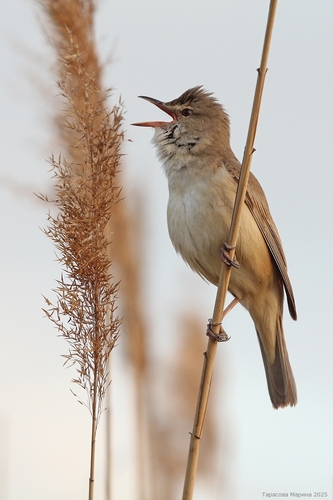 Great Reed Warbler
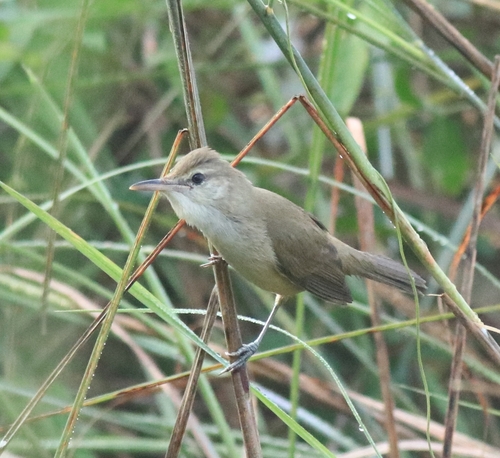 Clamorous Reed Warbler
In short
The most reliable field mark between Great Reed Warbler and Clamorous Reed Warbler is the color of the underparts: Great Reed Warbler shows richer, buffier underparts, while Clamorous Reed Warbler is paler and whiter below. Both are large, unstreaked brown warblers with similar structure, but Great Reed Warbler is generally bulkier and slightly larger. Their songs differ, with Great Reed Warbler's being louder and more raucous. In the field, subtle differences in plumage tone and voice are your best clues, as structure and jizz are very similar.
Identification tips
- Underparts color: Great Reed Warbler shows richer, buffier underparts, especially on the chin and breast; Clamorous Reed Warbler is paler and whiter below. This is the most consistent field mark for all ages.
- Upperparts tone: Both are unstreaked brown above, but Clamorous Reed Warbler (especially northern migrants) can appear slightly richer brown above, while Great Reed Warbler is more uniform.
- Juvenile/immature underparts: Young Great Reed Warblers are even more buffy below than adults, exaggerating the underparts difference with Clamorous Reed Warbler juveniles, which remain pale.
- Size and bulk: Great Reed Warbler is generally larger and bulkier, with a heavier build and longer wingspan (16–21 cm vs. 18–20 cm, but heavier and more robust overall). However, size overlap is considerable and not always reliable unless both are seen together.
- Bill and head structure: Both have strong, pointed bills and flattened foreheads; these features are not useful for separation.
- Song: Great Reed Warbler's song is much louder, harsher, and more raucous, often with a chattering and croaking quality. Clamorous Reed Warbler's song is slower, less harsh, and more chattering, with more pronounced whistles. Use song only when you have a clear, direct comparison.
- Song context: Great Reed Warbler males use long, complex songs to attract females and short, simple songs for territory defense. Clamorous Reed Warbler's song is less variable but still includes mimicry.
- Geographic context: If in Europe or the Western Palearctic, Great Reed Warbler is expected; Clamorous Reed Warbler is found from Egypt eastwards through South Asia. In overlap zones (Middle East), rely on plumage and voice.
- Habitat: Both are reed bed specialists; habitat is not a separator where both occur.
- Sex and season: Both species are sexually monomorphic; males and females look alike year-round. No seasonal plumage differences are described.
- Flight and jizz: Both species are described as thrush-sized and behave similarly in reeds. Flight style and jizz are not reliable separators.
- Subspecies variation: Clamorous Reed Warbler has several races, with the Sri Lanka form being the darkest, but these differences are subtle and not usually helpful in the field.
- Pitfalls: Do not rely on structure or behavior alone; focus on underparts color and song. Size is only helpful in direct comparison.
- When in doubt: If the bird is singing and you can record or compare the song, this is often the best separator. Otherwise, prioritize underparts tone in good light.
- Immature birds in flight: No distinctive upperwing or flight pattern differences are described for either species; focus on underparts color and overall size if seen well.
Size
Great Reed Warbler is the largest Acrocephalus warbler, measuring 16–21 cm in length with a wingspan of 25–30 cm and mass of 22–38 g [wikipedia]. Clamorous Reed Warbler is also large, at 18–20 cm, but generally averages slightly smaller and less bulky [wikipedia]. Both are described as thrush-sized, but Great Reed Warbler tends to look heavier and more robust, especially in direct comparison.
Plumage
No distinctive juvenile or immature upperwing patterns are described for either species; both lack streaking and show plain brown upperparts at all ages [wikipedia]. For adults and immatures, the key difference is below: Great Reed Warbler has richer, buffier underparts, especially on the chin and breast, while Clamorous Reed Warbler is noticeably paler and whiter below. Both have unstreaked brown backs, flattened foreheads, and strong, pointed bills. Clamorous Reed Warbler shows some geographic variation, with the migratory northern race being the richest brown above, and the Sri Lanka race being darkest overall, but these differences are subtle and not always useful in the field. Juvenile Great Reed Warblers are described as richer buff below, which may exaggerate the underparts difference in fresh young birds.
Behaviour
Both species behave similarly, typically skulking or singing from reed beds. No major behavioral differences are noted in the sources for field separation. Both may perch high to sing and are more often detected by voice than by movement.
Habitat
Both species are reed bed specialists during the breeding season. Great Reed Warbler breeds throughout Europe and the Western Palearctic, while Clamorous Reed Warbler breeds from Egypt east through South Asia to Southeast Asia [wikipedia]. Both winter in reed beds and similar wetland habitats, but their ranges do not overlap much except in parts of the Middle East. Habitat is not a reliable separator where both occur.
Voice
Great Reed Warbler has a very loud, far-carrying, and raucous song, with chattering, croaking, and harsh notes (carr-carr-cree-cree-cree-jet-jet), often including mimicry [wikipedia]. Its song is variable, with both short (territorial) and long (mate-attracting) types. Clamorous Reed Warbler's song is also loud and far-carrying, but is less raucous, slower, and more chattering (kereet-kereet-kereet), with typical Acrocephalus whistles and mimicry [wikipedia]. In direct comparison, Great Reed Warbler's song is harsher and more forceful.
Great Reed Warbler · Clamorous Reed Warbler · My Tricky Birds