

Great Hornbill vs Oriental Pied-Hornbill
Buceros bicornis versus Anthracoceros albirostris
Play a quiz with Great Hornbill and Oriental Pied-Hornbill
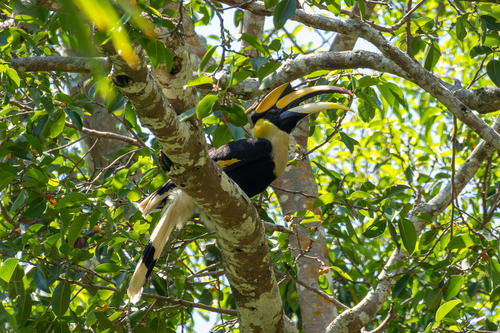 Great Hornbill
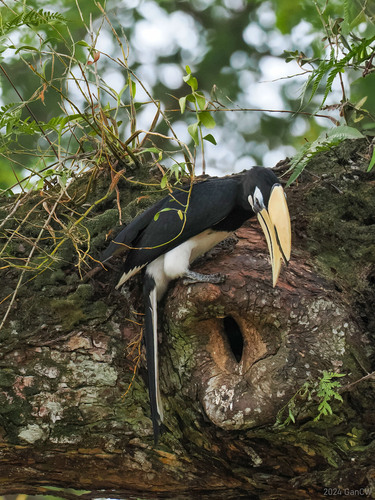 Oriental Pied-Hornbill
In short
The most reliable field mark is size and bill structure: Great Hornbill is an enormous, heavy-bodied bird with a massive, deeply curved bill topped by a huge, U-shaped yellow-and-black casque, while Oriental Pied-Hornbill is much smaller, lighter, and has a more slender bill with a laterally compressed, cylindrical casque. In flight or perched, Great Hornbill's sheer bulk, broad wings, and striking yellow-and-black patterning stand out, while Oriental Pied-Hornbill appears more compact and less dramatically marked. Female eye color (red in Great, greyish-brown in Oriental Pied) and casque details can help at close range. Juveniles of both species resemble adults but with smaller, less developed casques, and the size gap remains obvious at all ages.
Identification tips
- Size is the quickest separator: Great Hornbill is enormous, nearly twice the length and three times the weight of Oriental Pied-Hornbill. Even at a distance, Great Hornbill's bulk is unmistakable. This works for all ages and sexes.
- Bill and casque structure: Great Hornbill has a huge, deeply curved bill with a massive, U-shaped, concave casque with black and yellow coloring; Oriental Pied's bill is much slimmer, with a laterally compressed, cylindrical casque, mostly yellow with black at the base in males. Juveniles of both have smaller casques, but the shape difference remains.
- Casque color and pattern (sex-specific): Male Great Hornbill has a black underside to the casque; female has a reddish back to the casque. Oriental Pied males have a yellow bill and casque with black at the base; females have a partly black bill and casque. Use this only at close range.
- Eye color (sex-specific): Female Great Hornbill has bluish-white eyes; male has red eyes. Oriental Pied males have bright red eyes, females greyish-brown. This is subtle and only visible at close range.
- Plumage pattern: Great Hornbill is boldly pied with a white neck and underparts, black back and wings, and a white tail with a broad black band. Oriental Pied is black above with a greenish sheen, white underparts, and white-tipped tail feathers (except the central pair). The tail pattern is less bold in Oriental Pied.
- Wing and flight style: Great Hornbill flies with slow, heavy wingbeats and audible mechanical sounds, often gliding with splayed primaries. Oriental Pied is lighter, with quicker, less forceful wingbeats and a more buoyant flight. Listen for the wing noise in Great Hornbill.
- Perched jizz: Great Hornbill appears massive, top-heavy, and imposing, with a huge bill and casque. Oriental Pied is more slender and less top-heavy.
- Juvenile confusion: Juveniles of both species resemble adults but have smaller casques and bills. Size difference remains the best clue; no distinctive juvenile wing patterns are described for either.
- Habitat context: Great Hornbill is almost always in mature, primary forest with large emergent trees. Oriental Pied is more likely in secondary forest, edge, or even parks and plantations.
- Group size: Great Hornbill is usually in pairs or small groups; Oriental Pied can form larger flocks, especially outside the breeding season.
- Voice: Great Hornbill gives loud duets of 'kok' notes, roars, and barks, especially in breeding season. Oriental Pied gives crowlike, braying, or screeching calls. If you hear a duet, suspect Great Hornbill.
- Tail pattern: Great Hornbill's tail is white with a bold black band; Oriental Pied's tail is black with white tips except for the central feathers.
- Bill commissure: Great Hornbill's bill has a black, serrated edge that becomes worn with age; Oriental Pied's bill is smooth.
- Behavior at nest: Great Hornbill females are sealed in tree cavities during nesting; Oriental Pied also nests in cavities but is less strictly tied to very large trees.
- Color gloss: Oriental Pied adults have a greenish gloss on black feathers; juveniles lack this. Great Hornbill's black is less glossy.
Size
Great Hornbill is by far the larger species: adults measure 95–130 cm in length, with a wingspan up to 152 cm, and males average 3 kg in weight [wikipedia]. Oriental Pied-Hornbill is much smaller, at 55–60 cm long, wingspan 23–36 cm, and males average 900 g [wikipedia]. The difference is dramatic: Great Hornbill is more than twice as heavy and nearly twice as long. Even at a distance or in flight, the size contrast is unmistakable if both species are known from the area.
Plumage
- Juveniles/Immatures: Both species' juveniles resemble adults but have smaller, less developed casques and bills. Great Hornbill juveniles are still large and heavy-bodied, while Oriental Pied juveniles are smaller and lack the green gloss on black feathers seen in adults [wikipedia]. No distinctive age-specific upperwing pattern is described for either species, so size and bill/casque shape remain the best clues at all ages.
- Adults: Great Hornbill is boldly pied with a massive yellow-and-black bill and casque, white neck and underparts, black back and wings, and a white tail with a broad black band. Oriental Pied-Hornbill is black above with a greenish sheen, white belly, thighs, underwing, and white-tipped tail feathers except the central pair. The casque in Great Hornbill is U-shaped and concave, with black and reddish areas depending on sex; in Oriental Pied, the casque is a laterally flattened cylinder, sometimes forming a horn, and is mostly yellow with black at the base in males. Female Great Hornbill has a reddish back to the casque and bluish-white eyes; female Oriental Pied has a partly black bill and casque and greyish-brown eyes.
Behaviour
Great Hornbill is heavy and powerful in flight, with slow, deep wingbeats followed by glides, producing a loud, mechanical sound likened to a steam locomotive starting up [wikipedia]. Its flight is ponderous and direct, with broad wings and splayed primaries. Oriental Pied-Hornbill is more agile and lighter on the wing, with quicker, less forceful wingbeats and a more buoyant jizz. Both species perch upright and are often seen in the canopy, but Great Hornbill's bulk and massive bill make it appear top-heavy and imposing, while Oriental Pied is more slender and active. Both are frugivorous but may take small animals; Great Hornbill is more often seen in pairs or small groups, Oriental Pied can form larger flocks outside breeding season.
Habitat
Great Hornbill prefers mature, tall forests with large emergent trees, especially for nesting, and is typically found in less disturbed, primary forests [wikipedia]. Oriental Pied-Hornbill is more adaptable, occurring in a wider range of wooded habitats, including secondary forest, forest edge, and sometimes plantations or parks [wikipedia]. If seen in degraded or edge habitats, Oriental Pied is more likely; Great Hornbill is rarely found far from extensive, old-growth forest.
Voice
Great Hornbill is very vocal during the breeding season, with loud duets beginning with a repeated 'kok' from the male, then both sexes joining in a rapid series of roars and barks [wikipedia]. The wingbeats are also very noisy. Oriental Pied-Hornbill gives crowlike calls, braying sounds, harsh crackles, and screeches [wikipedia]. The calls are less booming and less duet-based than Great Hornbill, and the wingbeat is not as loud.