

Great Cormorant vs European Shag
Phalacrocorax carbo versus Gulosus aristotelis
Play a quiz with Great Cormorant and European Shag
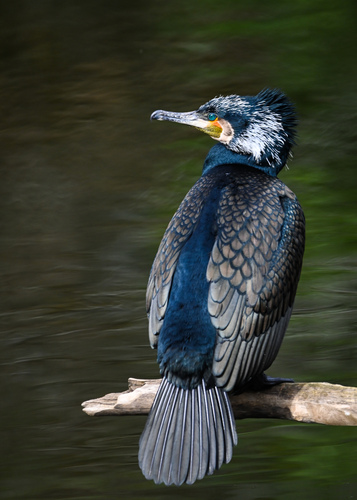 Great Cormorant
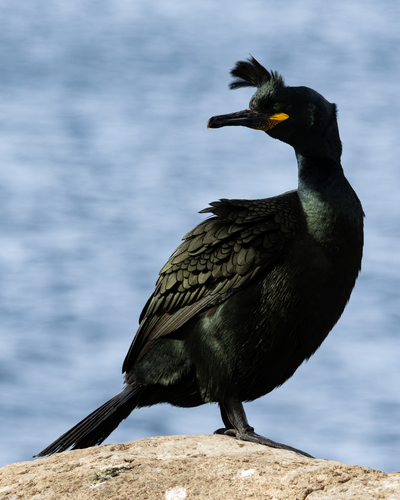 European Shag
In short
The most reliable field mark to separate Great Cormorant from European Shag is overall structure: Great Cormorant is much bulkier, with a heavier, thicker bill and a larger, more robust body, while European Shag is noticeably slimmer, with a thinner bill and lighter build. In breeding season, adult Shags show a small crest and a metallic green sheen, while Great Cormorants lack a crest and have a purplish or bronze gloss. Juvenile plumage also differs: young Great Cormorants have pale underparts, whereas juvenile Shags are darker below. Tail feather count (14 in cormorant, 12 in shag) is a technical but absolute difference. When seen in flight or at a distance, size and structure are usually the quickest clues.
Identification tips
- Overall size and bulk: Great Cormorant is much larger and heavier than European Shag. Use this especially when birds are side-by-side or in mixed flocks.
- Bill structure: Great Cormorant has a thick, powerful, strongly hooked bill; Shag's bill is noticeably thinner and more delicate. This is visible even at moderate range.
- Body shape and jizz: Great Cormorant is robust, deep-chested, and heavy-necked; Shag is slim, long-necked, and more streamlined. In flight, cormorant looks broad-winged and labored, shag more direct and agile.
- Tail feather count: Great Cormorant has 14 tail feathers, Shag has 12. This is diagnostic but requires a good view of the spread tail (rare in the field).
- Breeding adult crest: Only European Shag shows a small crest on the head in breeding season. Absence of crest in a large black cormorant-like bird rules out Shag in spring and early summer.
- Plumage gloss: Great Cormorant has a purple or bronze gloss, especially on the body and wings; Shag has a metallic green sheen, most obvious in good light. This is subtle and best used in close, direct sunlight.
- White thigh patches: In breeding season, Great Cormorant adults have distinctive white filoplume patches on the thighs (and sometimes head/neck); Shag never shows these. This is a strong mark in spring.
- Underparts in juveniles: Juvenile Great Cormorants have pale or whitish underparts, contrasting with the darker belly and breast of juvenile Shags. This is a key mark from late summer through winter.
- Throat patch: Both have a yellow throat patch, but Shag's is smaller and less extensive. Not always reliable at distance or in poor light.
- Leg and foot color: Both have dark legs and fully webbed feet; this is not a useful separation mark.
- Habitat context: Shag is almost exclusively coastal and prefers rocky shores; Great Cormorant is found both on coasts and inland waters. If seen far from the sea, it's almost certainly a cormorant.
- Group size: Great Cormorant often forms large, dense flocks, especially inland; Shag is usually in smaller groups or solitary, especially outside breeding colonies.
- Flight style: Great Cormorant flies with deeper, slower wingbeats and a heavier silhouette; Shag is quicker, with a more direct flight and slimmer profile.
- Bill color and gular patch: Both have yellow at the base of the bill, but the shape and angle of the gular patch can differ among cormorant subspecies (not a practical field mark for most observers).
- Voice: Both are mostly silent away from colonies; calls are not useful for field separation.
Size
Great Cormorant is substantially larger and heavier, with an average adult mass of 2200 g [wikidata], compared to the smaller, lighter European Shag (no exact mass given, but consistently described as medium-large and lighter built). Great Cormorant appears bulkier both at rest and in flight, with a thicker neck and more powerful jizz. Shag is more streamlined and slender, with a narrower bill and a less imposing presence.
Plumage
- Juveniles/immatures: Young Great Cormorants have pale to whitish underparts, especially obvious in first-year birds, while juvenile Shags have darker underparts, lacking the strong pale contrast. This is a key field mark in autumn and winter flocks.
- Adults (breeding): European Shag adults show a small crest on the head and a metallic green sheen to the plumage. Great Cormorant adults lack a crest and instead show a purplish or bronze gloss, especially on the body and wings. Both species have a yellowish throat patch, but the shape and extent differ subtly (not always reliable at distance).
- Adults (non-breeding): Great Cormorant loses the white thigh and head filoplumes after breeding, becoming more uniformly black but still bulkier and with a stouter bill. Shag loses the crest but remains slimmer and green-glossed.
- Tail feathers: Great Cormorant always has 14 tail feathers; European Shag has 12. This is diagnostic but rarely visible in the field.
Behaviour
Both species are often seen perched with wings spread to dry, but Great Cormorant is more likely to be found inland as well as on coasts, and often forms larger, denser flocks. European Shag is more strictly coastal, favoring rocky shores and islands, and is less likely to be seen far inland. In flight, Great Cormorant appears heavier and more labored, while Shag is quicker and more agile, with a more direct flight.
Habitat
Great Cormorant is highly adaptable, breeding and feeding on both inland waters and coasts across a wide range, including lakes, rivers, estuaries, and marine environments. European Shag is much more restricted to rocky marine coasts and islands, rarely venturing far from saltwater. If seen well inland, the bird is almost certainly a Great Cormorant.
Voice
Both species are mostly silent away from breeding colonies, where they make guttural noises. Vocalizations are not a practical field mark for separation.