

Grand Munia vs Snow Mountain Munia
Lonchura grandis versus Lonchura montana
Play a quiz with Grand Munia and Snow Mountain Munia
 Grand Munia
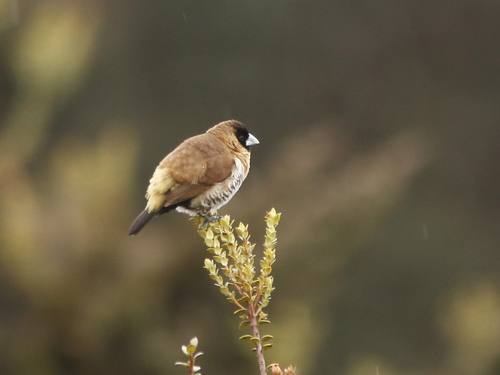 Snow Mountain Munia
In short
The most reliable way to separate Grand Munia from Snow Mountain Munia is by focusing on plumage pattern, especially the underparts and face. Snow Mountain Munia shows a distinctive black face, buff chest, and black-barred white belly, while Grand Munia lacks these strong contrasts. Juvenile Snow Mountain Munias also have a black bill and buffy-white underparts, unlike the more uniformly colored Grand Munia. Habitat is a strong supporting clue: Grand Munia is found in lowland wetlands, while Snow Mountain Munia is restricted to alpine grasslands of the Snow and Star Mountains. Size is similar, but Grand Munia may be slightly heavier.
Identification tips
- Face pattern: Snow Mountain Munia has a distinctive black face in adults, while Grand Munia lacks this feature. If you see a clear black mask, it's Snow Mountain Munia.
- Underpart contrast: Adult Snow Mountain Munia shows a buff chest and a black-barred white belly, creating a strong contrast with the dark upperparts. Grand Munia is more uniformly brown below, without the buff and white barring.
- Juvenile bill color: Juvenile Snow Mountain Munia has a black bill, which stands out against its buffy-white underparts. Young Grand Munia are more uniform in color and lack this sharp bill/underpart contrast.
- Juvenile underparts: Look for buffy-white below in young Snow Mountain Munia; Grand Munia juveniles are not described as having such pale bellies.
- Habitat context: If the bird is in alpine grassland above the treeline, especially in the Snow or Star Mountains, it is almost certainly Snow Mountain Munia. Wetland or lowland marshes indicate Grand Munia.
- Flock size: Snow Mountain Munia often forms larger flocks (6–20 birds), while Grand Munia may be found in smaller groups, though this is not always diagnostic.
- Size and structure: Grand Munia may appear slightly bulkier, but both are small estrildid finches. Use size only as a supporting clue.
- Sex differences: Both species show little sexual dimorphism in plumage, so do not rely on sex for identification.
- Flight views: No distinctive upperwing or flight pattern differences are noted, so focus on face and underpart pattern even in flight.
- Bill structure: While not described in detail, Snow Mountain Munia's black bill in juveniles is a good field mark; Grand Munia's bill color is not specifically noted but is not described as black in young.
- Geographic range: Snow Mountain Munia is endemic to a small alpine region in western New Guinea, while Grand Munia is more widespread in northern and eastern New Guinea. Use range as a context clue.
- Plumage pitfalls: Beware of worn or molting birds, which may obscure some of the underpart barring or face pattern in Snow Mountain Munia, but the general contrast should remain visible.
- Voice: No vocal differences are described in the notes, so do not rely on calls or song for separation.
- Season: Both species are resident and do not have strong seasonal plumage changes, so time of year is not a major factor.
- Lighting: In poor light, the black face and underpart contrast of Snow Mountain Munia may be less obvious; try to view birds in good light to confirm these features.
Size
Grand Munia has a recorded body mass of 14.0 g [wikidata], while no direct mass is given for Snow Mountain Munia, but it is described as a small estrildid finch about 11.5 cm in length [wikipedia]. Both are small, but Grand Munia may appear slightly bulkier, especially in direct comparison. However, in the field, size alone is subtle and should not be relied on as the primary separator.
Plumage
- Juvenile/immature birds: Juvenile Snow Mountain Munia has a black bill, dark brown upperparts, and buffy-white underparts, which contrasts with the more uniformly colored young Grand Munia. This pale belly and dark bill combination is a strong clue for Snow Mountain Munia in the field.
- Adults: Adult Snow Mountain Munia is dark brown above, with a black face, buff chest, and a black-barred white abdomen. Grand Munia lacks the black face and the sharply contrasting underparts; its plumage is more uniform brown without the distinct buff and white barring seen in Snow Mountain Munia. Both sexes of Snow Mountain Munia share this pattern, so sex is not a confounding factor.
- Wing pattern: No specific upperwing or flight pattern differences are described for either species, so focus on underpart and face pattern for both perched and flying birds.
Behaviour
Snow Mountain Munia is often seen in flocks of six to twenty birds, feeding on seeds and grasses in open alpine grassland. Grand Munia's behavior is less detailed in the notes, but as a wetland species, it is likely to be found in smaller groups or pairs in reedbeds or marshy areas. Foraging style and flock size may provide context, but are not as diagnostic as plumage and habitat.
Habitat
Habitat is a key separator: Grand Munia is found in wetlands of northern and eastern New Guinea, often in lowland marshes and reedbeds. In contrast, Snow Mountain Munia is restricted to alpine grassland in the Snow and Star Mountains of western New Guinea, at much higher elevations. If you encounter a munia in an open, grassy alpine setting well above the treeline, it is almost certainly Snow Mountain Munia. Wetland or lowland habitats point to Grand Munia.