

Golden Eagle vs Steller's Sea-Eagle
Aquila chrysaetos versus Haliaeetus pelagicus
Play a quiz with Golden Eagle and Steller's Sea-Eagle
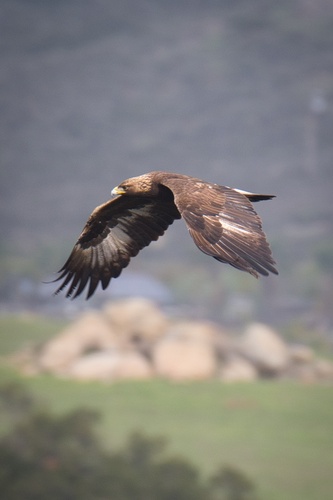 Golden Eagle
 Steller's Sea-Eagle
In short
The most reliable field mark for separating Golden Eagle from Steller's Sea-Eagle is the combination of overall structure and plumage: Steller's Sea-Eagle is bulkier with a massive yellow bill, bold white patches on the wings and tail (in adults), and a strikingly pied appearance, while Golden Eagle is more uniformly dark brown with a golden nape and lacks obvious white in adult plumage. Juvenile Golden Eagles show large, well-defined white patches on the wing and tail, but these differ in shape and placement from the more extensive and sharply-contrasting white of adult Steller's. In flight, Steller's appears heavier, with paddle-shaped wings and a diamond-shaped tail; Golden Eagle is more streamlined, with a proportionally longer tail and more hawk-like wings. Bill size and shape are also a key structural difference at any age.
Identification tips
- Bill size and color: Steller's Sea-Eagle has a massive, deep-based, bright yellow bill at all ages, which is much larger and more prominent than the Golden Eagle's dark, proportionate bill. This is often the easiest structural mark at close to medium range.
- Adult plumage: Adult Steller's Sea-Eagle is boldly pied, with extensive white on the shoulders (wing coverts), tail, thighs, and underparts, contrasting with a blackish body. Golden Eagle adults are uniformly dark brown with a golden nape and lack any white patches.
- Juvenile/immature plumage: Juvenile Golden Eagles show large, sharply defined white patches at the base of the primaries and on the tail, but the rest of the plumage is dark brown. Juvenile Steller's Sea-Eagles are more uniformly dark brown, with only some streaking on the head/neck and a white tail with black mottling at the tip. The white in Steller's is less sharply defined and more extensive in adults than in any Golden Eagle.
- Tail shape: In flight, Golden Eagle's tail is long and straight-edged, often appearing two to three times the length of the head. Steller's tail is shorter, broader, and diamond-shaped, especially obvious in soaring birds.
- Wing shape: Golden Eagle's wings are long, fairly slender, and more hawk-like, while Steller's wings are broader, paddle-shaped, and appear heavy in flight.
- Flight style: Golden Eagle soars with slightly raised wings (shallow dihedral) and shows powerful, controlled flight. Steller's Sea-Eagle has slower, deeper wingbeats and often holds its wings flatter.
- Head and neck: Steller's has a larger, more protruding head and bill, giving a blocky profile. Golden Eagle's head is smaller and less prominent in flight.
- Nape color: Golden Eagle shows a golden to rufous nape (especially in good light), which is absent in Steller's Sea-Eagle.
- Legs and feet: Adult Steller's has bright yellow feet and legs, while Golden Eagle's are duller.
- Perched posture: Steller's appears bulkier and more upright when perched, with a massive bill and heavy build. Golden Eagle is more streamlined and less bulky.
- Habitat context: If seen near large bodies of water, especially in northeast Asia, Steller's is much more likely. Golden Eagles are usually in open uplands or mountains, away from water.
- Size impression: Steller's is noticeably larger and heavier than Golden Eagle, but beware of distance and lone birds, as size can be hard to judge.
- White in wing and tail: In flight, check the pattern of white: sharply defined patches in juvenile Golden Eagle (base of primaries and tail base) vs. more extensive, contrasting white in adult Steller's (shoulders, tail, thighs, underwing coverts).
- Bill color in young birds: Even juvenile Steller's has a large, dark bill that is still proportionally bigger than Golden Eagle's at the same age.
- Confusion risk: If you see a large, dark eagle with white in the wings or tail, check the pattern, bill size, and context. Golden Eagle's white is limited and sharply defined in juveniles; Steller's adult is boldly pied, and even juveniles are bulkier with a bigger bill.
Size
Steller's Sea-Eagle is significantly larger and heavier than Golden Eagle, with an average body mass of 6675 g compared to Golden Eagle's 4383 g ([wikidata]). Steller's appears bulkier overall, with a massive, deep-based bill that is much larger than the Golden Eagle's more proportionate, raptor-like bill. In the field, this size difference is striking when both species are seen together, but can be harder to judge at a distance or singly. The tail of Golden Eagle is proportionally longer relative to the head, while Steller's tail is shorter and more diamond-shaped. Steller's also has broader, paddle-like wings compared to the more tapered, hawk-like wings of Golden Eagle.
Plumage
Juvenile and immature Golden Eagles (up to subadult) show large, sharply defined white patches at the base of the primaries and on the tail, but these are restricted and contrast with otherwise dark brown plumage. The white is typically limited to the inner primaries and the base of the tail, forming a clear-cut pattern that is different from the random, splotchy white of juvenile Haliaeetus eagles. In contrast, juvenile Steller's Sea-Eagles are mostly uniform dark brown with some grey-brown streaking on the head and neck, and the tail is white with black mottling at the tip. As Steller's matures, the white in the plumage increases, especially on the wing coverts, thighs, under-tail coverts, and tail, resulting in a bold, pied appearance in adults. Adult Golden Eagles are a rich dark brown overall, with a golden to rufous nape, and lack the extensive white of adult Steller's. The adult Steller's Sea-Eagle is unmistakable with its striking white shoulders, tail, and thighs against a blackish body, while the Golden Eagle remains more uniform in color. Bill color is also diagnostic: adult Steller's has a bright yellow bill, while Golden Eagle's is dark.
Behaviour
In flight, Golden Eagles are more streamlined and agile, often soaring with slightly raised wings in a shallow dihedral, reminiscent of large hawks. Their flight is powerful and controlled. Steller's Sea-Eagle, on the other hand, appears heavier and more ponderous, with slow, deep wingbeats and broader, paddle-shaped wings. Steller's often perches conspicuously near water, while Golden Eagles are more likely to be seen soaring over open country or perched on cliffs and large trees. Both species are typically solitary or in pairs, but Steller's can be seen in loose groups at rich food sources, especially in winter.
Habitat
Golden Eagles are birds of open country, mountains, and uplands, often far from water. They are rarely found near coasts or large bodies of water except during migration or winter. Steller's Sea-Eagle is strongly associated with coastal areas, large rivers, and lakes, almost always near water where fish and waterbirds are abundant. If seen inland and away from water, Golden Eagle is much more likely; if near large rivers, estuaries, or the coast, especially in northeast Asia, Steller's is favored.