
Goldcrest vs Eurasian Treecreeper
Regulus regulus versus Certhia familiaris
Play a quiz with Goldcrest and Eurasian Treecreeper
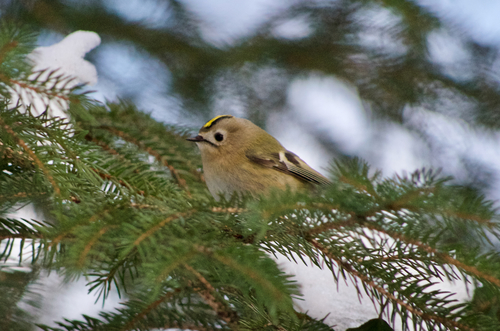 Goldcrest
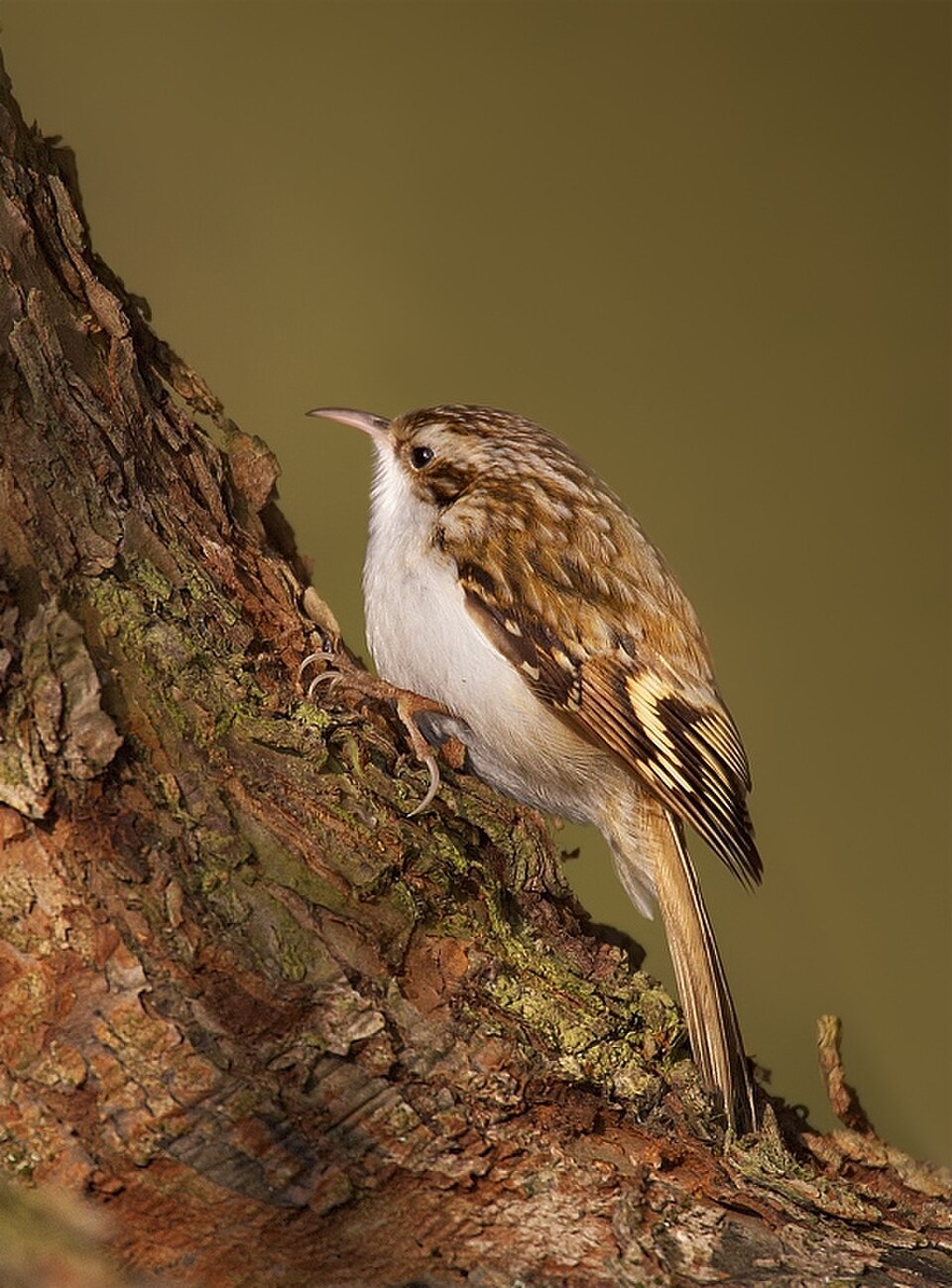 Eurasian Treecreeper
In short
The most reliable way to separate Goldcrest from Eurasian Treecreeper is by overall structure and behavior: Goldcrest is a tiny, round, warbler-like bird with a plain face and a bold yellow or orange crown stripe, while Eurasian Treecreeper is larger, slim, and mouse-like, with a long, decurved bill and cryptic brown-and-white streaked plumage, usually seen creeping up tree trunks. Goldcrest shows two white wingbars and a plain face with a bright crest (orange in males, yellow in females), while Eurasian Treecreeper has a white supercilium, streaked brown upperparts, and a long, stiff tail used for support against bark. In flight, Goldcrest is fluttery and agile, often hovering among foliage, whereas Treecreeper flies in short, undulating bursts between trees. Juvenile Goldcrests lack the colored crown but still appear plain-faced and tiny, while juvenile Treecreepers are duller but maintain their streaked pattern and tree-climbing behavior. These differences are consistent across all ages and seasons, making confusion unlikely with good views.
Identification tips
- Structure and posture: Goldcrest is tiny, round, and warbler-like, with a short thin bill and a compact body; Eurasian Treecreeper is larger, slim, and elongated, with a long, decurved bill and a long, stiff tail used for support. This difference is obvious in all ages and seasons.
- Behavior: Goldcrest flits and hovers among foliage, often at the tips of branches, and rarely climbs trunks. Treecreeper is almost always seen climbing up tree trunks in short hops, using its tail for support, and rarely perches in the open.
- Crown and face: Goldcrest has a bright crest (orange/yellow in males, yellow in females) bordered by black, and a plain face with no supercilium. Juveniles lack the colored crown but still have a plain face. Treecreeper has a white supercilium (eyebrow) that extends to the bill, and a streaked brown-and-white face; this is visible in both adults and juveniles.
- Wing pattern: Goldcrest shows two bold white wingbars on olive-green upperparts; Treecreeper's wings are intricately patterned brown with white spots but lack bold wingbars. In flight, Goldcrest's wingbars are distinctive, while Treecreeper's wings appear mottled and cryptic.
- Tail: Goldcrest has a short, rounded tail. Treecreeper has a long, stiff tail used for bracing against bark; the tail is plain brown in Eurasian Treecreeper.
- Bill: Goldcrest's bill is short, thin, and straight. Treecreeper's bill is long, slender, and strongly decurved; this is a key structural difference at any age.
- Underparts: Goldcrest has buff-white underparts with little or no streaking. Treecreeper has whitish underparts tinged with buff and fine spotting on the flanks (especially in juveniles).
- Upperparts: Goldcrest is olive-green above. Treecreeper is warm brown above, intricately streaked and spotted with black, buff, and white.
- Flight style: Goldcrest's flight is fluttery, with frequent hovering and rapid changes of direction. Treecreeper's flight is short, undulating, and erratic, usually between tree trunks.
- Vocalizations: Goldcrest gives high, thin, repetitive calls and a simple song. Treecreeper's song is more varied and complex, with a distinctive 'tsree' call and a series of twittering and rippling notes.
- Habitat context: Goldcrest is often found in dense foliage, especially in conifers or mixed woods, and is usually seen in the open. Treecreeper is nearly always on tree trunks or large branches, rarely in open foliage.
- Juvenile confusion: Juvenile Goldcrests lack the colored crown but remain plain-faced and tiny; juvenile Treecreepers are duller but still streaked and show the white supercilium.
- Sex differences: Goldcrest males have an orange center in the crest, females have all yellow; otherwise, sexes are similar. Treecreeper sexes are alike in the field.
- Pitfalls: In poor light or at a distance, Goldcrest's small size and plain face may be overlooked, but the lack of streaking and the presence of wingbars help. Treecreeper can be confused with other treecreepers, but not with Goldcrest if behavior and structure are noted.
- When marks fail: If only a fleeting view is obtained, focus on behavior (hovering in foliage vs. creeping on trunks) and overall shape (round vs. elongated with a long bill and tail) for the best chance at correct identification.
Size
Goldcrest is much smaller and lighter than Eurasian Treecreeper, though both are small birds. Goldcrest measures 8.5–9.5 cm in length and weighs 4.5–7.0 g [wikipedia], making it the smallest European bird. Eurasian Treecreeper is larger at 12.5 cm and nearly twice as heavy at about 9.95 g [wikidata]. In the field, Goldcrest appears round and compact, while Treecreeper is longer, slimmer, and more elongated, especially with its long tail and bill.
Plumage
Juvenile Goldcrests lack the colored crown but are otherwise similar to adults, with olive-green upperparts, buff-white underparts, and two white wingbars; their face remains plain and lacks any supercilium. By first winter, young Goldcrests are almost indistinguishable from adults. Eurasian Treecreeper juveniles are duller than adults, with dull white underparts and fine dark spotting on the flanks, but retain the streaked brown upperparts and white supercilium. Adults have a plain brown tail, warm brown upperparts intricately patterned with black, buff, and white, and a white throat and belly tinged with buff. Goldcrest always shows a plain face and a bright crest (orange/yellow in males, yellow in females), while Treecreeper has a white supercilium and cryptic streaked plumage. In all ages, Goldcrest's wingbars and plain face contrast with the Treecreeper's streaked upperparts and white eyebrow.
Behaviour
Goldcrest is highly active, flitting and hovering among foliage, often feeding at the tips of branches and sometimes creeping along twigs. Its flight is whirring and erratic with frequent hovering. Eurasian Treecreeper is almost always seen climbing up tree trunks in short hops, using its stiff tail for support, and rarely perches in the open. Its flight is undulating and erratic, usually short between trees. Goldcrest rarely, if ever, climbs up trunks in the treecreeper style, while Treecreeper rarely hovers or feeds at branch tips.
Habitat
Goldcrest is found in a wide range of woodland habitats, including coniferous and mixed forests, often high in the canopy or in dense foliage. Eurasian Treecreeper prefers mature woodland, especially with old trees and rough bark, and is most often seen in coniferous forests, but can also occur in mixed or deciduous woods. Goldcrest is more likely to be seen in open foliage, while Treecreeper is almost always on tree trunks or large branches.
Voice
Goldcrest's song is a series of high, thin notes, slightly higher-pitched than similar species, and its calls are also very high and thin. Eurasian Treecreeper has a quiet, high-pitched contact call ('sit'), but its most distinctive call is a penetrating, vibrato 'tsree.' The male's song is more varied and complex than that of Short-toed Treecreeper, beginning with 'srrih, srrih,' followed by twittering notes, a descending ripple, and a falling-rising whistle. Goldcrest's song and calls are less complex and more repetitive than the Treecreeper's varied song.