

Glossy Ibis vs Hadada Ibis
Plegadis falcinellus versus Bostrychia hagedash
Play a quiz with Glossy Ibis and Hadada Ibis
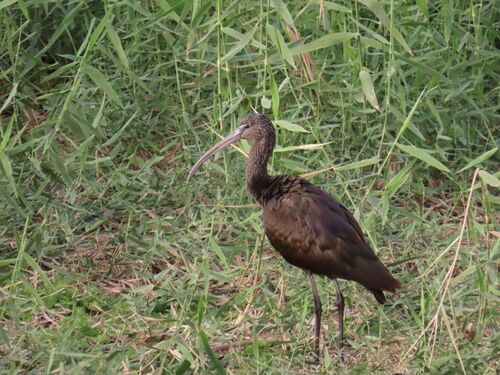 Glossy Ibis
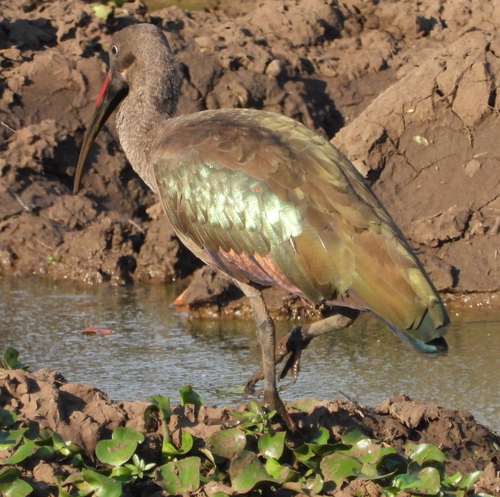 Hadada Ibis
In short
The most reliable field mark to separate Glossy Ibis from Hadada Ibis is overall coloration: Glossy Ibis is a much smaller, slimmer bird with a rich reddish-brown body and strong metallic green or purple gloss on the wings, while Hadada Ibis is a large, chunky, mostly grey-brown ibis with only a subtle purple sheen on the wings and a bold white cheek stripe. In flight, Glossy Ibis shows a uniform dark appearance with iridescent wings, while Hadada Ibis is bulkier with broad wings and lacks the deep chestnut tones. Bill color and face pattern are also key: Glossy Ibis has a brownish, slender, evenly curved bill and a narrow, faint facial border, whereas Hadada Ibis has a thick, grey-to-black bill with a red base in breeding season and a distinctive white 'moustache' across the cheek. Voice is a clincher—Hadada Ibis is extremely loud and raucous, while Glossy Ibis is generally silent. Size difference is striking when seen together, but beware lone birds.
Identification tips
- Overall size and build: Hadada Ibis is much larger and bulkier than Glossy Ibis. If the bird appears goose-sized or has a heavy, thickset look, it's likely Hadada. Glossy Ibis is more slender and medium-sized.
- Color and gloss: Glossy Ibis (all ages) shows rich reddish-brown body plumage with strong metallic green, bronze, or purple gloss on the wings, especially in good light. Hadada Ibis is plain grey-brown overall, with only a limited purple sheen on the wings, never reddish or chestnut.
- Facial pattern: Hadada Ibis has a bold, horizontal white stripe across the cheek ('moustache'), visible at all ages and seasons. Glossy Ibis has only a narrow, subtle white facial border above and below the bill, much less obvious and not forming a cheek stripe.
- Bill shape and color: Glossy Ibis has a slender, evenly curved brownish bill. Hadada Ibis has a thick, heavy, grey-black bill with a red base (breeding season), and the bill appears more massive and less evenly curved.
- Leg color: Glossy Ibis shows red-brown legs; Hadada Ibis has blackish legs, with toes sometimes reddish in breeding birds.
- Flight silhouette: Glossy Ibis is slim, with long neck and legs extended, wings narrow and pointed, flight graceful and often in V-formation. Hadada Ibis is bulkier, with broad wings and a heavier, less elegant flight, often accompanied by loud calls.
- Wing pattern in flight: Both species appear dark in flight, but Glossy Ibis has a uniform dark look with metallic gloss, while Hadada is plainer and lacks the deep chestnut tones.
- Juvenile marks: Glossy Ibis juveniles are duller, with fine white streaks on the head and neck; Hadada juveniles are similar to adults but may be slightly duller, always with the white cheek stripe.
- Vocalizations: Hadada Ibis is extremely loud and raucous, calling frequently in flight and at roost. Glossy Ibis is generally silent or very quiet.
- Habitat context: Glossy Ibis is almost always near water, in marshes or wetlands. Hadada Ibis is often found in dry fields, lawns, gardens, and urban parks, sometimes far from water.
- Social behavior: Glossy Ibis is often in flocks, especially when migrating or roosting. Hadada Ibis is usually in pairs or small groups, sometimes alone, and is more likely to be seen in urban or suburban settings.
- Breeding season marks: Hadada Ibis shows a red base to the bill and red on the toes during breeding; Glossy Ibis may show a cobalt blue facial border in breeding condition.
- Perched posture: Glossy Ibis stands more upright and appears more delicate; Hadada Ibis is heavier, with a more horizontal stance.
- Foraging behavior: Glossy Ibis probes in shallow water for aquatic prey; Hadada Ibis probes in soil for earthworms and insects, often in lawns and gardens.
- Confusion risk: At a distance or in poor light, a lone Hadada may appear dark and could be mistaken for a Glossy Ibis, but the lack of chestnut tones, the bold cheek stripe, and the loud calls are strong clues.
Size
Glossy Ibis is significantly smaller and lighter than Hadada Ibis. Glossy Ibis averages about 59 cm in length and 633 g in mass [wikidata], while Hadada Ibis is much larger, reaching about 76 cm in length and averaging 1.2 kg [wikipedia]. In the field, Hadada appears bulkier, with a heavier build and broader wings, while Glossy Ibis is more slender and graceful both at rest and in flight. The difference is especially obvious when both species are seen together, but can be underestimated at a distance or without direct comparison.
Plumage
- Juvenile/immature birds: No specific age-unique upperwing patterns are described for either species, but Glossy Ibis juveniles and non-breeders are duller overall, with dark brown heads and necks finely streaked with white. Hadada Ibis juveniles resemble adults but may be slightly duller; the white cheek stripe is present from a young age.
- Adult breeding Glossy Ibis: Shows a rich reddish-brown body with striking iridescent wings (bottle-green, bronze, or purple depending on light). A narrow white facial band is present but subtle. Legs are red-brown.
- Adult Hadada Ibis: Overall grey to brown, lacking any chestnut or reddish tones. The wings have a limited iridescent purple sheen, but the rest of the plumage is plain. The white horizontal cheek stripe is bold and diagnostic. Bill is grey-black with a red base in breeding season. Legs are blackish, toes may show red in breeding condition.
- In flight: Glossy Ibis appears uniformly dark with metallic gloss on the wings, slender and elegant. Hadada Ibis is bulkier, with broad wings and a paler, plainer body, lacking the deep gloss and chestnut tones.
Behaviour
Glossy Ibis is often seen in flocks, especially during migration or at communal roosts, and feeds in shallow wetlands, typically probing for aquatic prey. It flies with neck outstretched in graceful, sometimes V-shaped formations. Hadada Ibis is more often encountered in pairs or small groups, foraging noisily in gardens, lawns, and cultivated areas, probing for insects and earthworms. Its flight is powerful and direct, with broad wings and frequent loud calling, especially at dawn and dusk. Hadada is highly tolerant of human presence and often seen in urban settings.
Habitat
Glossy Ibis is a wetland specialist, favoring marshes, reedbeds, floodplains, and the margins of lakes and rivers, but may also use irrigated farmland and sewage ponds. It is less common in dry or urban areas. Hadada Ibis, in contrast, is much less tied to wetlands and is frequently found in open grassland, cultivated fields, gardens, and even city parks, as well as near water. If the bird is foraging on a suburban lawn or calling from a city tree, Hadada is far more likely.
Voice
Hadada Ibis is famously noisy, giving extremely loud, harsh, three- or four-note 'haa-haa-haa-de-dah' calls, especially in flight at dawn and dusk, and a loud 'haaaa' when roosting. Glossy Ibis is generally silent or gives only quiet, unremarkable calls, and does not vocalize conspicuously in flight or at roost.