

Glaucous Gull vs Iceland Gull
Larus hyperboreus versus Larus glaucoides
Play a quiz with Glaucous Gull and Iceland Gull
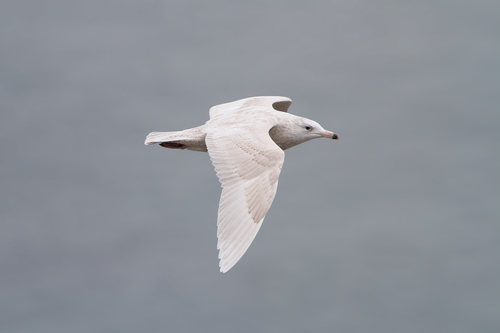 Glaucous Gull
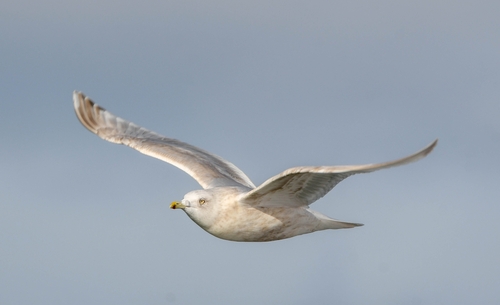 Iceland Gull
In short
The most reliable field mark between Glaucous Gull and Iceland Gull is size and structure: Glaucous is much larger and bulkier, with a thick, powerful bill, while Iceland is noticeably more slender and smaller overall. Both species are very pale at all ages and lack black on the wingtips and tail, so confusion is common, especially with immatures. However, juvenile and immature Iceland Gulls have a more extensively dark bill (lacking pink), while Glaucous juveniles show a pink-based bill with a dark tip. In flight or at rest, Glaucous always looks heavier and more imposing, while Iceland appears daintier and more graceful. Use bill color, overall bulk, and relative size to separate them, especially when seen together.
Identification tips
- Size and bulk: Glaucous Gull is much larger and heavier than Iceland Gull. Use this when birds are together or near other gulls for scale. Glaucous can approach Great Black-backed Gull in size; Iceland is closer to Herring Gull or smaller.
- Bill size and shape: Glaucous has a thick, powerful bill (especially obvious in adults), while Iceland's bill is noticeably thinner and more delicate. This is visible at all ages but clearest in adults.
- Bill color in immatures: Juvenile/first-winter Glaucous Gulls have a pink-based bill with a dark tip; Iceland Gull immatures have a more extensively dark bill, lacking pink. This is one of the best marks for separating young birds.
- Adult bill color: Adult Glaucous has a thick, yellow bill; Iceland's is yellowish-green and slimmer. Use this when age is clear.
- Overall structure: Glaucous appears bulkier, with a deep chest, thick neck, and heavy head. Iceland is more slender, with a finer head and bill, and a more graceful posture.
- Wingtips and tail: Both species lack black in the wingtips and tail at all ages, so this is not useful for separation, but it rules out other large gulls.
- Plumage tone: Both are very pale, but Glaucous can look more washed-out and uniform, while Iceland may show slightly more contrast on the upperparts and primaries. This is subtle and not always reliable.
- Flight appearance: In flight, Glaucous looks broad-winged and heavy, with slow, deep wingbeats. Iceland appears lighter and more buoyant, but this is best judged with experience or direct comparison.
- Leg length: Glaucous has longer, thicker tarsi, contributing to its overall robust look. Iceland's legs are shorter and finer.
- Habitat and range: Both can occur together in winter, but if you are far from the normal range of one species, this may help. Iceland is scarcer in Europe than Glaucous.
- Mixed flocks: When both species are present, look for the largest, bulkiest pale gulls (Glaucous) versus the smaller, daintier ones (Iceland).
- Age progression: Both species take four years to mature, so expect intermediate plumages. Use bill color and structure as primary clues in these cases.
- Voice: Glaucous has a deep, laughing call; Iceland's voice is not described, so do not rely on vocalizations.
- Sex differences: Both species show some sexual size dimorphism, but the difference between species is much greater than between sexes.
- When in doubt: If you cannot judge size or bill structure, and the bird is very pale with no black in the wingtips or tail, it may not be safely identified to species without more context or direct comparison.
Size
Glaucous Gull is significantly larger and heavier than Iceland Gull. Glaucous averages about 1412.5 g in body mass [wikidata], with a length of 55–77 cm and a wingspan of 132–170 cm. Iceland Gull is much lighter (480–1100 g), shorter (50–64 cm), and has a smaller wingspan (115–150 cm). In direct comparison, Glaucous is bulkier, with a thicker bill and longer tarsi. Even at a distance, Glaucous appears more massive and powerful, sometimes rivaling the Great Black-backed Gull in size, while Iceland is closer to Herring Gull or smaller. This size difference is often the quickest clue in mixed flocks.
Plumage
- Juveniles and immatures (first-winter/first-year): Both are very pale, but Glaucous Gull juveniles have a pink-based bill with a dark tip, while Iceland Gull immatures have a more extensively dark bill that lacks pink. Both lack black in the wingtips and tail, so overall wing and tail pattern are not helpful. The pale, almost unmarked appearance is shared, but Glaucous looks more washed-out and uniform, while Iceland may show slightly more contrast on the upperparts and primaries, but this is subtle and unreliable.
- Adults: Both species are pale grey above with white wingtips and tail, and both lack black in the primaries. The adult Glaucous Gull has a thick, yellow bill; Iceland's is yellowish-green and slimmer. No black in the wingtips is a shared feature, so focus on structure and bill color. Both take four years to reach maturity, so intermediate plumages can be confusing.
- Subspecies: The notes mention Kumlien's and Thayer's as subspecies of Iceland Gull, but only the nominate is described here; all are pale and lack black in the wingtips in adult plumage.
Behaviour
Both species are omnivorous scavengers, often seen foraging at garbage dumps, along coasts, or near human activity. No behavioral differences are highlighted in the notes. Both breed colonially or singly on cliffs or ground near water. In flight, Glaucous Gull appears heavier and more laborious, while Iceland Gull is lighter and more buoyant, but this is subtle and best appreciated with experience or side-by-side comparison.
Habitat
Both breed in Arctic regions, nesting on coasts and cliffs in Canada and Greenland. Iceland Gull winters further south, including the British Isles and northeastern US, but is scarcer in Europe than Glaucous Gull. Both species frequent similar habitats in winter: coasts, harbors, dumps, and open water. Habitat is not a strong separator unless you are outside the normal range of one species.
Voice
Glaucous Gull gives a deep, laughing cry similar to Herring Gull but lower-pitched. No vocal description is provided for Iceland Gull. Voice is not a reliable separator in the field for these two species.