

Giant Hummingbird vs Oasis Hummingbird
Patagona gigas versus Rhodopis vesper
Play a quiz with Giant Hummingbird and Oasis Hummingbird
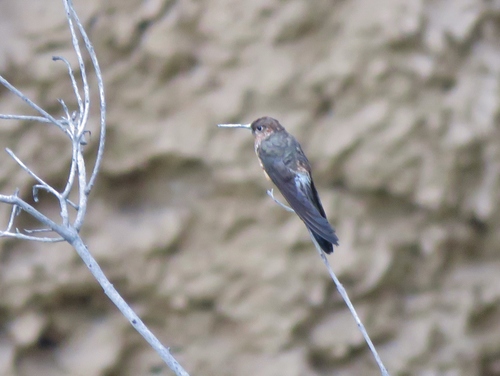 Giant Hummingbird
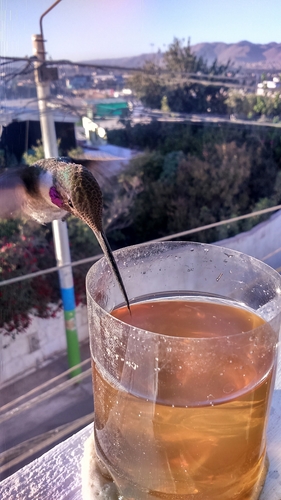 Oasis Hummingbird
In short
The most reliable way to separate Giant Hummingbird from Oasis Hummingbird in the field is by size: Giant Hummingbird is enormous, nearly twice as long and up to eight times heavier than Oasis, and looks more like a small swift or swallow than a typical hummingbird. If seen in flight, Giant Hummingbird’s slow, heavy wingbeats and broad wings are distinctive, while Oasis is much smaller, more agile, and has a deeply forked tail in males. Plumage is less helpful at a distance, but adult male Oasis shows a bright iridescent gorget and a white face stripe, while Giant Hummingbird is overall plain brownish or olive with no iridescence. Both species can occur in similar Andean and coastal habitats in Peru and Chile, so careful attention to structure and size is essential.
Identification tips
- Size is the single most reliable mark: Giant Hummingbird is enormous for a hummingbird, nearly twice as long and up to eight times heavier than Oasis. If your bird looks only slightly larger than a typical hummingbird, it is not a Giant.
- Flight style: Giant Hummingbird flies with slow, deep wingbeats and sometimes glides, resembling a small swift or swallow. Oasis Hummingbird is much more agile, with rapid, continuous wingbeats typical of small hummingbirds.
- Bill structure: Both species have long, decurved black bills, but Oasis Hummingbird's is proportionally longer and stouter in the nominate subspecies. Bill shape is not a primary separator in the field unless seen very well.
- Tail shape: Adult male Oasis Hummingbird has a deeply forked tail with purplish brown outer feathers, especially obvious during display or when perched with tail spread. Female Oasis has a shorter, only slightly forked tail with a black subterminal bar and white tips. Giant Hummingbird’s tail is straight-edged and lacks strong pattern.
- Gorget and face pattern: Adult male Oasis Hummingbird shows a brilliant iridescent gorget (rosy violet to purple with turquoise rear) and a long white stripe behind the eye. Female Oasis has a small white dot behind the eye. Giant Hummingbird lacks any iridescent gorget or strong facial markings, appearing plain brownish or olive.
- Underparts: Oasis Hummingbird males have dull white underparts with a greenish wash on the flanks; females are pale gray to buff with darker flanks. Giant Hummingbird is uniformly brownish or olive below, with P. g. peruviana showing some white on the chin and throat, but never the crisp pale underparts of Oasis.
- Rump color: Oasis Hummingbird has a cinnamon rump and uppertail coverts, which can be seen in good light. Giant Hummingbird’s rump is not contrasting.
- Wing pattern in flight: No distinctive juvenile or age-specific upperwing patterns are described for either species, so rely on size and structure.
- Habitat context: In high Andean scrub or forest edge above 2,600 m, especially in open country, Giant Hummingbird is more likely. In coastal oases, gardens, or agricultural areas below 2,600 m, especially in northern Chile and Peru, Oasis Hummingbird is more likely.
- Display behavior: If you see a hummingbird performing U-shaped shuttle flights, flaring a bright gorget, or making a sharp whistling sound with the tail, it is an Oasis Hummingbird male. Giant Hummingbird does not perform such displays.
- Perched posture: Giant Hummingbird appears long-bodied and heavy, often sitting upright with a thick neck and large head. Oasis Hummingbird is more delicate, with a proportionally longer tail in males.
- Sex differences: Only male Oasis Hummingbird shows the bright gorget and long white face stripe. Females are plainer but still show the small white post-ocular dot and tail pattern. Both sexes of Giant Hummingbird are plain and lack iridescence.
- Seasonal movement: Giant Hummingbird may move altitudinally, descending in winter. Oasis Hummingbird may nest year-round in some areas, but is not known for major migrations.
- Abundance: Both species can be locally common in their preferred habitats, but Oasis Hummingbird is more likely in gardens and human-modified landscapes.
- When in doubt, focus on size and tail shape: If you cannot judge color or see the gorget, use overall bulk and tail fork/depth to separate these species.
Size
Giant Hummingbird is truly gigantic for a hummingbird: 23 cm (9.1 in) long, with a wingspan of 21.5 cm (8.5 in), and weighing 17–31 g. This is roughly double the length and up to eight times the mass of Oasis Hummingbird, which is only 11–13.5 cm (4.3–5.3 in) long and weighs about 4 g. Even a female Oasis, the largest sex, is dwarfed by a Giant Hummingbird. In the field, Giant Hummingbird appears almost the size of a small swallow or swift, while Oasis is typical hummingbird-sized.
Plumage
No age-specific upperwing or juvenile flight marks are described for either species, so focus is on adult plumage. Giant Hummingbird is plain overall, with two subspecies: P. g. peruviana is yellowish brown with white on the chin and throat, while P. g. gigas is more olive-brown and lacks white on the chin/throat. It lacks any iridescent colors or strong facial markings. Oasis Hummingbird, by contrast, is olive green above with a cinnamon rump and uppertail coverts. Adult males have a striking iridescent gorget (rosy violet to purple with turquoise rear), a long white face stripe, and a deeply forked tail with purplish brown outer feathers. Females lack the gorget, have a small white dot behind the eye, and a shorter, only slightly forked tail with a black bar and white tips. Underparts are pale gray to buff in females, dull white with greenish flanks in males. Tail pattern is a key mark in perched or spread-tail views, especially for females.
Behaviour
Giant Hummingbird flies with slow, heavy wingbeats and often glides between flaps, giving a swallow- or swift-like impression. It is not particularly territorial and is often seen alone, moving steadily through open habitats. Oasis Hummingbird is much more active and agile, with rapid, regular wingbeats. Males are highly territorial and perform elaborate courtship displays: U-shaped shuttle flights with tail fanning and gorget flaring, and dramatic dive displays with tail-generated whistling. Oasis is more likely to be seen hovering at flowers or engaged in chases, especially in breeding season.
Habitat
Both species overlap in Peru and northern Chile, but Giant Hummingbird is mostly found at higher elevations (sea level to 4,600 m, often above 2,600 m) in Andean scrub and forest edges, sometimes descending in winter. Oasis Hummingbird prefers lower elevation arid coastal and near-coastal habitats, including oases, riparian zones, gardens, and agricultural areas, usually below 2,600 m in Peru but up to 3,800 m locally. If seen in dense city areas, Oasis is more likely, as Giant Hummingbird avoids heavily urbanized zones.