

Garganey vs Northern Shoveler
Spatula querquedula versus Spatula clypeata
Play a quiz with Garganey and Northern Shoveler
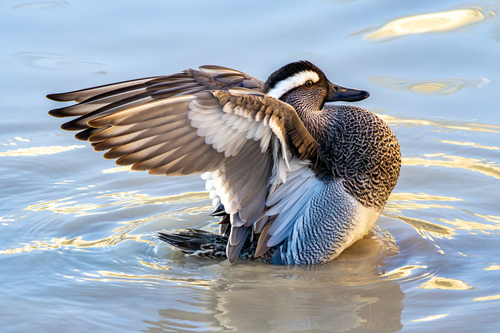 Garganey
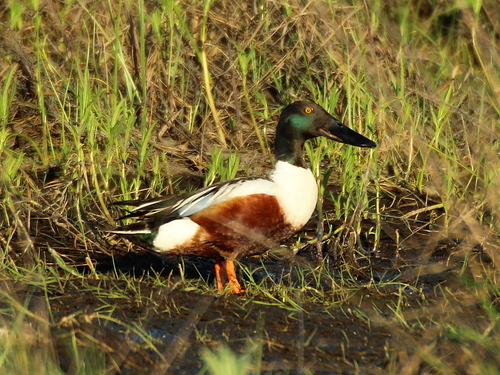 Northern Shoveler
In short
The most reliable field mark between Garganey and Northern Shoveler is the bill: Northern Shoveler has a very large, broad, shovel-shaped bill, while Garganey's bill is slimmer and more typical of dabbling ducks. In flight, both show pale blue forewing patches, but the Shoveler's is broader and the bird is bulkier overall. Male Garganey in breeding plumage is unmistakable with its bold white supercilium (eyebrow) and chestnut face, while male Shoveler shows a dark green head and white breast. Females and eclipse males are trickier, but Garganey females have stronger facial markings and a more delicate structure. Juveniles and females are often confused, especially in flight, but careful attention to bill shape, face pattern, and overall size will separate them.
Identification tips
- Bill shape is the single most reliable feature: Northern Shoveler always shows a very large, broad, spatulate (spoon-shaped) bill, even in females and juveniles. Garganey's bill is slimmer and more typical of dabbling ducks. Use this in all ages and seasons.
- Size and structure: Shoveler is bulkier, longer, and heavier than Garganey. Garganey is more petite and compact, with a finer jizz in flight and on water.
- Male breeding plumage: Garganey drake has a bold white supercilium (broad white crescent above the eye) and chestnut face—unique among dabbling ducks. Shoveler drake has a dark green (or blackish at distance) head, white breast, chestnut flanks, and a huge black bill.
- Female/immature face pattern: Garganey females and immatures have a strong pale eyebrow, dark eye-stripe, and a pale spot at the lore bordered by a second dark line. Shoveler females/immatures are plainer-faced, lacking such crisp facial contrast.
- In flight (all ages): Both show pale blue forewing patches, but Shoveler's is broader and separated from the green speculum by a white border. Garganey's is paler blue, and the bird is smaller and slimmer in flight.
- Leg color: Shoveler has bright orange-red legs in both sexes; Garganey's legs are grey.
- Feeding behavior: Shoveler often swings its bill side to side, straining water for invertebrates. Garganey feeds more like a typical dabbling duck and shows frequent head-shaking, especially in females.
- Eclipse males: Shoveler eclipse males resemble females but retain the pale blue forewing. Garganey eclipse males are less distinctive but still show the strong facial pattern.
- Habitat context: Garganey is strictly migratory and absent from breeding grounds in winter; Shoveler is more widespread and can be found year-round in some areas.
- Group size: Garganey can form large flocks in winter; Shoveler is less gregarious outside the breeding season.
- Voice: Male Garganey has a crackling mating call; Shoveler's voice is not distinctive for field separation.
- Potential confusion: Female Garganey can be confused with female Shoveler, but the bill shape and face pattern are key. Beware of eclipse males and juveniles, which can resemble females but still show the structural and face pattern differences.
- When marks fail: At long distance or in poor light, size and bill shape are still usually visible. In mixed flocks, compare directly if possible.
Size
Northern Shoveler is distinctly larger and heavier than Garganey. Shoveler measures 44–52 cm in length, with a wingspan of 70–84 cm and a weight ranging from 500–800 g ([wikipedia]). Garganey is a smaller dabbling duck; while exact measurements are not given in the notes, it is notably more petite and lighter in build than the Shoveler. This size difference is usually obvious when the two are seen side by side, but may be less apparent at a distance or with lone birds.
Plumage
- Juvenile/immature/female plumage: Both species are mottled brown, but Garganey females and immatures show a distinctive pale eyebrow, dark eye-stripe, and a pale spot at the lore bordered by a second dark line. Northern Shoveler females/immatures are plainer-faced, lacking such strong facial contrast, and have a duller, more mallard-like appearance. The Shoveler's bill is always much broader and longer, even in juveniles and females.
- Adult male breeding plumage: Garganey drake is unmistakable with a bold white supercilium (broad white crescent over the eye), chestnut face, brown head, and grey body. Northern Shoveler drake has a dark green (often looking black at a distance) head, white breast, chestnut flanks and belly, and a strikingly large black bill.
- In flight (all ages): Both show a pale blue forewing (speculum), but the Shoveler's is broader and separated from the green speculum by a white border. Garganey's pale blue speculum is also bordered by white, but the bird is smaller and slimmer in flight. Female Shoveler's forewing is greyish, while Garganey's is paler blue.
- Eclipse male: Shoveler males in eclipse resemble females but retain the pale blue forewing; Garganey eclipse males are less distinctive but still show the strong facial pattern.
Behaviour
Both species are dabbling ducks, but Northern Shoveler is noted for its unique feeding style: swinging its bill side to side and straining food from the water using the comb-like lamellae on its bill. Garganey feeds more like a typical dabbling duck and is noted for frequent head-shaking when dabbling, especially in females. Shoveler is less gregarious outside the breeding season, often in small groups, while Garganey can form large flocks in wintering areas.
Habitat
Both species breed in marshes and wetlands across Europe and the Palearctic, but Garganey is strictly migratory, leaving its breeding range entirely in winter and moving to Africa, India, and Australasia. Northern Shoveler is more widespread, breeding across Europe, Asia, and North America, and wintering further south, but some remain in southern Europe and Asia. Both prefer shallow, vegetated wetlands, but Shoveler is more tied to mud-bottomed marshes rich in invertebrates.
Voice
Male Garganey has a distinctive crackling mating call, while the female is mostly silent, with only a weak quack. Northern Shoveler vocalizations are not described in the notes, but are generally not a strong field mark for separation.