

Garden Warbler vs Eastern Orphean Warbler
Sylvia borin versus Curruca crassirostris
Play a quiz with Garden Warbler and Eastern Orphean Warbler
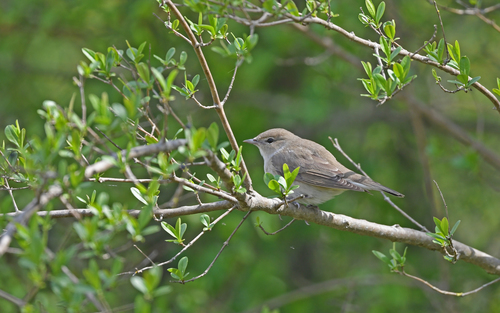 Garden Warbler
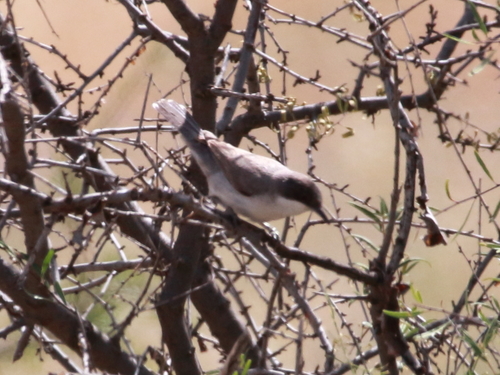 Eastern Orphean Warbler
In short
The most reliable field mark between Garden Warbler and Eastern Orphean Warbler is overall size and head pattern: Eastern Orphean Warbler is distinctly larger, with a longer, heavier bill and (in adult males) a striking dark grey head and white throat, contrasting with a pale iris. Garden Warbler is smaller, plainer, and lacks any strong facial markings, with a uniform brownish upperpart and dull white underparts. Juveniles of both species are less distinctive, but Orphean Warbler still shows a larger, heavier structure and a paler head with a brownish tinge. In flight or at rest, Garden Warbler always appears plain and compact, while Orphean Warbler is bulkier and longer-tailed. If you see a warbler with a plain face and no obvious head pattern, think Garden Warbler; if you see a large warbler with a contrasting face and white iris (in males), it is likely Eastern Orphean.
Identification tips
- Size and structure: Eastern Orphean Warbler is distinctly larger and bulkier than Garden Warbler. If the bird looks big for a warbler, with a long tail and heavy bill, think Orphean.
- Bill shape: Orphean has a noticeably longer, more pointed bill than the short, strong bill of Garden Warbler. This is visible even at a distance in good light.
- Head pattern (adult male Orphean): Look for a dark grey head, black eye mask, white throat, and white iris—none of which are ever shown by Garden Warbler.
- Head pattern (female/immature Orphean): Females and immatures have a paler head and reddish underparts, but still show a larger, heavier structure and a longer bill than Garden Warbler. The iris is dark in young birds, so do not rely on iris color for immatures.
- Garden Warbler's plainness: Garden Warbler is always plain-faced, with no strong supercilium, mask, or throat contrast. If the face looks featureless, it is likely Garden Warbler.
- Upperpart color: Garden Warbler is olive-brown above and dull white below, with a faint pale supercilium and a buff wash to throat/flanks. Orphean is greyer above, especially in adult males.
- Underpart color: Garden Warbler is dull white below with a buff wash; Orphean females/immatures have reddish underparts, which can be a useful clue.
- Iris color: Adult male Orphean has a striking white iris; Garden Warbler always has a dark eye. Immature Orphean has a dark iris, so this mark only works for adult males.
- Leg color: Garden Warbler has bluish-grey legs; Orphean's legs are black. This can be subtle, but may help in good views.
- Behavior: Garden Warbler is more likely to be seen skulking in dense low cover, while Orphean may perch more openly in bushes or trees.
- Habitat: In central/northern Europe, Garden Warbler is much more likely. In Mediterranean or southeastern Europe, both are possible, but Orphean prefers open, bushy woodland.
- Song: Garden Warbler's song is a rich, melodic warble similar to Blackcap; Orphean's is more varied, powerful, and Nightingale-like. Use song with caution, as both can be confusing.
- Juvenile confusion: Juvenile Garden Warblers are especially plain, with paler/greyer upperparts and buff underparts. Juvenile Orpheans are larger, with a paler head and reddish underparts, but lack the strong head pattern of adult males.
- No wing or tail pattern: Neither species shows distinctive wing or tail markings at any age, so do not rely on these features.
- Pitfalls: Beware of assuming any plain, brownish warbler is a Garden Warbler—always check for size, bill shape, and subtle head pattern, especially in the Mediterranean region.
Size
Garden Warbler is a small, compact warbler, about 14 cm in length with a wing length of 7.6–8.4 cm and typical weight of 16–22 g [wikipedia]. Eastern Orphean Warbler is noticeably larger at 15–16 cm in length—one of the largest typical warblers—and appears bulkier and longer-tailed in the field [wikipedia]. The Orphean's bill is also longer and more pointed, contributing to its heavier look. If you see both species side-by-side, the size and bulk difference is immediately apparent.
Plumage
-
Juveniles/immatures: Both species have plainer, duller plumage than adults, but Garden Warbler juveniles are especially plain, with paler and greyer upperparts and a buff tone to the underparts. Juvenile Orphean Warblers have a paler head and reddish underparts, and their grey back has a brownish tinge; their iris is dark, not white [wikipedia]. No distinctive wing or tail pattern is mentioned for either species at any age, so rely on overall coloration and head pattern.
-
Adults: Garden Warbler adults are uniformly brown above and dull white below, with a faint pale supercilium and a whitish eyering, but no strong facial markings. Eastern Orphean Warbler adult males have a plain grey back, dark grey head, black eye mask, white throat, and a striking white iris. Females and immatures are duller, with a paler head and reddish underparts, but still show a larger, heavier structure and a longer, pointed bill. Garden Warbler always lacks any contrasting head pattern or strong color contrasts.
Behaviour
Both species are typical warblers, but Garden Warbler is more compact and tends to skulk in dense low cover, moving quietly through vegetation. Eastern Orphean Warbler, being larger and bulkier, may appear more deliberate and less agile, often perching more openly in bushes or trees. The Orphean's longer tail and heavier bill may be noticeable in their posture and feeding behavior.
Habitat
Garden Warbler breeds in open woodland with dense low cover, usually avoiding gardens despite its name [wikipedia]. Eastern Orphean Warbler prefers open deciduous woodland, often in more southern and eastern regions (Mediterranean, Balkans, Turkey, Caucasus, Central Asia) [wikipedia]. Both winter in sub-Saharan Africa, but their breeding habitats do not overlap much except in migration. If you are in central or northern Europe, Garden Warbler is far more likely; in Mediterranean or southeastern Europe, both are possible but Orphean prefers more open, bushy woodland.
Voice
Garden Warbler's song is a rich, melodic warble, very similar to Blackcap [wikipedia]. Eastern Orphean Warbler's song is a series of warbling 'liroo-liroo' and scolding notes, more varied and approaching Nightingale in richness [wikipedia]. Both can be confusing to the ear, but Orphean's song is generally more powerful and varied. Calls are not described in detail for either species in the notes.