

Four-banded Sandgrouse vs Savile's Bustard
Pterocles quadricinctus versus Lophotis savilei
Play a quiz with Four-banded Sandgrouse and Savile's Bustard
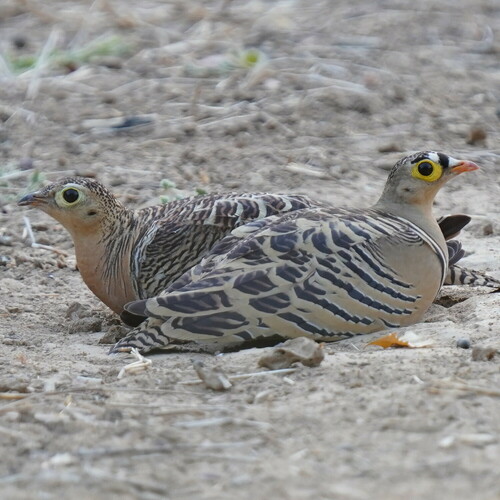 Four-banded Sandgrouse
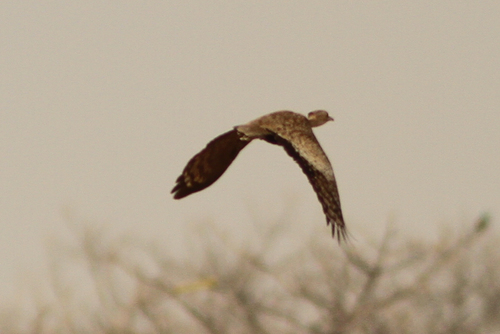 Savile's Bustard
In short
The most reliable way to separate Four-banded Sandgrouse from Savile's Bustard is by overall structure and flight style: sandgrouse are compact, pigeon-like birds with long pointed wings and fast, direct flight, while bustards are larger-headed, longer-legged, and have a heavier, slower flight. In perched or close views, male Four-banded Sandgrouse show bold black-and-white bands on the head and breast, absent in Savile's Bustard. Female sandgrouse are more cryptic but still lack the bustard's distinctive head pattern and streaked upperparts. Both species can occur in similar dry habitats, so careful attention to shape and plumage is essential.
Identification tips
- Flight shape and style: Four-banded Sandgrouse have long, pointed wings and a compact, pigeon-like body, flying fast and directly; Savile's Bustard is bulkier, with broader wings, a larger head, and slower, heavier flight. This is the quickest field separation, especially at a distance or in flight.
- Head and neck structure: Sandgrouse have a small, rounded head and short neck; bustards have a proportionally larger head, thicker neck, and longer legs, giving a taller, more upright posture when walking or standing.
- Male plumage (close views): Male Four-banded Sandgrouse show bold black-and-white bands on the forehead and breast, and a heavily barred belly. Male Savile's Bustard lacks these bands but has a grey head with a central black chin stripe and a rufous nape tuft when displaying; underparts are entirely black.
- Female plumage: Female sandgrouse lack the head and breast bands but are heavily barred on the back and flanks, with yellowish-green upperparts. Female bustards have a white throat, black restricted to the belly, and lack the blue-grey and black head markings of the male.
- Upperwing in flight: Sandgrouse show plain grey underwings and long pointed wings; bustards show more patterned wings with pale beige terminal thirds, blackish flight feathers with slender beige bars, and black tips, giving a more contrasting look in flight.
- Tail and legs: Sandgrouse have a short tail and legs, often hidden in flight; bustards have a longer tail and visible long legs, which may trail in flight or be obvious when walking.
- Back pattern: Sandgrouse upperparts are yellowish-green with heavy brown barring; bustards have pale upperparts with black streaks and arrowhead marks.
- Behavior on the ground: Sandgrouse are gregarious, often in flocks, and may flush together; bustards are solitary or in pairs, walk upright, and may crouch or run before flying.
- Habitat context: Both can occur in dry open country, but sandgrouse are more likely in areas with scattered trees, bustards in more open grassland or bushland.
- Bill color: Bustards have a yellowish bill with a brownish culmen; sandgrouse bill color is not specified but is less distinctive.
- Iris and feet: Bustards have a pale, clay-specked iris and yellowish clay feet; these details are subtle and rarely diagnostic in the field.
- Sexual dimorphism: Both species show sexual differences, but the sandgrouse's are more about banding, while the bustard's are about head and underpart color.
- Display behavior: Only male Savile's Bustard shows a rufous nape tuft during display, which is absent in sandgrouse.
- Contextual clues: Flocks at waterholes or flying fast and direct are likely sandgrouse; solitary, upright birds walking slowly in open grassland are likely bustards.
- When in doubt: Focus on overall shape (compact and pointed for sandgrouse, upright and heavy for bustard) and flight style as your primary field marks.
Size
Four-banded Sandgrouse is a medium-sized, compact bird (25–28 cm long), with a small pigeon-like head and short tail. In contrast, Savile's Bustard is slightly larger in apparent bulk, with a proportionally larger head, longer neck, and longer legs, giving it a taller, more upright stance. The bustard's wingspan is about 25 cm per wing (wingspan not given, but wings are relatively broad compared to the sandgrouse's long, pointed wings). In the field, sandgrouse look notably more compact and streamlined, while bustards appear bulkier and more upright.
Plumage
No age-specific upperwing pattern is described for either species, but plumage differences are still strong. Male Four-banded Sandgrouse have black-and-white bands on the forehead and breast, and a heavily barred belly; females lack the head and breast bands but are heavily barred above and on the flanks. Both sexes of sandgrouse have yellowish-green upperparts with brown markings and grey underwings in flight. Savile's Bustard adults have pale upperparts with black streaks and arrowhead marks, a grey head with a central black chin stripe, and a white shoulder strap. Males have completely black underparts and a rufous nape tuft in display; females have a white throat and black restricted to the belly, lacking the male's head pattern. The bustard's wings show pale beige terminal thirds and blackish flight feathers with slender beige bars and black tips, creating a more patterned look in flight compared to the sandgrouse's plainer grey underwings.
Behaviour
Four-banded Sandgrouse are gregarious, often seen in flocks, and fly with fast, direct, pigeon-like flight. They are typically seen on the ground or flying rapidly between feeding and watering sites. Savile's Bustard is more solitary or seen in pairs, walking slowly and upright through grassland or open scrub. Their flight is heavier and slower, with broad wings and a more labored takeoff. Bustards are less likely to flush at a distance and may crouch or run before flying.
Habitat
Both species can be found in dry open habitats in West and Central Africa, including savanna, scrubland, and light woodland. Four-banded Sandgrouse prefers open areas with some trees, while Savile's Bustard is more tied to arid and semi-arid grasslands, bush, and light woodland, often near dried pools or flat shrubs. Overlap in habitat is possible, especially in the Sahel and adjacent regions, but sandgrouse are more likely in areas with scattered trees, and bustards in more open, grassy or shrubby patches.