

Fork-tailed Palm Swift vs Roadside Hawk
Tachornis squamata versus Rupornis magnirostris
Play a quiz with Fork-tailed Palm Swift and Roadside Hawk
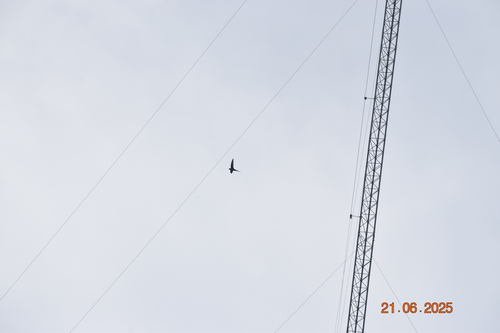 Fork-tailed Palm Swift
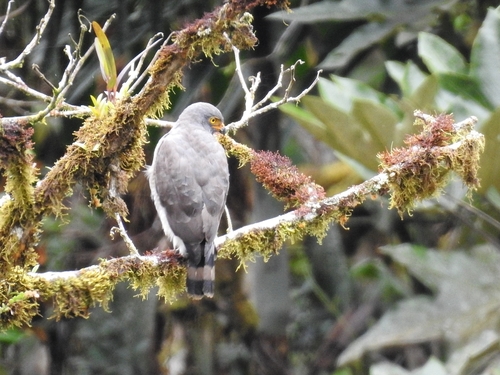 Roadside Hawk
In short
The most reliable way to separate Fork-tailed Palm Swift from Roadside Hawk is by overall structure and flight style: the swift is a tiny, slender, fast-flying aerial insectivore with long, narrow wings and a deeply forked tail, while the hawk is a much larger, broad-winged raptor with a relatively long, barred tail and short, rounded wings. In flight, the swift's sickle-shaped wings and rapid, erratic movements are unmistakable, contrasting with the hawk's slower, soaring or flapping flight. Plumage is also very different: the swift is mostly dark with pale mottled underparts, while the hawk shows brown or gray upperparts, barred underparts, and obvious tail bands. Even at a distance, the size difference is extreme—Fork-tailed Palm Swift is less than half the length and a tiny fraction of the mass of Roadside Hawk.
Identification tips
- Size: Roadside Hawk is more than twice as long and over twenty times heavier than Fork-tailed Palm Swift. Even distant silhouettes show the hawk as a large, robust bird.
- Flight style: Swifts are constantly in rapid, agile flight, with sickle-shaped wings and a deeply forked tail. Hawks soar, glide, or flap with slow, deep wingbeats and rarely exhibit the swift's erratic, bat-like movements.
- Tail shape: Fork-tailed Palm Swift has a long, deeply forked tail, always obvious in flight. Roadside Hawk has a long but squared or slightly rounded tail with distinct gray bars.
- Wing shape: Swifts have long, narrow, pointed wings; hawks have short, broad, rounded wings, especially noticeable in flight.
- Perching behavior: Swifts almost never perch in the open; if you see a bird perched upright on a wire, branch, or pole, it is a hawk, not a swift.
- Plumage pattern: The swift is uniformly dark above with pale mottled underparts and no barring or rufous tones. The hawk is brown or gray above, with brown-and-white barring below and a banded tail. In flight, the hawk may show a touch of rufous on the wings.
- Juvenile marks: Juvenile swifts have buffy feather edges and a buff tinge to the head, but still lack any barring or tail bands. Juvenile hawks resemble adults but may be paler or less distinctly barred; still, the overall pattern is completely different from the swift.
- Bill: Swifts have a tiny, short bill; hawks have a large, hooked bill, visible even at a distance when perched.
- Eye color: Adult hawks have whitish or yellow eyes, which can be seen at close range; swift eyes are dark and not distinctive in the field.
- Habitat context: Swifts are almost always seen around palms, often in small flocks. Hawks are found in a wide variety of open and semi-open habitats, often alone or in pairs, and are not tied to palms.
- Vocalizations: Roadside Hawk is very vocal, with a high-pitched squeal; swifts are generally silent or give only faint, high twittering.
- Feeding behavior: Swifts catch insects on the wing; hawks hunt from perches or while soaring, taking small mammals, reptiles, and occasionally birds.
- Flock size: Swifts often forage in small flocks; hawks are solitary or in pairs.
- Jizz at a glance: If the bird is moving fast, erratically, and never perching, think swift. If it is soaring, gliding, or perched upright, think hawk.
- Common pitfalls: At great distance, a small hawk might seem 'swift-like' if seen only as a silhouette, but the lack of a forked tail, the broader wings, and the slower, steadier flight are giveaways. Swifts never show the hawk's banded tail or barring below.
Size
Fork-tailed Palm Swift is about 13 cm long and weighs 9–13.6 g [wikipedia], making it a small, delicate bird. Roadside Hawk is much larger at 31–41 cm long and 250–300 g [wikipedia], with females up to 20% larger than males. The hawk is more than twice the length and over twenty times the mass of the swift. This size gap is obvious even at a distance, especially in flight.
Plumage
No age or wing pattern in either species is remotely similar. Fork-tailed Palm Swift (adult and juvenile) is blackish brown above with a greenish gloss, pale gray feather edges, and a very pale brownish white throat with dusky mottling. Underparts are pale with light brown mottling, and the tail is deeply forked and dark. Juveniles have a buff tinge to the head and buffy feather edges. Roadside Hawk (adult and juvenile) is brown or gray above, with a barred brown-and-white lower breast and underparts, and a tail with 4–5 gray bars. In flight, the hawk often shows a touch of rufous on the wings and a relatively long, obviously banded tail. The swift's plumage is uniform and lacks any barring or rufous tones. No seasonal or sex-based plumage differences are significant for field separation.
Behaviour
Fork-tailed Palm Swift is almost always seen flying rapidly and erratically high above or around palms, rarely perching except briefly on palm fronds. Its flight is fast, agile, and continuous, often in small flocks. Roadside Hawk is most often seen perched upright on exposed branches, wires, or poles along roadsides, scanning for prey, or soaring with slow, deep wingbeats and glides. It rarely hovers and is generally solitary or in pairs. The swift never soars or perches in the open like a hawk.
Habitat
Fork-tailed Palm Swift is tightly associated with palm trees, especially moriche palms, in lowland savannas, palm swamps, riparian forests, and urban areas with palms [wikipedia]. It is almost never seen away from palms. Roadside Hawk is a habitat generalist, common in open woodlands, forest edges, savannas, and especially along roads and clearings throughout its range. It is often the most common raptor in its area and is not tied to palms.
Voice
Fork-tailed Palm Swift is generally quiet and not noted for distinctive calls in the field. Roadside Hawk is very vocal, with a high-pitched, piercing squeak that is often heard before the bird is seen. If you hear a loud, repeated squealing call, it is almost certainly the hawk.